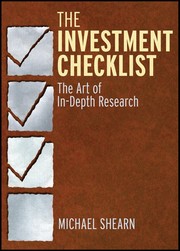
The Investment Checklist
About seventy questions to ask about a business before buying its shares.
Seventy questions to ask before buying any business.
Summary
Shearn, who ran a private investment partnership, sets out a structured process for evaluating a business before buying its equity, organised as roughly seventy questions grouped by subject: understanding the business, evaluating the customer, the competitive position, management's quality and integrity, management's capital allocation record, the financial statements, and valuation.
The distinctive material is on customers and management. Shearn argues that most investors examine financial statements before they understand who the customer is, why they buy, how much they would pay to keep buying, and what would make them stop. He gives specific methods for finding this out, including talking to customers, examining churn and repeat purchase data, and identifying whether the customer is captive. On management he sets out how to read proxy statements, compensation structures and share ownership, how to assess whether stated goals were met, and how to evaluate acquisition history and buyback timing as evidence of capital allocation judgement.
The book's premise is that a written checklist enforces the discipline of asking questions an investor will otherwise skip when enthusiastic. Shearn draws on Atul Gawande's checklist work and on Buffett and Munger's stated criteria. The weakness is that seventy questions is more than any process can sustain, the book does not weight them, and there is no evidence that following it improves returns. It is also written for concentrated long-horizon equity investing and does not fit other approaches. Used selectively, as a source of questions to build a shorter personal checklist, it is genuinely useful.
Key takeaways 7
- An investor should understand who the customer is and why they buy before examining any financial statement.
- Customer captivity, measured by switching cost and repeat purchase behaviour, predicts the durability of margins better than reported profitability does.
- Management's capital allocation record, visible in past acquisitions and buyback timing, is the most reliable evidence of judgement available to an outside investor.
- Compensation structure predicts management behaviour, so a proxy statement should be read before an annual report.
- A written checklist enforces asking the questions an enthusiastic investor will otherwise skip.
- An investor should be able to state what would make them sell before they buy, since defining the disconfirming evidence in advance is the only protection against rationalising.
- Businesses whose customers would be materially harmed by switching are worth more than businesses with equal current margins and no switching cost.
Who should read it
Concentrated long-horizon equity investors building a written diligence process, used as a source of questions rather than as a checklist to follow in full.
Who recommended it 2 · 2 direct
Similar books 6
Chosen by shared topics, the entries that hold them, and the people who recommended both.
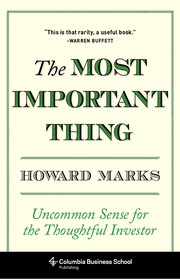
Second-level thinking, risk and market cycles, drawn from Oaktree's client memos.
“This is that rarity, a useful book.” — Warren Buffett
Source: The Most Important Thing — Columbia University Press
Recommended by: Matt Mullenweg, Mohnish Pabrai, Nat Eliason and 3 others
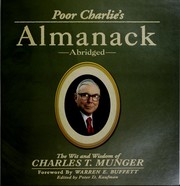
Speeches making the case for a latticework of mental models from many fields.
“…books I've recommended, highlighted to death, or forced on friends.” — Andrew Wilkinson
Source: Andrew Wilkinson's Bookshelf, neverenough.com
Recommended by: Andrew Wilkinson, Charlie Munger and 26 others
The questions and answers of one year's Berkshire Hathaway shareholders meeting.
Recommended by: Mohnish Pabrai

Mental models from physics, biology and psychology, applied to investing.
Recommended by: Mohnish Pabrai
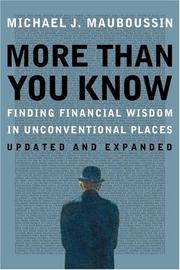
Essays on investing philosophy, psychology, competition and science.
“My colleague Michael Mauboussin applied some of Gould’s analysis to investing in Chapter 6 of his book More Than You Know.” — Bill Miller
Source: 2006 Q4 Market Commentary
Recommended by: Bill Miller and 1 other
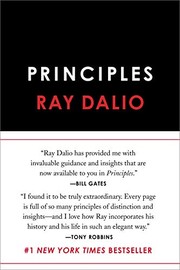
Decision rules from building Bridgewater: radical truth and radical transparency.
“Several people recommended Ray Dalio’s book Principles to me.” — Brad Feld
Source: Book: Principles by Ray Dalio — Feld Thoughts
Recommended by: Alfred Lin, Brad Feld, Derek Sivers and 31 others
Where it sits in the reference 2
Topics 2
As an Amazon Associate I earn from qualifying purchases.