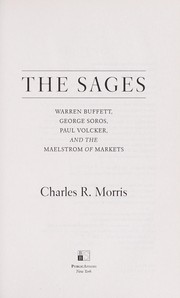
The Sages: Warren Buffett, George Soros, Paul Volcker, and the Maelstrom of Markets
Three men who saw the risks building in the financial system before the crash.
Summary
Morris, a lawyer, former banker and financial writer, wrote a short book profiling three men who he argues understood the risks building in the financial system before 2008 while the profession did not. He treats Buffett, Soros and Volcker as representatives of three different correct positions.
Buffett stands for the insistence that an investor must understand what they own, and Morris uses his 2002 description of derivatives as instruments that would cause serious trouble, and his refusal to participate in structured credit, as evidence. Soros stands for the argument that markets are reflexive and that regulators cannot rely on them to self-correct. Volcker stands for the position that banking is a public utility with public guarantees, that its risk-taking must therefore be limited, and that financial innovation of the preceding decades had produced little measurable benefit.
Morris connects these to his own diagnosis of the crisis, which he had set out earlier in The Trillion Dollar Meltdown. He argues that the combination of loose monetary policy, securitisation, rating agency failure, and compensation structures that paid for volume produced a credit bubble whose collapse was predictable in kind if not in timing.
The book is short and was written quickly after the crisis. It is a good summary of three points of view but it does not add new reporting or analysis, and the selection of three men who happened to be right is subject to the obvious objection about hindsight. Volcker's argument that financial innovation produced little benefit, in particular, deserves a fuller treatment than it gets here.
Key takeaways 7
- Buffett publicly identified derivatives as a source of systemic risk six years before the crisis and refused to hold structured credit.
- Soros's reflexivity implies that markets amplify errors rather than correcting them, so self-regulation cannot work.
- Volcker argued that banks carrying public guarantees should be restricted from proprietary risk taking.
- Financial innovation between 1980 and 2007 produced little measurable improvement in the allocation of capital.
- Compensation structures that paid on transaction volume rather than on outcomes drove the growth of securitisation.
- Understanding what you own is a practical constraint on portfolio size and complexity, not merely a slogan.
- The people who saw the crisis coming did so by reasoning about incentives and structures, not by forecasting.
Who should read it
Investors who want three coherent critiques of pre-crisis finance compressed into a short book, as an entry point rather than a full account.
About Charles R. Morris
Lawyer, banker and author on American finance and industrial history; died in 2021.
The Tycoons recounts how Carnegie, Rockefeller, Gould and Morgan assembled the industrial and financial structures of the American economy, with unusual attention to the financing and accounting they used to do it. The Sages compares the working methods of Buffett, Soros and Volcker against the crisis each of them read early.
Who recommended it 1 · 1 direct
Similar books 6
Chosen by shared topics, the entries that hold them, and the people who recommended both.
Investing lessons from the lives of great financiers and investors.
Recommended by: Mohnish Pabrai
Three generations of Davises, who built a fortune from insurance stocks.
Recommended by: Mohnish Pabrai, Peter Bernstein and 2 others
Bernard Baruch, from speculator to adviser of presidents and public figure.
Recommended by: Seth Klarman
Recommended by: Mohnish Pabrai

A financier and statesman's own account of his life in markets and politics.
“Lev, Baruch, Intangibles (Washington, D.C: Brookings Institution Press, 2001)” — Michael Mauboussin
Source: The Economics of Customer Businesses, page 19
Recommended by: Michael Mauboussin, Mohnish Pabrai and 1 other
How Capital Group built its long-term investing culture.
“A fine new book (Capital, with the foregoing words in its subtitle) by respected analyst Charles D. Ellis drives this point home.” — John C. Bogle
Source: As The Index Fund Moves From Heresy to Dogma… What More Do We Need To Know, page 10
Recommended by: John C. Bogle, Mohnish Pabrai