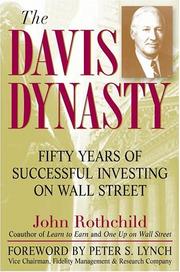
The Davis Dynasty
Three generations of Davises, who built a fortune from insurance stocks.
Three generations compounding a fortune through insurance stocks
Summary
Rothchild follows three generations of the Davis family as investors. Shelby Cullom Davis began in 1947 with around fifty thousand dollars and built it to roughly nine hundred million dollars by his death in 1994, almost entirely through insurance stocks. His son Shelby Davis ran the New York Venture Fund, and his grandson Chris Davis continued the firm.
The elder Davis' approach was concentrated and specialised. He had worked as an insurance regulator in New York State, understood the accounting of insurers better than the market did, and bought them when they traded at low multiples of earnings that were themselves understated by conservative reserving. He used leverage through margin borrowing, held positions for decades, and travelled internationally to buy Japanese insurers when few American investors did.
The book's most cited concept is the Davis double play, meaning the combination of earnings growth with an expansion in the multiple applied to those earnings, which produces returns far above the underlying business growth. The reverse also holds, which is why buying at a high multiple produces poor results even when earnings grow. The generational material contrasts the three approaches across different market environments, which is the book's structural interest.
The reference has verified the outline of the family's record and the double play concept, and has not verified the finer detail of the transactions described. The book is written for a general audience and the analysis is lighter than a professional reader would want. The specialisation argument, that decades of concentration in one sector produces knowledge the market does not have, is the transferable lesson.
Key takeaways 8
- Shelby Cullom Davis compounded roughly fifty thousand dollars into approximately nine hundred million over forty-seven years, concentrated almost entirely in insurance stocks.
- Deep specialisation in a single sector produced an understanding of the accounting that the general market did not have.
- Insurance earnings were understated by conservative reserving, which meant the reported multiples overstated what investors were paying.
- Returns come from earnings growth combined with expansion in the multiple applied to those earnings, which is the Davis double play.
- Buying at a high multiple produces poor results even when earnings grow, because multiple contraction offsets the growth.
- Holding positions for decades rather than trading them allowed compounding to operate and minimised tax and transaction costs.
- Buying foreign insurers, particularly in Japan, extended the same analytical advantage into markets other American investors ignored.
- Each generation faced a different market environment and adapted the approach, which the book uses to separate the method from the conditions.
Who should read it
Investors interested in sector specialisation and multi-decade compounding, particularly in insurance, as a case rather than as a method.
About John Rothchild
American financial journalist and Peter Lynch's writing partner on One Up on Wall Street, Beating the Street and Learn to Earn.
The Lynch books put a working fund manager's process into plain language - buy what you can explain, check the store, read the balance sheet, sit through drawdowns - and One Up on Wall Street still sets the standard for how a professional explains stock picking to amateurs. The Davis Dynasty follows three generations of one family compounding through insurance stocks.
Who recommended it 4 · 3 direct
Similar books 6
Chosen by shared topics, the entries that hold them, and the people who recommended both.
How people learned to measure risk, from early probability to portfolio theory.
“(Risk is the subject of Peter Bernstein’s wonderful new book, Against the Gods: The Remarkable Story of Risk.)” — Bill Miller
Source: 1996 Q3 Market Commentary
Recommended by: Bill Miller, Charles de Vaulx, Howard Marks and 9 others
Stock, bond and bill returns for sixteen countries from 1900 to 2000.
“Recently Dimson, Marsh, and Staunton, in their wonderful monograph, The Triumph of the Optimists, have examined the real dividend-growth rates in 16 nations over the entire 20th century.” — William J. Bernstein
Source: Efficient Frontier, issue 702 (2002)
Recommended by: Jason Zweig, Mohnish Pabrai and 1 other
A fund manager of sixty years on investing, business and a long life.
Recommended by: Mohnish Pabrai
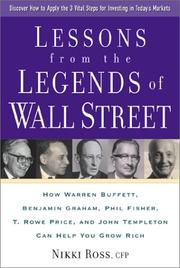
Investing lessons from the lives of great financiers and investors.
Recommended by: Mohnish Pabrai

Berkshire's shareholder letters arranged by topic: governance, valuation, mergers.
“The resource is as valuable as Larry Cunningham's The Essays of Warren Buffett, which similarly organizes by subject matter” — Christopher Bloomstran
Source: Semper Augustus 2024 Letter to Clients, 'Books and Tunes for Walking', p. 96
Recommended by: Christopher Bloomstran, Francois Rochon and 11 others
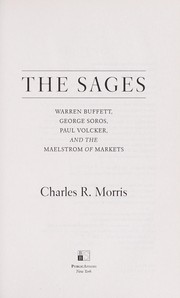
Three men who saw the risks building in the financial system before the crash.
Recommended by: Mohnish Pabrai
Where it sits in the reference 5
Topics 5
As an Amazon Associate I earn from qualifying purchases.