Updates

  1. Person pages list letters, writing, profiles and links as sortable tables with filters, and show each person's companies as links; Fund letters show each letter's description in its own column.
  2. Experts show a checked job title and a short description of each person; 30 more people have photographs.
  3. Every company, fund, university and publication the experts work for has a page listing the people there.
  4. Fund letters show each letter's thesis and filter by it; 225 person pages list the essays, columns and newsletter issues the person wrote.
  5. Person pages list every essay and newsletter issue a person wrote, and their own books as a table in List view.
  6. Recommends shows the five largest kinds of book and the rest under More; browse pictures load sooner.
  7. Podcasts and talks link the original episode, filter by Audio and video or Press, and list each publisher once.
  8. Pages are wider, Recommends has List and Grid, and a filter clicked again turns off.
  9. Book cards sit in a ruled grid with Open Library and Goodreads links and each book's one-line note.
  10. Funds is now Investors; each investor's styles are buttons that filter the table.
  11. Podcasts and talks on a person's page filter by year and publisher and show as a list or a grid of pictures.
  12. Quotes show only people's own words: 472 summaries written by list sites are gone.
  13. Country pages open from Browse again, and every link on the shelf lands on a page.
  14. Subject and person pages show their sections as tabs, and each book appears once on a person's page.
  15. Book cards show the quote, who said it and the source; grids show five cards to a row.
  16. On a phone, a menu holds the sections, search, Updates, Feedback and dark mode.
  17. Feedback takes a screenshot of the page with no browser prompt, opens a screenshot full size when you click it, and clears itself once sent.
  18. Book cards are centred, search names the topic each book sits in, and any text cut short shows whole on hover.
  19. Search groups its results by kind: people, companies, geographies, subjects, topics, books, funds, fund letters and papers.
  20. The Books table lists who recommended each book by name, and the browser tab names the section you are in.
  21. Feedback can take a screenshot of the page, or one you paste or choose, and opens in the corner beside Updates.
  22. Each rail button reopens its section where you left it, and Browse, Table and People show on every book and subject page.
  23. Filters grey out choices that hold nothing instead of hiding them, and Books › People filters by authors or recommenders.
  24. Feedback takes a subject line and up to three screenshots.
  25. Biographies are grouped by the person they are about: 41 new pages, from Abraham Lincoln to Lee Kuan Yew.
  26. Sport splits into 23 sports, and Religion into one topic per faith.
  27. Book lists show as cards: the cover, one recommendation quote and every recommender by name.
  28. Seventeen subjects that had two or three pages under different names now have one page each.
  29. Every page lists its Experts as authors and recommenders, with a link to them on the Experts tab.
  30. Economics, Financial history, Financial panics and Accounting are subjects of their own, with one page per financial crisis.
  31. Book, person and subject pages open inside the app, so the tabs stay in view.
  32. 996 more book covers, and photographs or logos for 227 more people and companies.
  33. Books › Browse shows every subject as cards, and the rail holds Fund letters, Papers, Experts, Books and Funds.
  34. Every topic over 150 books splits into narrower topics, each with a page of its own.

Send feedback

What is it?
Screenshots, up to 3 (optional)
or paste one with Ctrl+V

We use your email only to reply to you.

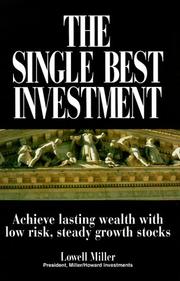
The Single Best Investment

The Single Best Investment

Lowell Miller
1999
T4 264 pages · about 4h 24m to read Open Librarygoodreads

Miller on buying rising-dividend businesses and holding them.

Summary

Lowell Miller ran a money management firm and wrote this as an argument for dividend growth investing, meaning buying high-quality companies with above-average dividend yields that raise those dividends consistently.

His formula is stated as high quality plus high current yield plus high growth of yield. Quality means a business with durable competitive position, conservative finances and a long record; high current yield means meaningfully above the market average, which he treats as a valuation discipline; and dividend growth means a company raising its payment consistently, which he argues both compounds the income and drives the share price, since a rising dividend pulls the price up to maintain a market-consistent yield.

Miller's arguments include that dividends impose discipline on management, since cash paid out cannot be misallocated; that dividend-paying companies are self-selecting for the qualities investors want, because a company committing to a payment must have confidence in its cash generation; that the compounding of a rising income stream produces returns that do not depend on selling; and that the investor's psychology is easier to manage when returns arrive as cash rather than as price appreciation. The book is written for individual investors and is repetitive. Its arguments are not novel and the historical evidence on dividend strategies is more mixed than Miller allows, particularly regarding the tax treatment for taxable investors and the periods when dividend payers underperformed substantially.

Key takeaways 7

  1. Miller's formula combines business quality, an above-average current yield and a consistent record of dividend increases.
  2. A rising dividend pulls the share price up over time, because the market reprices the security to a consistent yield.
  3. Dividends impose discipline on management, since cash paid out cannot be reinvested badly.
  4. Committing to a dividend requires confidence in cash generation, which makes the payment itself a signal about the business.
  5. Returns arriving as cash are psychologically easier to hold through declines than returns arriving as price appreciation.
  6. An above-average yield functions as a valuation discipline that prevents overpaying for quality.
  7. The historical evidence on dividend strategies is more mixed than the book allows, particularly on tax treatment for taxable holders.

Who should read it

Individual investors building income portfolios who want the case for dividend growth stated as a complete method.

Similar books 6

Chosen by shared topics, the entries that hold them, and the people who recommended both.

Daniel Peris · 2011

Peris argues dividends, not multiple expansion, drive real returns.

Elroy Dimson, Paul Marsh, Mike Staunton · 2002

Stock, bond and bill returns for sixteen countries from 1900 to 2000.

Recommended by: Mohnish Pabrai

Christopher Mayer · 2015

Subtitled Stocks That Return 100-to-1 and How to Find Them; expanded edition 2025.

Recommended by: Mohnish Pabrai

Philip L. Carret, Philip Carret · 1995

A fund manager of sixty years on investing, business and a long life.

Recommended by: Mohnish Pabrai
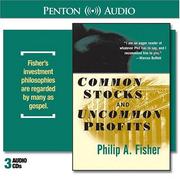
Philip Fisher · 1958

Buy a few outstanding growth companies, research them by scuttlebutt, and hold.

“The late Philip Fisher wrote several books that are very good [including] Common Stocks and Uncommon Profits.” — Arnold Van Den Berg

Source: Van Den Berg on Fisher's books

Recommended by: Arnold Van Den Berg, Bill Stewart and 10 others

Where it sits in the reference 2

Investment philosophy
Investment styles

Topics

Investing