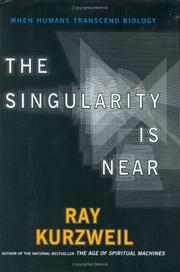
The Singularity Is Near
Kurzweil's optimistic counterpoint to the safety literature. His law of accelerating returns and the vision of intelligence explosion as fundamentally benign is the premise that alignment researchers are most directly arguing against. Reading it gives the other side of the debate its strongest formulation.
Summary
Kurzweil argues that technological progress is exponential rather than linear, that this pattern holds across multiple technologies over long periods, and that extrapolating it produces a point around 2045 where machine intelligence exceeds all human intelligence combined and the pace of change becomes incomprehensible from the current vantage point.
His central evidence is the law of accelerating returns, which he supports with plotted data on computing price-performance across mechanical, relay, vacuum tube, transistor and integrated circuit technologies, arguing that the exponential trend predates and will outlast any specific technology including silicon. He extends the argument to genome sequencing costs, brain scanning resolution, and communication bandwidth.
His specific predictions include computers passing the Turing test by 2029, molecular manufacturing, the reverse engineering of the brain enabling whole brain emulation, the merging of biological and non-biological intelligence through nanoscale devices, and eventual radical life extension. He addresses the three overlapping revolutions of genetics, nanotechnology and robotics, and devotes a chapter to the risks including self-replicating nanotechnology and hostile artificial intelligence.
The criticisms are substantial. Exponential trends in specific technologies have repeatedly stalled, and Moore's law has slowed considerably since publication. Kurzweil's method of plotting heterogeneous data on log scales has been criticised as producing the trend it claims to find. The molecular manufacturing predictions have not materialised at all. His record on the artificial intelligence predictions has been better than most critics expected, particularly on language capability, though the mechanism differs entirely from what he described. Read it for the argument about exponential extrapolation, with the specific timelines checked against what happened.
Key takeaways 8
- Technological progress follows an exponential rather than linear trajectory, which means intuitive forecasts based on recent experience systematically underestimate change.
- The exponential trend in computing price-performance spans five distinct technology substrates, which Kurzweil uses to argue it will survive the end of silicon scaling.
- Machine intelligence will exceed the combined capability of human intelligence around 2045, at which point prediction beyond that point becomes impossible.
- Biological and non-biological intelligence will merge rather than compete, through devices operating at the scale of neurons.
- Genetics, nanotechnology and robotics constitute three overlapping revolutions with different timelines and different risk profiles.
- Information technologies applied to biology convert medicine into an information science, which subjects it to the same exponential improvement.
- Kurzweil's specific predictions about molecular manufacturing have not materialised, while his predictions about machine language capability have been closer than critics expected.
- The method of plotting heterogeneous data on logarithmic scales has been criticised for producing the smooth trend it claims to discover.
Who should read it
Investors and founders in technology who want the fullest statement of the exponential extrapolation argument, checked against two decades of subsequent evidence.
Who recommended it 8 · 2 direct
Similar books 6
Chosen by shared topics, the entries that hold them, and the people who recommended both.

Why machines smarter than humans pose a control problem to solve before they arrive.
Recommended by: Patrick Collison, Brad Feld, Brett Adcock and 6 others
Recommended by: Patrick Collison
Recommended by: Patrick Collison

Harari's concern — that humans may cede decision-making to opaque systems through preference rather than coercion — reframes the alignment problem as a cultural and political challenge, not only a technical one. Less rigorous than Bostrom or Russell, but more widely read, making it a useful lens for understanding public discourse.
Recommended by: Andrew Wilkinson, Bill Gates, Nat Eliason and 7 others
How machine learning and robots will displace work faster than institutions adapt.
Recommended by: Antonio García Martínez, Brian Armstrong
Where it sits in the reference 1
Topics