Updates

  1. Person pages list letters, writing, profiles and links as sortable tables with filters, and show each person's companies as links; Fund letters show each letter's description in its own column.
  2. Experts show a checked job title and a short description of each person; 30 more people have photographs.
  3. Every company, fund, university and publication the experts work for has a page listing the people there.
  4. Fund letters show each letter's thesis and filter by it; 225 person pages list the essays, columns and newsletter issues the person wrote.
  5. Person pages list every essay and newsletter issue a person wrote, and their own books as a table in List view.
  6. Recommends shows the five largest kinds of book and the rest under More; browse pictures load sooner.
  7. Podcasts and talks link the original episode, filter by Audio and video or Press, and list each publisher once.
  8. Pages are wider, Recommends has List and Grid, and a filter clicked again turns off.
  9. Book cards sit in a ruled grid with Open Library and Goodreads links and each book's one-line note.
  10. Funds is now Investors; each investor's styles are buttons that filter the table.
  11. Podcasts and talks on a person's page filter by year and publisher and show as a list or a grid of pictures.
  12. Quotes show only people's own words: 472 summaries written by list sites are gone.
  13. Country pages open from Browse again, and every link on the shelf lands on a page.
  14. Subject and person pages show their sections as tabs, and each book appears once on a person's page.
  15. Book cards show the quote, who said it and the source; grids show five cards to a row.
  16. On a phone, a menu holds the sections, search, Updates, Feedback and dark mode.
  17. Feedback takes a screenshot of the page with no browser prompt, opens a screenshot full size when you click it, and clears itself once sent.
  18. Book cards are centred, search names the topic each book sits in, and any text cut short shows whole on hover.
  19. Search groups its results by kind: people, companies, geographies, subjects, topics, books, funds, fund letters and papers.
  20. The Books table lists who recommended each book by name, and the browser tab names the section you are in.
  21. Feedback can take a screenshot of the page, or one you paste or choose, and opens in the corner beside Updates.
  22. Each rail button reopens its section where you left it, and Browse, Table and People show on every book and subject page.
  23. Filters grey out choices that hold nothing instead of hiding them, and Books › People filters by authors or recommenders.
  24. Feedback takes a subject line and up to three screenshots.
  25. Biographies are grouped by the person they are about: 41 new pages, from Abraham Lincoln to Lee Kuan Yew.
  26. Sport splits into 23 sports, and Religion into one topic per faith.
  27. Book lists show as cards: the cover, one recommendation quote and every recommender by name.
  28. Seventeen subjects that had two or three pages under different names now have one page each.
  29. Every page lists its Experts as authors and recommenders, with a link to them on the Experts tab.
  30. Economics, Financial history, Financial panics and Accounting are subjects of their own, with one page per financial crisis.
  31. Book, person and subject pages open inside the app, so the tabs stay in view.
  32. 996 more book covers, and photographs or logos for 227 more people and companies.
  33. Books › Browse shows every subject as cards, and the rail holds Fund letters, Papers, Experts, Books and Funds.
  34. Every topic over 150 books splits into narrower topics, each with a page of its own.

Send feedback

What is it?
Screenshots, up to 3 (optional)
or paste one with Ctrl+V

We use your email only to reply to you.

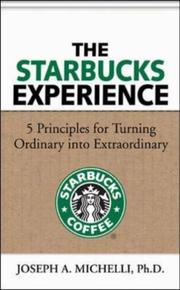
The Starbucks Experience

The Starbucks Experience

Joseph A. Michelli
2006
T4 208 pages · about 3h 28m to read Open Librarygoodreads

Consultant's distillation of Starbucks service principles.

Summary

The reference has not verified this book in detail; the summary states only what the title, author and subject establish.

Joseph Michelli, a consultant who writes books about customer experience at well-known companies, produced this account of Starbucks organised around five principles he draws from its practice.

The principles are stated as make it your own, meaning that employees are given latitude to personalise interactions; everything matters, meaning attention to the details of the store environment and product; surprise and delight, meaning unplanned gestures toward customers; embrace resistance, meaning treating criticism as information; and leave your mark, meaning community involvement. Each is illustrated with anecdotes from stores and from employees.

The reference has not verified this book's contents in detail. It is a consultant's treatment based on company access and interviews rather than independent research, and its method is to extract principles from anecdotes without testing whether they explain the company's results. It was published in 2006, before the 2008 decline and Howard Schultz's return, before the store closures and the retraining day, and before the current labour organising. Readers wanting the company's history should go to Schultz's own accounts, which are also promotional but at least first-hand.

Key takeaways 6

  1. Michelli extracts five principles from Starbucks practice and illustrates each with anecdotes from stores and employees.
  2. Giving front-line employees latitude to personalise interactions is presented as the company's central service mechanism.
  3. Attention to the physical detail of the store environment is treated as part of the product rather than as presentation.
  4. Treating customer criticism as information rather than as complaint is presented as a deliberate practice.
  5. The method extracts principles from anecdotes without testing whether they explain the company's financial results.
  6. The book predates the 2008 decline, Schultz's return and the current labour organising.

Who should read it

Readers wanting a consultant's account of Starbucks service practices, with the caveat that this entry is not verified in detail.

Similar books 6

Chosen by shared topics, the entries that hold them, and the people who recommended both.

Bryce G. Hoffman · 2012

The 2006-2010 turnaround told with close management access.

Recommended by: Mohnish Pabrai

Dieter Brandes · 2004

Aldi's hard-discount method: radical simplicity as the way to keep costs low.

Where it sits in the reference 3

Companies
Business themes
Business themes

Topics

Company HistoriesBusiness and Management