Updates

  1. Person pages list letters, writing, profiles and links as sortable tables with filters, and show each person's companies as links; Fund letters show each letter's description in its own column.
  2. Experts show a checked job title and a short description of each person; 30 more people have photographs.
  3. Every company, fund, university and publication the experts work for has a page listing the people there.
  4. Fund letters show each letter's thesis and filter by it; 225 person pages list the essays, columns and newsletter issues the person wrote.
  5. Person pages list every essay and newsletter issue a person wrote, and their own books as a table in List view.
  6. Recommends shows the five largest kinds of book and the rest under More; browse pictures load sooner.
  7. Podcasts and talks link the original episode, filter by Audio and video or Press, and list each publisher once.
  8. Pages are wider, Recommends has List and Grid, and a filter clicked again turns off.
  9. Book cards sit in a ruled grid with Open Library and Goodreads links and each book's one-line note.
  10. Funds is now Investors; each investor's styles are buttons that filter the table.
  11. Podcasts and talks on a person's page filter by year and publisher and show as a list or a grid of pictures.
  12. Quotes show only people's own words: 472 summaries written by list sites are gone.
  13. Country pages open from Browse again, and every link on the shelf lands on a page.
  14. Subject and person pages show their sections as tabs, and each book appears once on a person's page.
  15. Book cards show the quote, who said it and the source; grids show five cards to a row.
  16. On a phone, a menu holds the sections, search, Updates, Feedback and dark mode.
  17. Feedback takes a screenshot of the page with no browser prompt, opens a screenshot full size when you click it, and clears itself once sent.
  18. Book cards are centred, search names the topic each book sits in, and any text cut short shows whole on hover.
  19. Search groups its results by kind: people, companies, geographies, subjects, topics, books, funds, fund letters and papers.
  20. The Books table lists who recommended each book by name, and the browser tab names the section you are in.
  21. Feedback can take a screenshot of the page, or one you paste or choose, and opens in the corner beside Updates.
  22. Each rail button reopens its section where you left it, and Browse, Table and People show on every book and subject page.
  23. Filters grey out choices that hold nothing instead of hiding them, and Books › People filters by authors or recommenders.
  24. Feedback takes a subject line and up to three screenshots.
  25. Biographies are grouped by the person they are about: 41 new pages, from Abraham Lincoln to Lee Kuan Yew.
  26. Sport splits into 23 sports, and Religion into one topic per faith.
  27. Book lists show as cards: the cover, one recommendation quote and every recommender by name.
  28. Seventeen subjects that had two or three pages under different names now have one page each.
  29. Every page lists its Experts as authors and recommenders, with a link to them on the Experts tab.
  30. Economics, Financial history, Financial panics and Accounting are subjects of their own, with one page per financial crisis.
  31. Book, person and subject pages open inside the app, so the tabs stay in view.
  32. 996 more book covers, and photographs or logos for 227 more people and companies.
  33. Books › Browse shows every subject as cards, and the rail holds Fund letters, Papers, Experts, Books and Funds.
  34. Every topic over 150 books splits into narrower topics, each with a page of its own.

Send feedback

What is it?
Screenshots, up to 3 (optional)
or paste one with Ctrl+V

We use your email only to reply to you.

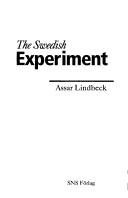
The Swedish Experiment

The Swedish Experiment

Assar Lindbeck
1997
T2 104 pages · about 1h 44m to read Open Librarygoodreads

The insider economist's account of what the welfare state did to incentives.

Summary

Assar Lindbeck was Sweden's most prominent economist and chaired the commission that examined the country's economic problems after the crisis of the early 1990s. This work sets out his analysis of what went wrong with the Swedish model.

His argument is that Sweden's welfare state and labour market institutions worked well for a period and then overshot. He divides the postwar record into phases: a period through the 1960s in which Sweden combined a large public sector with strong growth and low unemployment, and a period from the 1970s in which expanding benefits, rising marginal tax rates, employment protection and public sector employment growth progressively weakened the incentives on which the earlier performance had depended.

His specific mechanisms include the effect of high marginal tax rates on labour supply and on the choice between market and household production; the effect of generous and long-duration benefits on job search and on the acceptability of unemployment; the ratchet in public sector employment; and what he calls hazardous dynamics, meaning that social norms about work and benefit use erode slowly, so that behavioural responses to policy appear with long lags and are then hard to reverse. The 1991 to 1993 crisis he treats as the culmination. Lindbeck writes from within Swedish social democratic economics rather than against it, and his prescription was reform of incentives rather than dismantling. Sweden adopted much of it.

Key takeaways 7

  1. Sweden combined a large public sector with strong growth through the 1960s and the model deteriorated as benefits and tax rates expanded after 1970.
  2. High marginal tax rates shift activity from the market to household production and to the informal economy.
  3. Generous long-duration benefits affect job search behaviour and the social acceptability of not working.
  4. Lindbeck's concept of hazardous dynamics holds that social norms erode slowly, so behavioural responses to policy appear with long lags.
  5. Norms that have eroded are difficult to restore, which makes the lagged response asymmetric.
  6. Public sector employment growth ratcheted upward because reversing it required decisions no government would make.
  7. Lindbeck argued for reforming incentives rather than dismantling the welfare state, and Sweden adopted much of that programme.

Who should read it

Policy analysts and investors assessing welfare state economics who want the internal critique that shaped Sweden's reforms.

Similar books 6

Chosen by shared topics, the entries that hold them, and the people who recommended both.

Richard B. Freeman, Birgitta Swedenborg, Robert H. Topel · 2010

NBER volume on the post-crisis reforms that restored Swedish growth.

Marquis W. Childs · 1936

The book that made the Swedish model an international reference point.

George Lakey · 2016

Popular and partisan, but the clearest short account of the Nordic bargain.

Yanis Varoufakis · 2016

The euro's design flaws traced back through the postwar monetary system.

Costas Meghir, Christopher A. Pissarides, Dimitri Vayanos, Nikolaos Vettas · 2017

How the Greek economy actually works: its product markets, courts and firms.

Peadar Kirby · 2010

Structural reading of why the growth model was fragile from the start.

Where it sits in the reference 2

Geographies
Economics

Topics

EconomicsPolitics and GovernmentEurope, Britain and Russia