Updates

  1. Person pages list letters, writing, profiles and links as sortable tables with filters, and show each person's companies as links; Fund letters show each letter's description in its own column.
  2. Experts show a checked job title and a short description of each person; 30 more people have photographs.
  3. Every company, fund, university and publication the experts work for has a page listing the people there.
  4. Fund letters show each letter's thesis and filter by it; 225 person pages list the essays, columns and newsletter issues the person wrote.
  5. Person pages list every essay and newsletter issue a person wrote, and their own books as a table in List view.
  6. Recommends shows the five largest kinds of book and the rest under More; browse pictures load sooner.
  7. Podcasts and talks link the original episode, filter by Audio and video or Press, and list each publisher once.
  8. Pages are wider, Recommends has List and Grid, and a filter clicked again turns off.
  9. Book cards sit in a ruled grid with Open Library and Goodreads links and each book's one-line note.
  10. Funds is now Investors; each investor's styles are buttons that filter the table.
  11. Podcasts and talks on a person's page filter by year and publisher and show as a list or a grid of pictures.
  12. Quotes show only people's own words: 472 summaries written by list sites are gone.
  13. Country pages open from Browse again, and every link on the shelf lands on a page.
  14. Subject and person pages show their sections as tabs, and each book appears once on a person's page.
  15. Book cards show the quote, who said it and the source; grids show five cards to a row.
  16. On a phone, a menu holds the sections, search, Updates, Feedback and dark mode.
  17. Feedback takes a screenshot of the page with no browser prompt, opens a screenshot full size when you click it, and clears itself once sent.
  18. Book cards are centred, search names the topic each book sits in, and any text cut short shows whole on hover.
  19. Search groups its results by kind: people, companies, geographies, subjects, topics, books, funds, fund letters and papers.
  20. The Books table lists who recommended each book by name, and the browser tab names the section you are in.
  21. Feedback can take a screenshot of the page, or one you paste or choose, and opens in the corner beside Updates.
  22. Each rail button reopens its section where you left it, and Browse, Table and People show on every book and subject page.
  23. Filters grey out choices that hold nothing instead of hiding them, and Books › People filters by authors or recommenders.
  24. Feedback takes a subject line and up to three screenshots.
  25. Biographies are grouped by the person they are about: 41 new pages, from Abraham Lincoln to Lee Kuan Yew.
  26. Sport splits into 23 sports, and Religion into one topic per faith.
  27. Book lists show as cards: the cover, one recommendation quote and every recommender by name.
  28. Seventeen subjects that had two or three pages under different names now have one page each.
  29. Every page lists its Experts as authors and recommenders, with a link to them on the Experts tab.
  30. Economics, Financial history, Financial panics and Accounting are subjects of their own, with one page per financial crisis.
  31. Book, person and subject pages open inside the app, so the tabs stay in view.
  32. 996 more book covers, and photographs or logos for 227 more people and companies.
  33. Books › Browse shows every subject as cards, and the rail holds Fund letters, Papers, Experts, Books and Funds.
  34. Every topic over 150 books splits into narrower topics, each with a page of its own.

Send feedback

What is it?
Screenshots, up to 3 (optional)
or paste one with Ctrl+V

We use your email only to reply to you.

Sweden, the Middle Way

Sweden, the Middle Way

Marquis W. Childs
1936
T3 223 pages · about 3h 43m to read Open Librarygoodreads

The book that made the Swedish model an international reference point.

Summary

Marquis Childs was an American journalist who reported from Sweden in the early 1930s and produced this book, which introduced the American public to the idea that a country could operate between American capitalism and Soviet communism. It sold widely and shaped the international reputation Sweden held for decades.

Childs's subject is chiefly the cooperative movement. He describes Swedish consumer cooperatives, particularly Kooperativa Forbundet, and their strategy of entering monopolised markets in order to break the price. The best-known case is the electric lamp market, where the international Phoebus cartel had fixed prices and limited bulb life, and the Swedish cooperative built a factory that undercut it. Childs also covers cooperative housing, banking and insurance, the agricultural cooperatives, and the state's approach to monopoly, which he describes as competing with private firms rather than prohibiting them.

He also covers the social democratic government elected in 1932, the labour arrangements that led to the Saltsjobaden agreement of 1938 between employers and unions, and the housing and social policies then being developed. The book is enthusiastic and simplifies considerably. Its portrait of Sweden as a settled middle way understates the conflict of the period and the fact that the arrangements it described were then very new. It is a period document whose influence exceeded its accuracy, and it is worth reading as the origin of a durable international idea.

Key takeaways 7

  1. Swedish consumer cooperatives entered monopolised markets specifically to break prices rather than to serve members alone.
  2. The cooperative lamp factory undercut the international Phoebus cartel and forced prices down across the market.
  3. State and cooperative enterprises competing with private firms was presented as an alternative to prohibiting monopoly.
  4. Childs described a settlement between labour and capital that was then very recent and much less settled than he implied.
  5. Cooperative ownership extended across housing, banking, insurance and agriculture rather than being confined to retail.
  6. The book's influence on international perceptions of Sweden exceeded its analytical accuracy and lasted for decades.
  7. Childs argues that a mixed economy can discipline private monopoly through competition rather than through regulation.

Who should read it

Readers interested in the origin of Sweden's international reputation and in cooperative enterprise as a competitive instrument against cartels.

Similar books 6

Chosen by shared topics, the entries that hold them, and the people who recommended both.

Richard B. Freeman, Birgitta Swedenborg, Robert H. Topel · 2010

NBER volume on the post-crisis reforms that restored Swedish growth.
Assar Lindbeck · 1997

What went wrong with Sweden's welfare-state model, leading to the 1990s crisis.
George Lakey · 2016

Popular and partisan, but the clearest short account of the Nordic bargain.
Leonor Freire Costa, Pedro Lains, Susana Münch Miranda · 2016

Portugal's economy over nine centuries, from imperial trade to EU convergence.
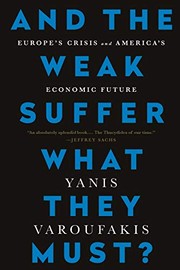
Yanis Varoufakis · 2016

The euro's design flaws traced back through the postwar monetary system.

Costas Meghir, Christopher A. Pissarides, Dimitri Vayanos, Nikolaos Vettas · 2017

How the Greek economy actually works: its product markets, courts and firms.

Where it sits in the reference 2

Geographies
Economics

Topics

Politics and GovernmentEconomicsGeneral HistoryModern Europe and RussiaEurope, Britain and Russia