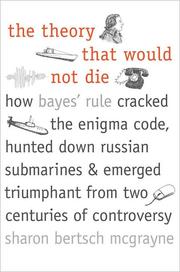
The Theory That Would Not Die
The history of Bayes' rule and the long fight over it.
Who recommended it 1 · 1 direct
“To read more about the controversy, see Sharon Bertsch McGrayne, The Theory That Would Not Die: How Bayes’ Rule Cracked the Enigma Code, Hunted Down Russian Submarines, and Emerged Triumphant from Two Centuries of Controversy (New Haven, CT: Yale University Press, 2011).”
Similar books 6
Chosen by shared topics, the entries that hold them, and the people who recommended both.
How judges, juries and scientists weighed evidence before formal statistics.
Recommended by: Nassim Nicholas Taleb
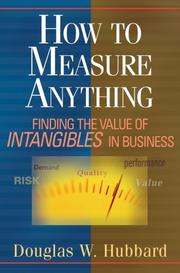
Why anything a manager cares about can be measured, and how to measure it.
“Hubbard, Douglas, How to Measure Anything: Finding the Value of Intangibles in Business (Hoboken, NJ: John Wiley & Sons, 2007)” — Michael Mauboussin
Source: The Wisdom of Crowds in Markets: Crowd Behavior in Prediction, Betting, and Stock Markets
Recommended by: Michael Mauboussin, Julia Galef, Nick Ganju
Why some forecasts succeed and most fail, from weather to earthquakes and economics.
“See Gigerenzer, Calculated Risks, 28-29. 14 For a book that treats this topic and more, see Annie Duke, Thinking in Bets: Making Smarter Decisions When You Don't Have All the Facts (New York: Portfolio/Penguin, 2018). 15 For a good discussion of Bayes’ Theorem, see Nate Silver, The Signal and the Noise: Why So Many Predictions Fail—But Some Don’t (New York, The Penguin Press, 2012), 232-261.” — Michael Mauboussin
Source: Confidence: Methods to Assess Confidence Under Uncertainty, page 7
Recommended by: Bill Gates, Michael Mauboussin and 2 others
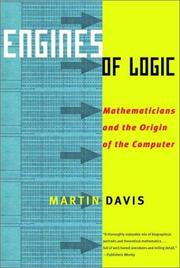
The mathematicians whose logic led to the computer.
Recommended by: Patrick Collison
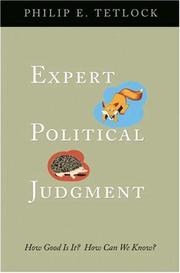
A 20-year test of 28,000 expert forecasts: foxes with many models beat hedgehogs.
“All pundits and commentators should publish their prediction track records, yet don't. What to pay attention to and what to ignore.” — Marc Andreessen
Source: @pmarca, 'Thread: Books I've recently read and recommend'
Recommended by: Marc Andreessen, Michael Mauboussin and 2 others
The centuries-long search for a proof of Fermat's Last Theorem.
“And then some blast from the past if you're interested, there's a great book called "Fermat's Enigma" by this guy Simon Singh, which is talking about, you know, Fermat has this theorem, which is X to the N plus Y to the N equal Z to the N.” — Chamath Palihapitiya
Source: Transcript: Chamath Palihapitiya
Recommended by: Chamath Palihapitiya, Mohnish Pabrai
Where it sits in the reference 1
Topics 4
As an Amazon Associate I earn from qualifying purchases.