Updates

  1. Person pages list letters, writing, profiles and links as sortable tables with filters, and show each person's companies as links; Fund letters show each letter's description in its own column.
  2. Experts show a checked job title and a short description of each person; 30 more people have photographs.
  3. Every company, fund, university and publication the experts work for has a page listing the people there.
  4. Fund letters show each letter's thesis and filter by it; 225 person pages list the essays, columns and newsletter issues the person wrote.
  5. Person pages list every essay and newsletter issue a person wrote, and their own books as a table in List view.
  6. Recommends shows the five largest kinds of book and the rest under More; browse pictures load sooner.
  7. Podcasts and talks link the original episode, filter by Audio and video or Press, and list each publisher once.
  8. Pages are wider, Recommends has List and Grid, and a filter clicked again turns off.
  9. Book cards sit in a ruled grid with Open Library and Goodreads links and each book's one-line note.
  10. Funds is now Investors; each investor's styles are buttons that filter the table.
  11. Podcasts and talks on a person's page filter by year and publisher and show as a list or a grid of pictures.
  12. Quotes show only people's own words: 472 summaries written by list sites are gone.
  13. Country pages open from Browse again, and every link on the shelf lands on a page.
  14. Subject and person pages show their sections as tabs, and each book appears once on a person's page.
  15. Book cards show the quote, who said it and the source; grids show five cards to a row.
  16. On a phone, a menu holds the sections, search, Updates, Feedback and dark mode.
  17. Feedback takes a screenshot of the page with no browser prompt, opens a screenshot full size when you click it, and clears itself once sent.
  18. Book cards are centred, search names the topic each book sits in, and any text cut short shows whole on hover.
  19. Search groups its results by kind: people, companies, geographies, subjects, topics, books, funds, fund letters and papers.
  20. The Books table lists who recommended each book by name, and the browser tab names the section you are in.
  21. Feedback can take a screenshot of the page, or one you paste or choose, and opens in the corner beside Updates.
  22. Each rail button reopens its section where you left it, and Browse, Table and People show on every book and subject page.
  23. Filters grey out choices that hold nothing instead of hiding them, and Books › People filters by authors or recommenders.
  24. Feedback takes a subject line and up to three screenshots.
  25. Biographies are grouped by the person they are about: 41 new pages, from Abraham Lincoln to Lee Kuan Yew.
  26. Sport splits into 23 sports, and Religion into one topic per faith.
  27. Book lists show as cards: the cover, one recommendation quote and every recommender by name.
  28. Seventeen subjects that had two or three pages under different names now have one page each.
  29. Every page lists its Experts as authors and recommenders, with a link to them on the Experts tab.
  30. Economics, Financial history, Financial panics and Accounting are subjects of their own, with one page per financial crisis.
  31. Book, person and subject pages open inside the app, so the tabs stay in view.
  32. 996 more book covers, and photographs or logos for 227 more people and companies.
  33. Books › Browse shows every subject as cards, and the rail holds Fund letters, Papers, Experts, Books and Funds.
  34. Every topic over 150 books splits into narrower topics, each with a page of its own.

Send feedback

What is it?
Screenshots, up to 3 (optional)
or paste one with Ctrl+V

We use your email only to reply to you.

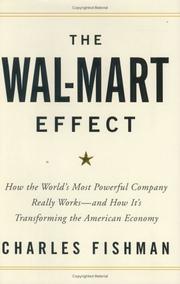
The Wal-Mart Effect

The Wal-Mart Effect

Charles Fishman
2006
T2 294 pages · about 4h 54m to read Open Librarygoodreads

How the buying power reshapes suppliers, prices and wages.

Summary

Fishman, a business journalist, investigated what Wal-Mart's scale actually does to the companies that supply it, to the communities where it operates, and to prices across the economy.

The supplier material is the most original. Fishman documents the relationship from the supplier's side: the annual price reduction expectation, the requirement to open cost structures to Wal-Mart's buyers, the volume that makes a supplier dependent and then makes the terms non-negotiable, and the consequences that follow. He reports cases where suppliers moved production offshore because the price required could not be met domestically, where suppliers redesigned products to lower cost in ways that reduced quality, and where suppliers grew rapidly and then failed when they became too dependent. The Vlasic pickle case, where a gallon jar sold at a price that damaged the entire category's economics, became the standard illustration.

The economic material covers the estimates of consumer savings, which are large, and the studies on local wage and employment effects, which Fishman reports as contested rather than settled. He notes that the price savings and the wage effects are both real and are not measured against each other in any public accounting.

He also covers the difficulty of researching the company, which does not disclose the data that would allow independent assessment, and the effects on fisheries and on production in supplier countries.

The book is reporting rather than economic analysis, and Fishman is careful not to overstate the causal claims. It is from 2006 and the retail environment has changed substantially with Amazon's growth, though the supplier dynamics it describes now apply to platform marketplaces in similar form.

Key takeaways 7

  1. Wal-Mart expects annual price reductions from suppliers and requires access to their cost structures to verify what is achievable.
  2. Suppliers that grow to depend on the account lose the ability to negotiate, because losing it would end the business.
  3. Meeting the required price forced suppliers to move production offshore or to redesign products in ways that reduced quality.
  4. Selling a product at a price that captures market share can destroy the category's economics for every participant including the supplier.
  5. Consumer price savings from the company's scale are large and real, and so are the local wage effects, and neither is measured against the other.
  6. The company does not disclose the data that would permit independent assessment of its economic effects.
  7. The same supplier dynamics now operate on platform marketplaces, where the intermediary sets terms and holds the customer relationship.

Who should read it

Operators supplying large retailers or platforms, and investors assessing companies with concentrated customer exposure.

Similar books 6

Chosen by shared topics, the entries that hold them, and the people who recommended both.

Bob Ortega · 1998

First major critical history by a WSJ Walmart reporter.

Sam Walton, John Huey · 1992

How Walmart grew from one Arkansas store by cutting costs and prices.

Anthony Bianco · 2006

Business-press account of supplier and wage pressure.
Nelson Lichtenstein · 2006

Edited volume on the supply chain and logistics model.

Where it sits in the reference 3

Companies
Biographies
Business models

Topics

Company HistoriesSociology and CultureConsumer culture and cultural criticism