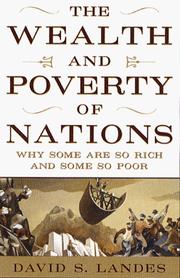
The Wealth and Poverty of Nations
Why some nations grew rich over 500 years, with culture as the deciding factor.
Why some economies grew rich; culture and institutions across five centuries
Summary
Landes, an economic historian at Harvard, explains the divergence in national wealth over five hundred years, arguing that culture is the decisive factor while geography, institutions and contingency all contribute. He states directly that if economic history teaches anything, culture makes almost all the difference, which is the book's most quoted and most contested claim.
The argument covers why Europe industrialised rather than China or the Islamic world. He credits European political fragmentation, which prevented any single authority from suppressing innovation; the development of property rights and of contract enforcement; the Christian attitude toward work and toward the manipulation of nature; the independence of intellectual inquiry from religious authority after the Reformation; and the diffusion of technical knowledge through printing.
He contrasts this with Chinese centralisation, which he argues allowed a single decision to terminate maritime exploration, and with Islamic and Iberian trajectories where he argues that religious orthodoxy suppressed inquiry. His treatment of Spain, which received enormous American silver and industrialised late, is used to argue that resources without the appropriate institutions and culture produce nothing.
The cultural argument has drawn heavy criticism as Eurocentric and as close to circular, since culture is inferred partly from the outcomes it is used to explain. Landes gives limited weight to colonial extraction and to the specific advantages Europe obtained from it. Critics including Pomeranz argue that the divergence was later and more contingent than Landes allows. The historical detail is excellent and the causal argument should be read alongside the institutional and geographic accounts it rejects.
Key takeaways 8
- Landes argues that culture makes almost all the difference in explaining national wealth, which is the book's central and most contested claim.
- European political fragmentation prevented any single authority from suppressing innovation, which he treats as the decisive structural difference from China.
- Property rights and enforceable contracts allowed people to invest in outcomes they would capture, which is a precondition for sustained growth.
- Chinese centralisation meant a single imperial decision could terminate maritime exploration, which no fragmented system could have imposed.
- Spain received enormous quantities of American silver and industrialised late, which shows that resources without appropriate institutions produce nothing.
- The independence of intellectual inquiry from religious authority allowed knowledge to accumulate and be applied to production.
- Attitudes toward work, time and the manipulation of nature differ across societies and affect economic outcomes over long periods.
- The cultural explanation is close to circular, since culture is inferred partly from the outcomes it is invoked to explain.
Who should read it
Readers wanting the cultural explanation of divergence in its strongest form, read against the institutional and geographic accounts it argues with.
Who recommended it 4 · 3 direct
Similar books 6
Chosen by shared topics, the entries that hold them, and the people who recommended both.
Prosperity grows as trade and specialisation let ideas meet and combine.
“…books I've recommended, highlighted to death, or forced on friends.” — Andrew Wilkinson
Source: Andrew Wilkinson's Bookshelf, neverenough.com
Recommended by: Andrew Wilkinson, Bill Gates, Frank Martin and 12 others
American economic growth from colonial times to now, driven by creative destruction.
Recommended by: Li Lu
How Britain, Germany, Japan and the US each built their own form of capitalism.
Recommended by: Mohnish Pabrai

How American manufacturing rose to lead the world, and why its share then fell.
Recommended by: Mohnish Pabrai, Bill Gates
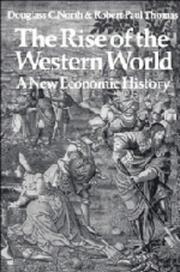
A new economic history of how Western Europe grew rich.
“Douglass C. North and Robert P. Thomas, The Rise of the Western World (Cambridge: Cambridge University Press, 1981), 102’119” — William J. Bernstein
Source: Efficient Frontier, issue 404 (2004)
Recommended by: Mohnish Pabrai, William J. Bernstein
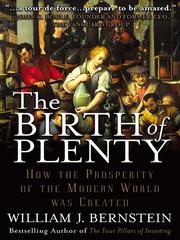
The four institutions modern growth needed, from property rights to capital markets.
“This is morally and ethically unacceptable,” the essay concluded, “but also a corruption of capitalism itself.” 3 For a marvelous exposition of this great era—as well as a compelling and delightful experience—I urge you to read William Bernstein’s fine new book, The Birth of Plenty. 3” — John C. Bogle
Source: Creating Sound Governance: The Shareholder’s Perspective, page 3
Recommended by: John C. Bogle, Mohnish Pabrai, Morgan Housel
Where it sits in the reference 3
Topics 3
As an Amazon Associate I earn from qualifying purchases.