Updates

  1. Person pages list letters, writing, profiles and links as sortable tables with filters, and show each person's companies as links; Fund letters show each letter's description in its own column.
  2. Experts show a checked job title and a short description of each person; 30 more people have photographs.
  3. Every company, fund, university and publication the experts work for has a page listing the people there.
  4. Fund letters show each letter's thesis and filter by it; 225 person pages list the essays, columns and newsletter issues the person wrote.
  5. Person pages list every essay and newsletter issue a person wrote, and their own books as a table in List view.
  6. Recommends shows the five largest kinds of book and the rest under More; browse pictures load sooner.
  7. Podcasts and talks link the original episode, filter by Audio and video or Press, and list each publisher once.
  8. Pages are wider, Recommends has List and Grid, and a filter clicked again turns off.
  9. Book cards sit in a ruled grid with Open Library and Goodreads links and each book's one-line note.
  10. Funds is now Investors; each investor's styles are buttons that filter the table.
  11. Podcasts and talks on a person's page filter by year and publisher and show as a list or a grid of pictures.
  12. Quotes show only people's own words: 472 summaries written by list sites are gone.
  13. Country pages open from Browse again, and every link on the shelf lands on a page.
  14. Subject and person pages show their sections as tabs, and each book appears once on a person's page.
  15. Book cards show the quote, who said it and the source; grids show five cards to a row.
  16. On a phone, a menu holds the sections, search, Updates, Feedback and dark mode.
  17. Feedback takes a screenshot of the page with no browser prompt, opens a screenshot full size when you click it, and clears itself once sent.
  18. Book cards are centred, search names the topic each book sits in, and any text cut short shows whole on hover.
  19. Search groups its results by kind: people, companies, geographies, subjects, topics, books, funds, fund letters and papers.
  20. The Books table lists who recommended each book by name, and the browser tab names the section you are in.
  21. Feedback can take a screenshot of the page, or one you paste or choose, and opens in the corner beside Updates.
  22. Each rail button reopens its section where you left it, and Browse, Table and People show on every book and subject page.
  23. Filters grey out choices that hold nothing instead of hiding them, and Books › People filters by authors or recommenders.
  24. Feedback takes a subject line and up to three screenshots.
  25. Biographies are grouped by the person they are about: 41 new pages, from Abraham Lincoln to Lee Kuan Yew.
  26. Sport splits into 23 sports, and Religion into one topic per faith.
  27. Book lists show as cards: the cover, one recommendation quote and every recommender by name.
  28. Seventeen subjects that had two or three pages under different names now have one page each.
  29. Every page lists its Experts as authors and recommenders, with a link to them on the Experts tab.
  30. Economics, Financial history, Financial panics and Accounting are subjects of their own, with one page per financial crisis.
  31. Book, person and subject pages open inside the app, so the tabs stay in view.
  32. 996 more book covers, and photographs or logos for 227 more people and companies.
  33. Books › Browse shows every subject as cards, and the rail holds Fund letters, Papers, Experts, Books and Funds.
  34. Every topic over 150 books splits into narrower topics, each with a page of its own.

Send feedback

What is it?
Screenshots, up to 3 (optional)
or paste one with Ctrl+V

We use your email only to reply to you.

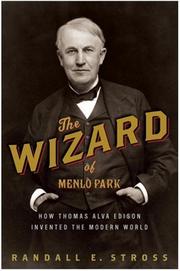
The Wizard of Menlo Park

The Wizard of Menlo Park

Randall E. Stross
2007
T3 384 pages · about 6h 24m to read Open Librarygoodreads

Edison as the first manufactured celebrity.

Summary

Stross argues that Edison's most consequential invention was his own celebrity. He documents how Edison, from the phonograph announcement in 1877 onward, cultivated newspaper reporters, announced inventions before they worked, and built a public identity as the wizard which he then converted into capital, credit and commercial advantage.

The reporting establishes a pattern. Edison would announce a breakthrough to the press, the announcement would move markets and attract investors, and he would then attempt to build the thing. The electric light announcement preceded a working lamp by more than a year and was made partly to depress gas company shares. Many of the announced inventions never worked. Stross covers the failures at length, including the iron ore separation venture that consumed years and most of Edison's fortune, the concrete house, the electric car battery, and the film business he lost control of.

Stross also examines the Menlo Park laboratory as an organisational innovation, an industrial research operation with a staff of specialists working on commercial problems, and argues this was a more durable contribution than most of the individual inventions. He is direct that Edison's technical judgement was often poor, particularly on direct current, and that his managerial performance was worse.

The book is a corrective to hagiography and is written from newspaper archives and the Edison papers. Readers wanting technical history of the inventions themselves should look elsewhere, since Stross's subject is the manufacture and management of reputation. Some reviewers have found the debunking framing insistent.

Key takeaways 7

  1. Edison's most valuable creation was his public identity, which he converted into investment capital, credit and commercial advantage repeatedly.
  2. He announced inventions to the press before they worked, and the announcements themselves moved markets and attracted the financing needed to build the thing.
  3. The Menlo Park laboratory was an organisational innovation, being the first industrial research operation staffed with specialists working on commercial problems.
  4. Most of Edison's ventures failed, and the iron ore separation project consumed years and most of his accumulated fortune.
  5. His technical judgement was frequently wrong, most consequentially on direct current, and his commitment to it cost him control of his own company.
  6. Edison's managerial performance was poor, and the businesses built on his inventions succeeded when others ran them.
  7. Sustained press attention functions as a financial asset for an inventor or founder, and Edison was the first person to manage it deliberately.

Who should read it

Founders and investors interested in how reputation is manufactured and converted into capital, and in the origin of the industrial research laboratory.

About Randall E. Stross

Business historian and journalist, longtime professor at San Jose State University; wrote reported histories of Edison, Microsoft, Google and Y Combinator.

Each book reports one organisation from inside over a defined stretch of time: a year among Y Combinator's batch companies, Benchmark's partners through the dot-com IPO wave, Edison's Menlo Park laboratory. The result records how venture firms and inventors actually spent their days, which reads as evidence rather than retrospective summary.

San Jose State University

Who recommended it 2 · 1 direct

“I've recently been reading Randall Stross's marvelous book about Thomas Edison, The Wizard of Menlo Park”

Similar books 6

Chosen by shared topics, the entries that hold them, and the people who recommended both.
Edmund Morris · 2019

Thomas Edison's life, told in reverse chronological order.

“on perhaps the greatest American builder of all, the builder who brought electricity to us all, Thomas Edison” — Marc Andreessen

Source: @pmarca, companion thread to 'It's Time to Build'

Recommended by: Marc Andreessen
Randall E. Stross · 1993

Contemporaneous account of the NeXT failure.

Recommended by: Mohnish Pabrai, Keith Rabois
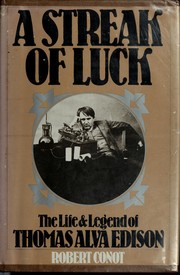
Robert Conot · 1979

Edison's life drawn from his papers, unsparing about his finances.
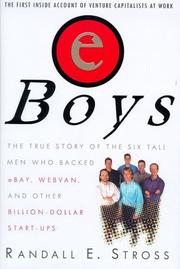
Randall E. Stross · 2000

Two years embedded inside Benchmark Capital.

Paul Israel · 1998

Edison's whole inventive career, set in its era and drawn from his archive.
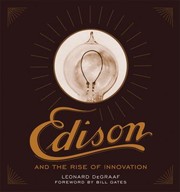
Leonard DeGraaf · 2013

Edison's laboratory as a business, with pictures from his archive.

Where it sits in the reference 2

Journalists
Biographies

Topics

Biography of ScientistsBiography and MemoirCompany HistoriesScientists, Doctors and Thinkers