Updates

  1. Person pages list letters, writing, profiles and links as sortable tables with filters, and show each person's companies as links; Fund letters show each letter's description in its own column.
  2. Experts show a checked job title and a short description of each person; 30 more people have photographs.
  3. Every company, fund, university and publication the experts work for has a page listing the people there.
  4. Fund letters show each letter's thesis and filter by it; 225 person pages list the essays, columns and newsletter issues the person wrote.
  5. Person pages list every essay and newsletter issue a person wrote, and their own books as a table in List view.
  6. Recommends shows the five largest kinds of book and the rest under More; browse pictures load sooner.
  7. Podcasts and talks link the original episode, filter by Audio and video or Press, and list each publisher once.
  8. Pages are wider, Recommends has List and Grid, and a filter clicked again turns off.
  9. Book cards sit in a ruled grid with Open Library and Goodreads links and each book's one-line note.
  10. Funds is now Investors; each investor's styles are buttons that filter the table.
  11. Podcasts and talks on a person's page filter by year and publisher and show as a list or a grid of pictures.
  12. Quotes show only people's own words: 472 summaries written by list sites are gone.
  13. Country pages open from Browse again, and every link on the shelf lands on a page.
  14. Subject and person pages show their sections as tabs, and each book appears once on a person's page.
  15. Book cards show the quote, who said it and the source; grids show five cards to a row.
  16. On a phone, a menu holds the sections, search, Updates, Feedback and dark mode.
  17. Feedback takes a screenshot of the page with no browser prompt, opens a screenshot full size when you click it, and clears itself once sent.
  18. Book cards are centred, search names the topic each book sits in, and any text cut short shows whole on hover.
  19. Search groups its results by kind: people, companies, geographies, subjects, topics, books, funds, fund letters and papers.
  20. The Books table lists who recommended each book by name, and the browser tab names the section you are in.
  21. Feedback can take a screenshot of the page, or one you paste or choose, and opens in the corner beside Updates.
  22. Each rail button reopens its section where you left it, and Browse, Table and People show on every book and subject page.
  23. Filters grey out choices that hold nothing instead of hiding them, and Books › People filters by authors or recommenders.
  24. Feedback takes a subject line and up to three screenshots.
  25. Biographies are grouped by the person they are about: 41 new pages, from Abraham Lincoln to Lee Kuan Yew.
  26. Sport splits into 23 sports, and Religion into one topic per faith.
  27. Book lists show as cards: the cover, one recommendation quote and every recommender by name.
  28. Seventeen subjects that had two or three pages under different names now have one page each.
  29. Every page lists its Experts as authors and recommenders, with a link to them on the Experts tab.
  30. Economics, Financial history, Financial panics and Accounting are subjects of their own, with one page per financial crisis.
  31. Book, person and subject pages open inside the app, so the tabs stay in view.
  32. 996 more book covers, and photographs or logos for 227 more people and companies.
  33. Books › Browse shows every subject as cards, and the rail holds Fund letters, Papers, Experts, Books and Funds.
  34. Every topic over 150 books splits into narrower topics, each with a page of its own.

Send feedback

What is it?
Screenshots, up to 3 (optional)
or paste one with Ctrl+V

We use your email only to reply to you.

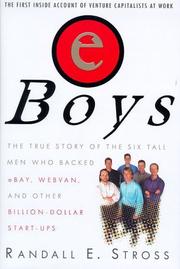
eBoys

eBoys

Randall E. Stross
2000
T3 327 pages · about 5h 27m to read Open Librarygoodreads

Two years embedded inside Benchmark Capital.

Summary

Stross was given access to Benchmark Capital during 1997 to 1999 and sat in on partner meetings, board meetings and negotiations. The result is a documented account of venture capital decision-making during the internet boom.

The firm's central investment was eBay, where Benchmark invested six and a half million dollars and the position became worth billions, one of the best returns in venture history. Stross covers the diligence, the decision, the recruitment of Meg Whitman as chief executive, and the initial public offering. He also covers investments that went badly, including Webvan, where Benchmark participated in one of the period's largest failures, and several others.

The value of the book is the process detail. Stross records the partner meetings where deals are argued, the way partners defer to whoever will take the board seat, the negotiation of terms, the pressure to move fast when a deal is competitive, the handling of a portfolio company that is failing, and the internal disagreements about whether valuations had detached from reality. He shows the partners knowing that prices were unsustainable and continuing to invest at them, which is the most useful observation in the book.

Benchmark's partners cooperated and the account is not adversarial, though Stross records enough of the failures that it is not promotional either. It stops in 1999, before the collapse, so the reader knows what the participants did not. The specific market conditions are entirely of that period.

Key takeaways 7

  1. Venture partnerships defer substantially to whichever partner will take the board seat, which means individual conviction rather than collective judgement drives most decisions.
  2. Competitive deals compress diligence to days, and the partners know this degrades the decision and proceed anyway.
  3. A single investment can return a fund many times over, which means the portfolio construction question is about not missing those rather than about avoiding losses.
  4. Recruiting the right chief executive into a portfolio company is frequently the venture investor's largest contribution, and Benchmark's recruitment of Whitman to eBay is the demonstration.
  5. Partners recognised that valuations had detached from any defensible basis and continued investing at them, because not investing meant not participating.
  6. Board involvement in a failing company consumes far more partner time than a successful one, which distorts how attention is allocated across a portfolio.
  7. Marketplace businesses with network effects were identifiable as structurally different from ordinary e-commerce at the time, and the firms that saw this earned the period's best returns.

Who should read it

Founders and venture investors who want a documented view of how partnership decisions actually get made under competitive pressure.

About Randall E. Stross

Business historian and journalist, longtime professor at San Jose State University; wrote reported histories of Edison, Microsoft, Google and Y Combinator.

Each book reports one organisation from inside over a defined stretch of time: a year among Y Combinator's batch companies, Benchmark's partners through the dot-com IPO wave, Edison's Menlo Park laboratory. The result records how venture firms and inventors actually spent their days, which reads as evidence rather than retrospective summary.

San Jose State University

Similar books 6

Chosen by shared topics, the entries that hold them, and the people who recommended both.
Adam Cohen · 2002

eBay: the cleanest early case of a pure marketplace take rate.

Recommended by: Ev Williams

Jason Calacanis · 2017

An angel investor's rules for picking, backing and helping early-stage startups.
Spencer E. Ante · 2008

Georges Doriot, who showed that investing in small, risky firms could pay.

Recommended by: Patrick Collison
William H. Janeway · 2012

Innovation as a game played by the state, capital markets and competition.

“He wrote this book, which I really recommend, it's called Doing Capitalism” — Marc Andreessen

Source: Dwarkesh Podcast — Marc Andreessen (transcript)

Recommended by: Marc Andreessen

Where it sits in the reference 4

Journalists
Companies
Industries
Assets

Topics

Entrepreneurship and StartupsInvestingCompany Histories