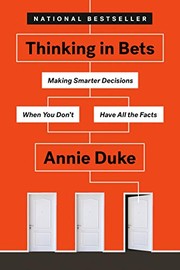
Thinking in Bets: Making Smarter Decisions When You Don't Have All the Facts
Judge decisions by their reasoning, not their outcomes, and think in odds.
Annie Duke's best insight is definitional: a good decision is not one that produced a good outcome. Poker forces this distinction because the feedback loop is fast and the randomness is visible. Most other domains let you confuse luck and skill for years.
Who recommended it 11 · 5 direct
“Professional poker player turned author Annie Duke writes about many similar situations in her book, Thinking in Bets.”
“Amazing point: Would your belief in something stand up to the question, “Wanna bet?” If you had to gamble significant money on that belief, would you still feel 100% about it? Or maybe more honestly 60%? This creates healthy skepticism encouraging you to seek the best information instead of just defending your belief. Now objective accuracy wins instead of argument. Combine with “The Biggest Bluff” by Maria Konnikova”
“And that brings me to the source of the inspiration for this memo: a book called Thinking in Bets: Making Smarter Decisions When You Don’t Have All the Facts by Annie Duke.”
“See Gigerenzer, Calculated Risks, 28-29. 14 For a book that treats this topic and more, see Annie Duke, Thinking in Bets: Making Smarter Decisions When You Don't Have All the Facts (New York: Portfolio/Penguin, 2018). 15 For a good discussion of Bayes’ Theorem, see Nate Silver, The Signal and the Noise: Why So Many Predictions Fail—But Some Don’t (New York, The Penguin Press, 2012), 232-261.”
Similar books 6
Chosen by shared topics, the entries that hold them, and the people who recommended both.
How fast, automatic thought and slow, deliberate thought shape judgment and error.
“…books I've recommended, highlighted to death, or forced on friends.” — Andrew Wilkinson
Source: Andrew Wilkinson's Bookshelf, neverenough.com
Recommended by: Andrew Wilkinson, Charles de Vaulx and 36 others

Why people mistake luck for skill, above all in markets.
“Fooled By Randomness was unquestionably the best non-fiction book I read in 2005.” — Brad Feld
Source: Book Review: Fooled By Randomness — Feld Thoughts
Recommended by: Barton Biggs, Brad Feld, Derek Sivers and 15 others
How people learned to measure risk, from early probability to portfolio theory.
“(Risk is the subject of Peter Bernstein’s wonderful new book, Against the Gods: The Remarkable Story of Risk.)” — Bill Miller
Source: 1996 Q3 Market Commentary
Recommended by: Bill Miller, Charles de Vaulx, Howard Marks and 9 others
What a four-year forecasting tournament showed about the best forecasters' habits.
“In a book many in our research department have enjoyed, Superforecasting: The Art and Science of Prediction, Philip Tetlock and Dan Gardner state: “The humility required for good judgment is not self-doubt—the sense that you are untalented, unintelligent, or unworthy.” — Bill Nygren
Source: Bill Nygren Market Commentary | 1Q17
Recommended by: Bill Nygren, Mark Leonard and 11 others
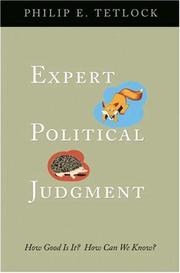
A 20-year test of 28,000 expert forecasts: foxes with many models beat hedgehogs.
“All pundits and commentators should publish their prediction track records, yet don't. What to pay attention to and what to ignore.” — Marc Andreessen
Source: @pmarca, 'Thread: Books I've recently read and recommend'
Recommended by: Marc Andreessen, Michael Mauboussin and 2 others
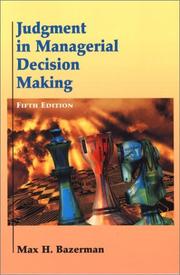
The biases that distort managers' decisions, with exercises that show them.
“Max Bazerman, Judgment in Managerial Decision Making, 4th ed. (New York: John Wiley & Son, 1998), 6-17” — Michael Mauboussin
Source: The Janitor’s Dream: Why Listening to Individuals Can be Hazardous to Your Wealth, page 3
Recommended by: Michael Mauboussin, Mohnish Pabrai and 1 other
Where it sits in the reference 5
Topics 1
As an Amazon Associate I earn from qualifying purchases.