Updates

  1. Person pages list letters, writing, profiles and links as sortable tables with filters, and show each person's companies as links; Fund letters show each letter's description in its own column.
  2. Experts show a checked job title and a short description of each person; 30 more people have photographs.
  3. Every company, fund, university and publication the experts work for has a page listing the people there.
  4. Fund letters show each letter's thesis and filter by it; 225 person pages list the essays, columns and newsletter issues the person wrote.
  5. Person pages list every essay and newsletter issue a person wrote, and their own books as a table in List view.
  6. Recommends shows the five largest kinds of book and the rest under More; browse pictures load sooner.
  7. Podcasts and talks link the original episode, filter by Audio and video or Press, and list each publisher once.
  8. Pages are wider, Recommends has List and Grid, and a filter clicked again turns off.
  9. Book cards sit in a ruled grid with Open Library and Goodreads links and each book's one-line note.
  10. Funds is now Investors; each investor's styles are buttons that filter the table.
  11. Podcasts and talks on a person's page filter by year and publisher and show as a list or a grid of pictures.
  12. Quotes show only people's own words: 472 summaries written by list sites are gone.
  13. Country pages open from Browse again, and every link on the shelf lands on a page.
  14. Subject and person pages show their sections as tabs, and each book appears once on a person's page.
  15. Book cards show the quote, who said it and the source; grids show five cards to a row.
  16. On a phone, a menu holds the sections, search, Updates, Feedback and dark mode.
  17. Feedback takes a screenshot of the page with no browser prompt, opens a screenshot full size when you click it, and clears itself once sent.
  18. Book cards are centred, search names the topic each book sits in, and any text cut short shows whole on hover.
  19. Search groups its results by kind: people, companies, geographies, subjects, topics, books, funds, fund letters and papers.
  20. The Books table lists who recommended each book by name, and the browser tab names the section you are in.
  21. Feedback can take a screenshot of the page, or one you paste or choose, and opens in the corner beside Updates.
  22. Each rail button reopens its section where you left it, and Browse, Table and People show on every book and subject page.
  23. Filters grey out choices that hold nothing instead of hiding them, and Books › People filters by authors or recommenders.
  24. Feedback takes a subject line and up to three screenshots.
  25. Biographies are grouped by the person they are about: 41 new pages, from Abraham Lincoln to Lee Kuan Yew.
  26. Sport splits into 23 sports, and Religion into one topic per faith.
  27. Book lists show as cards: the cover, one recommendation quote and every recommender by name.
  28. Seventeen subjects that had two or three pages under different names now have one page each.
  29. Every page lists its Experts as authors and recommenders, with a link to them on the Experts tab.
  30. Economics, Financial history, Financial panics and Accounting are subjects of their own, with one page per financial crisis.
  31. Book, person and subject pages open inside the app, so the tabs stay in view.
  32. 996 more book covers, and photographs or logos for 227 more people and companies.
  33. Books › Browse shows every subject as cards, and the rail holds Fund letters, Papers, Experts, Books and Funds.
  34. Every topic over 150 books splits into narrower topics, each with a page of its own.

Send feedback

What is it?
Screenshots, up to 3 (optional)
or paste one with Ctrl+V

We use your email only to reply to you.

Treasure Islands

Treasure Islands

Nicholas Shaxson
2011
T2 344 pages · about 5h 44m to read Open Librarygoodreads

The tax-haven system and Switzerland's founding role in it.

Summary

Shaxson, a journalist who had written on oil and Africa, wrote an account of offshore finance covering its history, its mechanisms and its effects.

His central structural argument concerns Britain. He describes what he calls the British spider's web: the City of London at the centre, surrounded by the Crown Dependencies of Jersey, Guernsey and the Isle of Man, and beyond them the Overseas Territories including the Cayman Islands, the British Virgin Islands and Bermuda. He argues these are not independent jurisdictions competing with London but a connected system that captures business which could not be conducted in London directly and channels it there, with British legal and political protection but without British disclosure requirements.

The historical material traces the origins to the 1950s eurodollar market, when the Bank of England permitted dollar business conducted in London to be treated as outside its jurisdiction, which created the template for regulatory escape. He then covers the American development of offshore centres, the role of Delaware and other American states, and the specific mechanisms: transfer pricing between subsidiaries of multinationals, trusts and their treatment of ownership, shell companies with nominee directors, and the secrecy that prevents any authority establishing who benefits.

He argues that the effects fall hardest on developing countries, whose resource revenues and tax bases leave through these structures, and that the standard defence, that offshore centres provide efficient capital allocation, does not survive examination of what the structures actually do.

The book is journalism and campaigns for a position. Its estimates of amounts involved are inherently uncertain and drawn from advocacy sources. The historical and structural analysis of the British network is well documented and has been supported by subsequent disclosures including the Panama and Paradise Papers, which came after publication.

Key takeaways 7

  1. The City of London sits at the centre of a connected network of Crown Dependencies and Overseas Territories rather than competing with them.
  2. The eurodollar market established the template for regulatory escape when the Bank of England treated dollar business in London as outside its jurisdiction.
  3. Offshore secrecy rather than low tax rates is the product these jurisdictions sell, because the rate can be matched but the anonymity cannot.
  4. Transfer pricing between subsidiaries lets multinationals locate profit in jurisdictions where no economic activity occurs.
  5. American states including Delaware provide corporate anonymity comparable to offshore jurisdictions.
  6. Developing countries lose resource revenues and tax base through these structures in amounts comparable to the aid they receive.
  7. Secrecy jurisdictions exist because larger states permit and protect them, so the remedy lies with those states rather than with the islands.

Who should read it

Investors, advisers and policy readers who want the structural account of how offshore finance is organised and who sustains it.

Similar books 6

Chosen by shared topics, the entries that hold them, and the people who recommended both.
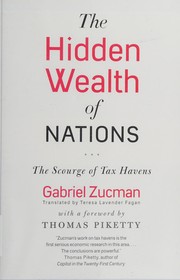
Gabriel Zucman · 2015

How much wealth is hidden in tax havens, and how to tax it.

Brooke Harrington · 2016

A sociologist trains as a wealth manager to show how fortunes are shielded offshore.

Bradley Birkenfeld · 2016

Insider: the UBS banker whose disclosure ended cross-border Swiss secrecy.

Jake Bernstein · 2017

How the offshore shell-company industry is actually built and sold.

Ronen Palan, Richard Murphy, Christian Chavagneux · 2010

The academic account of what havens do and how they compete.

Javier Blas, Jack Farchy · 2021

Glencore, Vitol, Trafigura and Cargill; the definitive book on the trading houses.

Where it sits in the reference 2

Geographies
Geographies

Topics

Finance and MarketsPolitics and GovernmentGlobalisation, development and offshore money