Updates

  1. Person pages list letters, writing, profiles and links as sortable tables with filters, and show each person's companies as links; Fund letters show each letter's description in its own column.
  2. Experts show a checked job title and a short description of each person; 30 more people have photographs.
  3. Every company, fund, university and publication the experts work for has a page listing the people there.
  4. Fund letters show each letter's thesis and filter by it; 225 person pages list the essays, columns and newsletter issues the person wrote.
  5. Person pages list every essay and newsletter issue a person wrote, and their own books as a table in List view.
  6. Recommends shows the five largest kinds of book and the rest under More; browse pictures load sooner.
  7. Podcasts and talks link the original episode, filter by Audio and video or Press, and list each publisher once.
  8. Pages are wider, Recommends has List and Grid, and a filter clicked again turns off.
  9. Book cards sit in a ruled grid with Open Library and Goodreads links and each book's one-line note.
  10. Funds is now Investors; each investor's styles are buttons that filter the table.
  11. Podcasts and talks on a person's page filter by year and publisher and show as a list or a grid of pictures.
  12. Quotes show only people's own words: 472 summaries written by list sites are gone.
  13. Country pages open from Browse again, and every link on the shelf lands on a page.
  14. Subject and person pages show their sections as tabs, and each book appears once on a person's page.
  15. Book cards show the quote, who said it and the source; grids show five cards to a row.
  16. On a phone, a menu holds the sections, search, Updates, Feedback and dark mode.
  17. Feedback takes a screenshot of the page with no browser prompt, opens a screenshot full size when you click it, and clears itself once sent.
  18. Book cards are centred, search names the topic each book sits in, and any text cut short shows whole on hover.
  19. Search groups its results by kind: people, companies, geographies, subjects, topics, books, funds, fund letters and papers.
  20. The Books table lists who recommended each book by name, and the browser tab names the section you are in.
  21. Feedback can take a screenshot of the page, or one you paste or choose, and opens in the corner beside Updates.
  22. Each rail button reopens its section where you left it, and Browse, Table and People show on every book and subject page.
  23. Filters grey out choices that hold nothing instead of hiding them, and Books › People filters by authors or recommenders.
  24. Feedback takes a subject line and up to three screenshots.
  25. Biographies are grouped by the person they are about: 41 new pages, from Abraham Lincoln to Lee Kuan Yew.
  26. Sport splits into 23 sports, and Religion into one topic per faith.
  27. Book lists show as cards: the cover, one recommendation quote and every recommender by name.
  28. Seventeen subjects that had two or three pages under different names now have one page each.
  29. Every page lists its Experts as authors and recommenders, with a link to them on the Experts tab.
  30. Economics, Financial history, Financial panics and Accounting are subjects of their own, with one page per financial crisis.
  31. Book, person and subject pages open inside the app, so the tabs stay in view.
  32. 996 more book covers, and photographs or logos for 227 more people and companies.
  33. Books › Browse shows every subject as cards, and the rail holds Fund letters, Papers, Experts, Books and Funds.
  34. Every topic over 150 books splits into narrower topics, each with a page of its own.

Send feedback

What is it?
Screenshots, up to 3 (optional)
or paste one with Ctrl+V

We use your email only to reply to you.

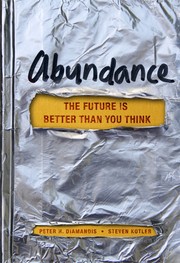
Abundance

Abundance

Peter Diamandis
2012
400 pages · about 6h 40m to read Open Librarygoodreads

Summary

Diamandis, who founded the XPRIZE Foundation, and Kotler argue that exponentially improving technologies will make the resources humans need cheap enough that scarcity ceases to be the organising economic problem. Their claim is that this is achievable within a few decades for the basic requirements of water, food, energy, healthcare, education and freedom.

The argument rests on several components. Exponential technologies including computing, networks, sensors, robotics, biotechnology, nanomaterials and artificial intelligence improve at rates that compound and that human intuition consistently underestimates. Scarcity is frequently a function of access and technology rather than of physical availability, which they illustrate with aluminium, once more precious than gold and now trivially cheap because electrolysis made extraction possible. Three additional forces contribute: what they call do-it-yourself innovators working with cheap tools, technophilanthropists directing large fortunes at specific problems, and the rising billion, meaning people entering the connected economy who represent both a market and a source of solutions.

They cover specific domains with the technologies they expect to solve each, including desalination and water purification, vertical farming and cultured meat, solar and storage, diagnostics and telemedicine, and online education.

The book is unrelentingly optimistic and gives limited weight to political economy, distribution or the possibility that technologies fail to arrive. Published in 2012, several of its specific predictions have not materialised on the stated timelines. The aluminium example and the argument that scarcity is often a technology problem are the durable contributions.

Key takeaways 8

  1. Scarcity is frequently a function of access and technology rather than of physical availability, which aluminium demonstrates historically.
  2. Exponentially improving technologies compound at rates that human intuition consistently underestimates.
  3. The basic requirements of water, food, energy, healthcare and education could be met cheaply enough that scarcity ceases to organise economic life.
  4. Cheap tools have allowed small groups to attempt problems that previously required governments or large corporations.
  5. Large individual fortunes directed at specific problems can fund work that neither markets nor governments will undertake.
  6. People entering the connected economy represent both a large new market and a source of solutions rather than only a demand on resources.
  7. Prize competitions can direct effort toward defined problems at a fraction of the cost of funding research directly.
  8. The book gives limited weight to distribution, political economy and the possibility that the technologies do not arrive on schedule.

Who should read it

Founders and investors in resource and deep technology sectors who want the optimistic framework, with its 2012 timelines checked against what happened.

Who recommended it 5 · 1 direct

Tim Ferrissreported

Similar books 6

Chosen by shared topics, the entries that hold them, and the people who recommended both.

Marcus Wohlsen · 2011

Recommended by: Balaji S. Srinivasan

Randall Munroe · 2019

Recommended by: Bill Gates

Kevin Kelly · 1994

How machines and economies grow so complex that they behave like living systems.

Where it sits in the reference 0

No entry holds this book yet. It reached the reference because someone recommended it.

Topics

Technology and ComputingScienceInvention, engineering and spaceTechnology and society