Updates

  1. Person pages list letters, writing, profiles and links as sortable tables with filters, and show each person's companies as links; Fund letters show each letter's description in its own column.
  2. Experts show a checked job title and a short description of each person; 30 more people have photographs.
  3. Every company, fund, university and publication the experts work for has a page listing the people there.
  4. Fund letters show each letter's thesis and filter by it; 225 person pages list the essays, columns and newsletter issues the person wrote.
  5. Person pages list every essay and newsletter issue a person wrote, and their own books as a table in List view.
  6. Recommends shows the five largest kinds of book and the rest under More; browse pictures load sooner.
  7. Podcasts and talks link the original episode, filter by Audio and video or Press, and list each publisher once.
  8. Pages are wider, Recommends has List and Grid, and a filter clicked again turns off.
  9. Book cards sit in a ruled grid with Open Library and Goodreads links and each book's one-line note.
  10. Funds is now Investors; each investor's styles are buttons that filter the table.
  11. Podcasts and talks on a person's page filter by year and publisher and show as a list or a grid of pictures.
  12. Quotes show only people's own words: 472 summaries written by list sites are gone.
  13. Country pages open from Browse again, and every link on the shelf lands on a page.
  14. Subject and person pages show their sections as tabs, and each book appears once on a person's page.
  15. Book cards show the quote, who said it and the source; grids show five cards to a row.
  16. On a phone, a menu holds the sections, search, Updates, Feedback and dark mode.
  17. Feedback takes a screenshot of the page with no browser prompt, opens a screenshot full size when you click it, and clears itself once sent.
  18. Book cards are centred, search names the topic each book sits in, and any text cut short shows whole on hover.
  19. Search groups its results by kind: people, companies, geographies, subjects, topics, books, funds, fund letters and papers.
  20. The Books table lists who recommended each book by name, and the browser tab names the section you are in.
  21. Feedback can take a screenshot of the page, or one you paste or choose, and opens in the corner beside Updates.
  22. Each rail button reopens its section where you left it, and Browse, Table and People show on every book and subject page.
  23. Filters grey out choices that hold nothing instead of hiding them, and Books › People filters by authors or recommenders.
  24. Feedback takes a subject line and up to three screenshots.
  25. Biographies are grouped by the person they are about: 41 new pages, from Abraham Lincoln to Lee Kuan Yew.
  26. Sport splits into 23 sports, and Religion into one topic per faith.
  27. Book lists show as cards: the cover, one recommendation quote and every recommender by name.
  28. Seventeen subjects that had two or three pages under different names now have one page each.
  29. Every page lists its Experts as authors and recommenders, with a link to them on the Experts tab.
  30. Economics, Financial history, Financial panics and Accounting are subjects of their own, with one page per financial crisis.
  31. Book, person and subject pages open inside the app, so the tabs stay in view.
  32. 996 more book covers, and photographs or logos for 227 more people and companies.
  33. Books › Browse shows every subject as cards, and the rail holds Fund letters, Papers, Experts, Books and Funds.
  34. Every topic over 150 books splits into narrower topics, each with a page of its own.

Send feedback

What is it?
Screenshots, up to 3 (optional)
or paste one with Ctrl+V

We use your email only to reply to you.

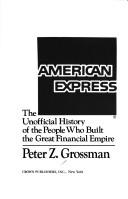
American Express: The Unofficial History of

American Express: The Unofficial History of the People Who Built the Great Financial Empire

Peter Z. Grossman
1987
T3 405 pages · about 6h 45m to read Open Librarygoodreads

The fullest narrative history, from freight forwarding to cards.

Summary

Grossman wrote an unauthorised history of American Express from its founding as an express freight company in 1850 through the conglomerate the firm had become by the mid-1980s.

The business story is one of repeated reinvention. American Express began moving parcels and valuables by rail, and when the express business faced competition and eventual nationalisation during the First World War, the company's travellers cheque business, launched in 1891, became its foundation. The travellers cheque is a remarkable product economically: the customer pays in advance, the company holds the float until the cheque is presented, and a portion is never presented at all. The charge card business launched in 1958 built on the same customer base and on the merchant relationships the travel business had created.

Grossman covers the salad oil swindle of 1963, in which a warehousing subsidiary's fraudulent receipts nearly destroyed the company and produced the situation Warren Buffett invested into; the acquisition programme of the 1980s under James Robinson, including Shearson, Lehman Brothers and Investors Diversified Services, which assembled a financial supermarket that was subsequently dismantled; and the internal politics of the period.

The reference has not verified the specific figures in this account. The book is from 1987 and ends before the Optima card losses, the Robinson departure and the Harvey Golub and Kenneth Chenault periods that made the modern company. It is useful for the float economics and the early history rather than as a current account.

Key takeaways 7

  1. The travellers cheque business generates revenue from float on customer money paid in advance and from cheques that are never presented at all.
  2. American Express reinvented itself repeatedly, moving from express freight to financial services as each business faced obsolescence or nationalisation.
  3. The charge card business was built on merchant relationships and an affluent customer base that the travel business had already created.
  4. The 1963 salad oil swindle nearly destroyed the company through a warehousing subsidiary whose fraudulent receipts created liabilities unrelated to the core businesses.
  5. The financial supermarket assembled through acquisitions in the 1980s did not produce the cross-selling benefits that justified it and was subsequently dismantled.
  6. A brand built on trust and affluence permits pricing that competitors offering identical functionality cannot match.
  7. The reference has not verified the specific figures in this unauthorised account.

Who should read it

Readers interested in float economics, charge card business models and a company that survived by repeatedly changing what it did.

Who recommended it 1 · 1 direct

Similar books 6

Chosen by shared topics, the entries that hold them, and the people who recommended both.

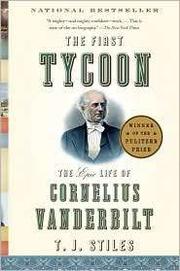
T. J. Stiles · 2009

Vanderbilt's rise through ferries, steamships and railroads.

Recommended by: Mohnish Pabrai

Ron Chernow · 1998

How Rockefeller built Standard Oil, faced its breakup and gave his fortune away.

“…books I've recommended, highlighted to death, or forced on friends.” — Andrew Wilkinson

Source: Andrew Wilkinson's Bookshelf, neverenough.com

Recommended by: Andrew Wilkinson, Charlie Munger and 12 others

Where it sits in the reference 2

Companies
Financial history

Topics

Company HistoriesFinancial History