Updates

  1. Person pages list letters, writing, profiles and links as sortable tables with filters, and show each person's companies as links; Fund letters show each letter's description in its own column.
  2. Experts show a checked job title and a short description of each person; 30 more people have photographs.
  3. Every company, fund, university and publication the experts work for has a page listing the people there.
  4. Fund letters show each letter's thesis and filter by it; 225 person pages list the essays, columns and newsletter issues the person wrote.
  5. Person pages list every essay and newsletter issue a person wrote, and their own books as a table in List view.
  6. Recommends shows the five largest kinds of book and the rest under More; browse pictures load sooner.
  7. Podcasts and talks link the original episode, filter by Audio and video or Press, and list each publisher once.
  8. Pages are wider, Recommends has List and Grid, and a filter clicked again turns off.
  9. Book cards sit in a ruled grid with Open Library and Goodreads links and each book's one-line note.
  10. Funds is now Investors; each investor's styles are buttons that filter the table.
  11. Podcasts and talks on a person's page filter by year and publisher and show as a list or a grid of pictures.
  12. Quotes show only people's own words: 472 summaries written by list sites are gone.
  13. Country pages open from Browse again, and every link on the shelf lands on a page.
  14. Subject and person pages show their sections as tabs, and each book appears once on a person's page.
  15. Book cards show the quote, who said it and the source; grids show five cards to a row.
  16. On a phone, a menu holds the sections, search, Updates, Feedback and dark mode.
  17. Feedback takes a screenshot of the page with no browser prompt, opens a screenshot full size when you click it, and clears itself once sent.
  18. Book cards are centred, search names the topic each book sits in, and any text cut short shows whole on hover.
  19. Search groups its results by kind: people, companies, geographies, subjects, topics, books, funds, fund letters and papers.
  20. The Books table lists who recommended each book by name, and the browser tab names the section you are in.
  21. Feedback can take a screenshot of the page, or one you paste or choose, and opens in the corner beside Updates.
  22. Each rail button reopens its section where you left it, and Browse, Table and People show on every book and subject page.
  23. Filters grey out choices that hold nothing instead of hiding them, and Books › People filters by authors or recommenders.
  24. Feedback takes a subject line and up to three screenshots.
  25. Biographies are grouped by the person they are about: 41 new pages, from Abraham Lincoln to Lee Kuan Yew.
  26. Sport splits into 23 sports, and Religion into one topic per faith.
  27. Book lists show as cards: the cover, one recommendation quote and every recommender by name.
  28. Seventeen subjects that had two or three pages under different names now have one page each.
  29. Every page lists its Experts as authors and recommenders, with a link to them on the Experts tab.
  30. Economics, Financial history, Financial panics and Accounting are subjects of their own, with one page per financial crisis.
  31. Book, person and subject pages open inside the app, so the tabs stay in view.
  32. 996 more book covers, and photographs or logos for 227 more people and companies.
  33. Books › Browse shows every subject as cards, and the rail holds Fund letters, Papers, Experts, Books and Funds.
  34. Every topic over 150 books splits into narrower topics, each with a page of its own.

Send feedback

What is it?
Screenshots, up to 3 (optional)
or paste one with Ctrl+V

We use your email only to reply to you.

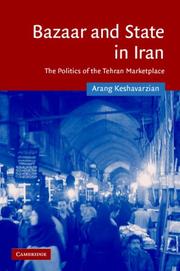
Bazaar and State in Iran: The Politics of th

Bazaar and State in Iran: The Politics of the Tehran Marketplace

Arang Keshavarzian
2003
T3 318 pages · about 5h 18m to read Open Librarygoodreads

How informal credit, trust networks and trade finance work when the banking system does not.

Summary

The reference has not verified this book in detail; the summary states only what the title, author and subject establish.

Keshavarzian, a political scientist, studied the Tehran bazaar and its relationship with the state, working from interviews with merchants and from archival research.

His argument challenges the standard account. The conventional view treats the bazaar as a traditional institution whose merchants are religiously conservative, politically oppositional and structurally unchanged, and which supported the 1979 revolution as a natural expression of that character. Keshavarzian argues that the bazaar is not a fixed traditional entity but a network whose structure has been reshaped by state policy in each period.

Under the Pahlavi state, he argues, policies including credit allocation, import licensing and the promotion of alternative distribution channels attempted to marginalise the bazaar, which produced cohesion among merchants and made collective political action possible. That cohesion, rather than any inherent religious conservatism, is what enabled bazaar participation in the revolutionary coalition. Under the Islamic Republic, by contrast, state policies of selective licensing, foundation involvement in trade and the allocation of foreign exchange fragmented the bazaar's networks by creating differentiated access, which reduced its capacity for collective action despite the regime's ideological alignment with it.

The methodological point is that the capacity of an economic group to act politically depends on the structure of its internal networks, and that state policy shapes that structure whether or not it intends to.

The book is academic political economy and assumes some familiarity with Iranian history. The reference has not verified every empirical claim. The general argument, that a commercial community's political capacity depends on network structure rather than on its members' beliefs, has application well beyond Iran.

Key takeaways 7

  1. The bazaar is a network whose structure has been reshaped by state policy rather than a fixed traditional institution.
  2. Pahlavi policies that attempted to marginalise the bazaar produced the cohesion that made collective political action possible.
  3. Bazaar participation in the 1979 revolution followed from network cohesion rather than from inherent religious conservatism.
  4. Islamic Republic policies fragmented the bazaar's networks by creating differentiated access to licences and foreign exchange.
  5. A regime ideologically aligned with a commercial group can reduce that group's political capacity more effectively than a hostile one.
  6. The political capacity of an economic group depends on the structure of its internal networks rather than on its members' beliefs.
  7. Selective allocation of state-controlled resources is an effective method of fragmenting a commercial community.

Who should read it

Analysts working on Iran or on state-business relations who want a structural account of how policy shapes a commercial community's political capacity.

Similar books 6

Chosen by shared topics, the entries that hold them, and the people who recommended both.

Jahangir Amuzegar · 1993

The earlier survey: nationalisation, war financing and the bonyad economy.

Suzanne Maloney · 2015

The standard survey: bonyads, IRGC commercial holdings, subsidies and sanctions.

Jahangir Amuzegar · 2014

Former finance minister on subsidies, privatisation and the rial.

Adam Hanieh · 2011

A class analysis of the Gulf states that rejects the standard rentier-state view.

Alan Richards, John Waterbury · 1990

Egypt is the anchor case throughout; the standard textbook on regional state-business relations.

Steffen Hertog, Giacomo Luciani, Marc Valeri · 2015

How business associations and state elites actually bargain across the region.

Where it sits in the reference 2

Geographies
Economics

Topics

Politics and GovernmentEconomicsSociology and CultureMiddle East and North AfricaGlobalisation and national societies