Updates

  1. Person pages list letters, writing, profiles and links as sortable tables with filters, and show each person's companies as links; Fund letters show each letter's description in its own column.
  2. Experts show a checked job title and a short description of each person; 30 more people have photographs.
  3. Every company, fund, university and publication the experts work for has a page listing the people there.
  4. Fund letters show each letter's thesis and filter by it; 225 person pages list the essays, columns and newsletter issues the person wrote.
  5. Person pages list every essay and newsletter issue a person wrote, and their own books as a table in List view.
  6. Recommends shows the five largest kinds of book and the rest under More; browse pictures load sooner.
  7. Podcasts and talks link the original episode, filter by Audio and video or Press, and list each publisher once.
  8. Pages are wider, Recommends has List and Grid, and a filter clicked again turns off.
  9. Book cards sit in a ruled grid with Open Library and Goodreads links and each book's one-line note.
  10. Funds is now Investors; each investor's styles are buttons that filter the table.
  11. Podcasts and talks on a person's page filter by year and publisher and show as a list or a grid of pictures.
  12. Quotes show only people's own words: 472 summaries written by list sites are gone.
  13. Country pages open from Browse again, and every link on the shelf lands on a page.
  14. Subject and person pages show their sections as tabs, and each book appears once on a person's page.
  15. Book cards show the quote, who said it and the source; grids show five cards to a row.
  16. On a phone, a menu holds the sections, search, Updates, Feedback and dark mode.
  17. Feedback takes a screenshot of the page with no browser prompt, opens a screenshot full size when you click it, and clears itself once sent.
  18. Book cards are centred, search names the topic each book sits in, and any text cut short shows whole on hover.
  19. Search groups its results by kind: people, companies, geographies, subjects, topics, books, funds, fund letters and papers.
  20. The Books table lists who recommended each book by name, and the browser tab names the section you are in.
  21. Feedback can take a screenshot of the page, or one you paste or choose, and opens in the corner beside Updates.
  22. Each rail button reopens its section where you left it, and Browse, Table and People show on every book and subject page.
  23. Filters grey out choices that hold nothing instead of hiding them, and Books › People filters by authors or recommenders.
  24. Feedback takes a subject line and up to three screenshots.
  25. Biographies are grouped by the person they are about: 41 new pages, from Abraham Lincoln to Lee Kuan Yew.
  26. Sport splits into 23 sports, and Religion into one topic per faith.
  27. Book lists show as cards: the cover, one recommendation quote and every recommender by name.
  28. Seventeen subjects that had two or three pages under different names now have one page each.
  29. Every page lists its Experts as authors and recommenders, with a link to them on the Experts tab.
  30. Economics, Financial history, Financial panics and Accounting are subjects of their own, with one page per financial crisis.
  31. Book, person and subject pages open inside the app, so the tabs stay in view.
  32. 996 more book covers, and photographs or logos for 227 more people and companies.
  33. Books › Browse shows every subject as cards, and the rail holds Fund letters, Papers, Experts, Books and Funds.
  34. Every topic over 150 books splits into narrower topics, each with a page of its own.

Send feedback

What is it?
Screenshots, up to 3 (optional)
or paste one with Ctrl+V

We use your email only to reply to you.

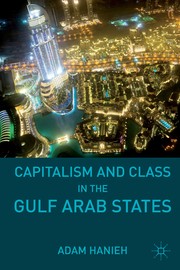
Capitalism and Class in the Gulf Arab States

Capitalism and Class in the Gulf Arab States

Adam Hanieh
2011
T2 268 pages · about 4h 28m to read Open Librarygoodreads

How Gulf merchant families became regional capital, and where they invest.

Summary

Hanieh applies a Marxist framework to the Gulf Cooperation Council states, arguing against the standard rentier-state analysis. The rentier account treats these states as distributing oil revenue to quiescent populations, with no significant capitalist class formation. Hanieh argues that this misses what has actually happened.

His central claim is that a capitalist class has formed across the Gulf, and that it is regional rather than national. He calls the resulting capital khaleeji capital, and argues that liberalisation of investment rules within the GCC allowed the largest family conglomerates and state-linked holding companies to accumulate assets across all six states simultaneously, in construction, real estate, retail, banking, telecommunications and logistics. This class therefore has an interest in regional integration and in the political arrangements that sustain it. He documents the leading business groups and their cross-border holdings.

His second claim concerns labour. Temporary migrant workers, mostly from South Asia, constitute the majority of the workforce in several Gulf states, hold no citizenship rights, and are tied to employers through the kafala sponsorship system. Hanieh argues that this arrangement is not incidental but constitutive: the class structure depends on a working class that can be imported and expelled according to demand and that cannot organise or claim political rights.

He also situates Gulf capital in the wider region, arguing that Gulf investment in Egypt, Jordan, Lebanon and Palestine shapes political outcomes there.

The framework is explicitly Marxist and readers who reject that apparatus will find the argument harder to use. The empirical documentation of cross-border business group holdings is valuable independent of the theory. The book predates the post-2014 oil price decline, the diversification programmes, the Qatar blockade and the subsequent restructuring of sovereign wealth deployment, all of which bear on the regional integration thesis.

Key takeaways 7

  1. A capitalist class has formed across the Gulf states that holds assets regionally rather than within single national markets.
  2. Liberalisation of investment rules within the Gulf Cooperation Council enabled large family and state-linked groups to accumulate across all six states.
  3. The rentier state framework understates class formation by treating oil revenue distribution as the whole of the political economy.
  4. Temporary migrant labour without citizenship rights is a structural component of Gulf capitalism rather than a policy choice that could easily change.
  5. The kafala sponsorship system ties workers to individual employers, which prevents labour market mobility and collective organisation.
  6. Gulf capital invested across the wider Arab region shapes economic policy in recipient countries.
  7. State-linked holding companies and ruling family business interests are not separable, which makes conventional public and private sector categories misleading.

Who should read it

Investors and analysts operating in Gulf markets who want a structural account of who owns what regionally and how the labour system underpins it.

Similar books 6

Chosen by shared topics, the entries that hold them, and the people who recommended both.
Adam Hanieh · 2018

How the Gulf states became central to the Middle East's political economy after 2011.
Kristian Coates Ulrichsen · 2016

Sovereign funds, diversification plans and the limits of the rentier bargain.
Arang Keshavarzian · 2003

How informal credit, trust networks and trade finance work when the banking system does not.
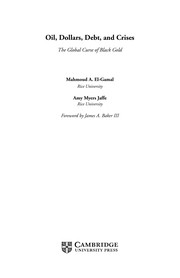
Mahmoud A. El-Gamal, Amy Myers Jaffe · 2009

Petrodollar recycling and the boom-bust cycle Gulf investors keep repeating.
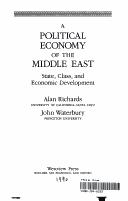
Alan Richards, John Waterbury · 1990

Egypt is the anchor case throughout; the standard textbook on regional state-business relations.
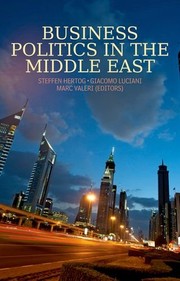
Steffen Hertog, Giacomo Luciani, Marc Valeri · 2015

How business associations and state elites actually bargain across the region.

Where it sits in the reference 3

Geographies
Geographies
Economics

Topics

EconomicsPolitics and GovernmentSociology and CultureMiddle East and North AfricaGlobalisation and national societies