Updates

  1. Person pages list letters, writing, profiles and links as sortable tables with filters, and show each person's companies as links; Fund letters show each letter's description in its own column.
  2. Experts show a checked job title and a short description of each person; 30 more people have photographs.
  3. Every company, fund, university and publication the experts work for has a page listing the people there.
  4. Fund letters show each letter's thesis and filter by it; 225 person pages list the essays, columns and newsletter issues the person wrote.
  5. Person pages list every essay and newsletter issue a person wrote, and their own books as a table in List view.
  6. Recommends shows the five largest kinds of book and the rest under More; browse pictures load sooner.
  7. Podcasts and talks link the original episode, filter by Audio and video or Press, and list each publisher once.
  8. Pages are wider, Recommends has List and Grid, and a filter clicked again turns off.
  9. Book cards sit in a ruled grid with Open Library and Goodreads links and each book's one-line note.
  10. Funds is now Investors; each investor's styles are buttons that filter the table.
  11. Podcasts and talks on a person's page filter by year and publisher and show as a list or a grid of pictures.
  12. Quotes show only people's own words: 472 summaries written by list sites are gone.
  13. Country pages open from Browse again, and every link on the shelf lands on a page.
  14. Subject and person pages show their sections as tabs, and each book appears once on a person's page.
  15. Book cards show the quote, who said it and the source; grids show five cards to a row.
  16. On a phone, a menu holds the sections, search, Updates, Feedback and dark mode.
  17. Feedback takes a screenshot of the page with no browser prompt, opens a screenshot full size when you click it, and clears itself once sent.
  18. Book cards are centred, search names the topic each book sits in, and any text cut short shows whole on hover.
  19. Search groups its results by kind: people, companies, geographies, subjects, topics, books, funds, fund letters and papers.
  20. The Books table lists who recommended each book by name, and the browser tab names the section you are in.
  21. Feedback can take a screenshot of the page, or one you paste or choose, and opens in the corner beside Updates.
  22. Each rail button reopens its section where you left it, and Browse, Table and People show on every book and subject page.
  23. Filters grey out choices that hold nothing instead of hiding them, and Books › People filters by authors or recommenders.
  24. Feedback takes a subject line and up to three screenshots.
  25. Biographies are grouped by the person they are about: 41 new pages, from Abraham Lincoln to Lee Kuan Yew.
  26. Sport splits into 23 sports, and Religion into one topic per faith.
  27. Book lists show as cards: the cover, one recommendation quote and every recommender by name.
  28. Seventeen subjects that had two or three pages under different names now have one page each.
  29. Every page lists its Experts as authors and recommenders, with a link to them on the Experts tab.
  30. Economics, Financial history, Financial panics and Accounting are subjects of their own, with one page per financial crisis.
  31. Book, person and subject pages open inside the app, so the tabs stay in view.
  32. 996 more book covers, and photographs or logos for 227 more people and companies.
  33. Books › Browse shows every subject as cards, and the rail holds Fund letters, Papers, Experts, Books and Funds.
  34. Every topic over 150 books splits into narrower topics, each with a page of its own.

Send feedback

What is it?
Screenshots, up to 3 (optional)
or paste one with Ctrl+V

We use your email only to reply to you.

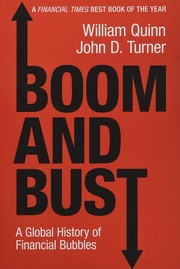
Boom and Bust

Boom and Bust

William Quinn, John D. Turner
2020
T2 296 pages · about 4h 56m to read Open Librarygoodreads

A comparative bubble triangle: marketability, money and speculation.

Summary

Quinn and Turner, both financial historians at Queen's University Belfast, examined bubbles across three centuries and proposed a framework for understanding when they occur.

Their framework is the bubble triangle, drawn from the fire triangle. Three conditions must be present. Marketability means the ease with which an asset can be bought and sold, which includes the existence of exchanges, low denominations, the removal of transfer restrictions and the availability of the asset to new buyers. Money and credit means abundant capital seeking returns and, particularly, the availability of borrowing to buy the asset. Speculation means a substantial number of participants buying to resell rather than to hold. All three must be present, and then a spark ignites them, which the authors identify as either technological innovation or government policy.

The case studies run from the South Sea and Mississippi episodes of 1720, through the British railway mania of the 1840s, the Australian land boom, the 1920s American market, the Japanese bubble, the dot-com episode, the subprime housing bubble, and the Chinese equity episodes of 2007 and 2015. In each they identify the three components and the spark, and they document how marketability was increased in each case, frequently by a deliberate change in rules.

Their most useful analytical contribution is on consequences. They argue that bubbles differ substantially in their aftermath, and that the damage depends on whether the asset was bought with borrowed money and on whether banks were exposed. Bubbles in assets bought with equity, including the dot-com episode, produced comparatively little economic damage; bubbles financed by bank credit, including the housing bubbles, produced severe damage.

They also argue that some bubbles are socially useful, since the railway mania left a railway network and the technology bubbles left infrastructure.

The framework is descriptive rather than predictive, since the three conditions are frequently present without a bubble following. The historical work is solid and the leverage distinction is the practically important finding.

Key takeaways 7

  1. A bubble requires marketability, abundant money and credit, and speculation, and all three must be present together.
  2. Marketability is usually increased by a deliberate change in rules shortly before a bubble, which makes it an observable warning.
  3. The spark that ignites a bubble is either technological innovation or a government policy decision.
  4. The economic damage from a bubble depends on whether the asset was bought with borrowed money, not on the size of the price move.
  5. Bubbles financed by equity, including the dot-com episode, produced far less economic damage than those financed by bank credit.
  6. Bank exposure to the bubble asset is the mechanism that converts a price collapse into an economic contraction.
  7. Some bubbles leave useful infrastructure behind, so their net social effect is not always negative.

Who should read it

Investors and policymakers who want a testable framework for identifying bubble conditions and for judging which ones will cause real economic damage.

Similar books 6

Chosen by shared topics, the entries that hold them, and the people who recommended both.

Charles P. Kindleberger · 1996

Financial crises follow a repeated sequence of boom, mania, panic and crash.

Recommended by: Howard Marks, Li Lu
John Kenneth Galbraith · 1990

The recurring features of speculative booms, and why short memories bring them back.

Recommended by: Howard Marks and 2 others
Ray Dalio · 2018

A template for how big debt crises unfold, with detailed case studies.

Lars Tvede · 1997

The history of business cycle theory and how credit cycles drive asset prices.
Gregory Makoff · 2024

Argentina's 2001 default and the fifteen years of lawsuits and talks that followed.

Edward Chancellor · 1999

Speculation from ancient Rome and tulip mania to the 1990s, and its recurring traits.

Where it sits in the reference 1

Financial panics

Topics

Financial HistoryFinance and Markets