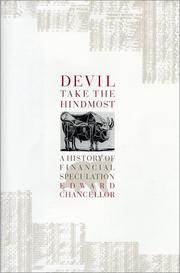
Devil Take the Hindmost: A History of Financial Speculation
Summary
Chancellor writes a history of financial speculation from ancient Rome through the 1990s, and argues that speculation is a recurring feature with consistent characteristics rather than a series of unrelated episodes.
The coverage includes Roman speculation in the publicani companies, tulip mania with the historical qualifications Mackay omits, the South Sea Bubble and the parallel Mississippi Scheme, the railway manias of the 1830s and 1840s in Britain, the American speculative episodes of the nineteenth century including the Erie war and the corners, the 1920s and the crash, the conglomerate and go-go periods, the 1980s Japanese bubble, and the derivatives and technology developments of the 1990s.
Chancellor's analytical contribution is the identification of consistent elements: a technological or financial innovation supplying the story, credit expansion supplying the fuel, the entry of inexperienced participants at the late stage, the appearance of fraudulent imitators, and the political and legal responses that follow each collapse and are then dismantled during the next expansion. His treatment of the Japanese bubble is unusually detailed and covers the specific mechanisms including cross-shareholdings, land as collateral and the zaitech financial engineering practised by industrial companies.
The book is scholarly and heavily sourced, which makes it more reliable than Mackay and denser to read. It ends in 1999 and therefore predates the dot-com peak, the housing bubble and everything since. Chancellor writes as a historian rather than as a practitioner, so there is no advice for positioning. Its value is the accumulation of cases, which makes the pattern harder to dismiss than any single episode does.
Key takeaways 8
- Speculative episodes recur across four centuries with consistent structural features rather than as unrelated events.
- Each episode requires a story, usually supplied by a technological or financial innovation that appears to justify new valuations.
- Credit expansion is the necessary fuel, and no episode has occurred without it regardless of how compelling the story was.
- Inexperienced participants enter at the late stage, which is when the transfer of losses from insiders to outsiders occurs.
- Fraudulent imitators appear reliably during the late phase, which is one of the few observable signals of position within the cycle.
- Political and legal responses follow each collapse and are dismantled during the following expansion, which is why the same failures recur.
- The Japanese bubble was amplified by cross-shareholdings and by the use of land as collateral, which converted asset price rises into further lending capacity.
- Industrial companies engaging in financial speculation alongside their operations is a recurring late-cycle feature across multiple episodes.
Who should read it
Investors who want a scholarly and well-sourced history of speculation rather than the unreliable popular accounts.
About Edward Chancellor
Financial historian and investment strategist; formerly Lazard Brothers, GMO and Breakingviews; columnist, Reuters Breakingviews
Devil Take the Hindmost remains the standard history of speculative bubbles, and The Price of Time did the same job for interest rates.
Who recommended it 3 · 3 direct
Similar books 6
Chosen by shared topics, the entries that hold them, and the people who recommended both.
Financial crises follow a repeated sequence of boom, mania, panic and crash.
Recommended by: Howard Marks, Li Lu
Crowd manias from the Mississippi scheme and South Sea Bubble to witch trials.
“The first couple of chapters of this book, which describes in detail the great financial and stock market manias of the eighteenth century, are essential reading for all serious investors.” — Barton Biggs
Source: Biggs on the first chapters as essential reading
Recommended by: Barton Biggs, Bernard Baruch, Peter Cundill and 2 others
The recurring features of speculative booms, and why short memories bring them back.
Recommended by: Howard Marks and 2 others

The history of business cycle theory and how credit cycles drive asset prices.

Why mass movements of every kind draw the same frustrated people and use one method.
“My favourite book to recommend is The True Believer: Thoughts on the Nature of Mass Movements by Eric Hoffer. There is no discussion about investing, but it is extremely helpful in understanding…” — Joe Rosenberg
Source: Rosenberg on the book he most often recommends
Recommended by: Joe Rosenberg, Mohnish Pabrai and 6 others

How individuals lose judgement in a crowd and how leaders sway crowds.
“The Crowd, written in 1895 by Gustave Le Bon, is probably the most instrumental book in framing my ability to go against the grain of conventional thought and not feel insecure.” — Frank Martin
Source: Martin on the book that let him go against conventional thought
Recommended by: Frank Martin, Mohnish Pabrai, Peter Cundill and 1 other
Where it sits in the reference 4
Topics