
The Crowd: A Study of the Popular Mind
The founding study of crowd psychology behind every mania
Summary
Le Bon published this in 1895 as an analysis of how individuals behave differently when part of a crowd, and it became one of the founding texts of social psychology despite its methodological failings.
His central claim is that a crowd possesses characteristics different from those of its members, that individuals in a crowd lose their sense of individual responsibility, become suggestible, and act on emotion rather than reasoning. He identifies three mechanisms: anonymity, which removes personal responsibility; contagion, by which behaviour and emotion spread through the group; and suggestibility, which he compares to a hypnotic state.
His account of how crowds are led is the material that has had the most consequence. He argues that a leader must use assertion without proof, repetition, and contagion; that reasoning has no effect on a crowd while images and simple slogans do; that a crowd requires certainty and rejects nuance; and that prestige, whether personal or acquired, is what makes a leader accepted. The book was read by Mussolini, Hitler and Goebbels, and its influence on twentieth-century propaganda is documented rather than inferred.
The methodology is nonexistent. Le Bon generalises from observation, the class and racial assumptions are of their period and are offensive, and modern crowd research contradicts many of his claims, particularly the loss of individual rationality and the depiction of crowds as inherently irrational. Reicher and others have shown that crowds behave according to shared social identity rather than losing identity. Read it as a historically consequential document rather than as psychology.
Key takeaways 8
- Individuals in a crowd behave differently than they would alone, which Le Bon attributes to anonymity, contagion and suggestibility.
- Anonymity within a group removes the sense of individual responsibility that constrains behaviour.
- Crowds respond to images, assertions and repetition rather than to reasoning or evidence.
- A crowd requires certainty and rejects qualification, which is why leaders who express doubt lose them.
- Assertion without proof, repeated frequently, is the mechanism by which a claim becomes accepted by a group.
- Prestige, whether personal or acquired through position, is what makes a leader accepted rather than the content of what they say.
- The book was read by twentieth-century propagandists and its influence on their methods is documented rather than inferred.
- Modern crowd research contradicts the central claim that individuals lose rationality, showing instead that crowds act on shared social identity.
Who should read it
Readers interested in the historical foundation of crowd psychology and propaganda technique, treated as a document rather than as science.
Who recommended it 4 · 3 direct
“The Crowd, written in 1895 by Gustave Le Bon, is probably the most instrumental book in framing my ability to go against the grain of conventional thought and not feel insecure.”
“There are a few books - really not that many which I believe are indispensable reading for every serious investor in whatever facet of investment practice they may favour - The Crowd: A Study of the…”
Similar books 6
Chosen by shared topics, the entries that hold them, and the people who recommended both.

Why mass movements of every kind draw the same frustrated people and use one method.
“My favourite book to recommend is The True Believer: Thoughts on the Nature of Mass Movements by Eric Hoffer. There is no discussion about investing, but it is extremely helpful in understanding…” — Joe Rosenberg
Source: Rosenberg on the book he most often recommends
Recommended by: Joe Rosenberg, Mohnish Pabrai and 6 others

Preference falsification: why people hide their views and how that hides change.
“So this is one of the all time great books. Incredible.” — Marc Andreessen
Source: Lex Fridman Podcast #458 transcript — Marc Andreessen
Recommended by: Marc Andreessen
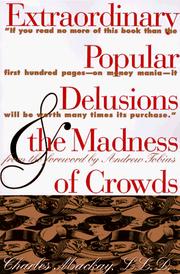
Crowd manias from the Mississippi scheme and South Sea Bubble to witch trials.
“The first couple of chapters of this book, which describes in detail the great financial and stock market manias of the eighteenth century, are essential reading for all serious investors.” — Barton Biggs
Source: Biggs on the first chapters as essential reading
Recommended by: Barton Biggs, Bernard Baruch, Peter Cundill and 2 others

Common knowledge, where everyone knows that everyone knows, and what it does.
Recommended by: Bill Gates

Speculation from ancient Rome and tulip mania to the 1990s, and its recurring traits.
Recommended by: Howard Marks, Mohnish Pabrai and 1 other

Techniques for handling people, being liked and winning others to your view.
Recommended by: Mohnish Pabrai, Alex and Books and 13 others
Where it sits in the reference 2
Topics