
Private Truths, Public Lies
Preference falsification: why opinion cascades and regimes collapse suddenly
Summary
Kuran, an economist, analyses preference falsification, meaning the misrepresentation of one's own preferences under perceived social pressure, and shows what follows when it is widespread.
His central mechanism is that each person's willingness to state a private view depends on how many others they believe hold it, so public opinion is a function of what people believe public opinion to be. This produces stable equilibria that can be very far from the distribution of private views, and it makes those equilibria fragile: if enough people reveal their true position at once, the threshold for others falls, and opinion can shift completely in a short period without any change in underlying beliefs.
His principal application is the collapse of communist regimes in 1989, which almost nobody predicted. Kuran argues the failure of prediction was structural rather than a matter of insufficient information: the regimes' apparent stability rested on preference falsification, the true distribution of private views was unobservable by construction, and therefore the collapse was genuinely unforecastable.
He applies the framework to affirmative action, to caste in India, to religious observance, and to what he calls the corruption of public discourse, arguing that widespread falsification distorts collective knowledge because the arguments that would change minds are never made.
The book is analytically rigorous and the model is precisely specified. Its limitation is that preference falsification is unmeasurable by definition, which makes the theory difficult to test and easy to invoke after the fact for any unexpected change.
Key takeaways 7
- People misrepresent their preferences under perceived social pressure, and each person's willingness to speak depends on how many others they believe agree.
- Public opinion is a function of what people believe public opinion to be, which produces stable equilibria far from the actual distribution of private views.
- Such equilibria are fragile, since enough simultaneous revelation lowers the threshold for everyone and opinion can shift completely without any change in beliefs.
- The 1989 collapse of communist regimes was structurally unforecastable, because the information required to predict it was unobservable by construction.
- Widespread preference falsification corrupts collective knowledge, because the arguments that would change minds are never made publicly.
- Policies sustained by falsified support persist long after private support has disappeared and then collapse suddenly.
- Preference falsification is unmeasurable by definition, which is the theory's central limitation and makes it easy to invoke after the fact.
Who should read it
Investors and analysts assessing the stability of arrangements sustained by apparent consensus, and anyone reasoning about sudden opinion shifts.
Who recommended it 1 · 1 direct
“So this is one of the all time great books. Incredible.”
Similar books 6
Chosen by shared topics, the entries that hold them, and the people who recommended both.
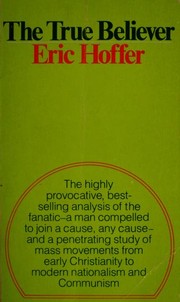
Why mass movements of every kind draw the same frustrated people and use one method.
“My favourite book to recommend is The True Believer: Thoughts on the Nature of Mass Movements by Eric Hoffer. There is no discussion about investing, but it is extremely helpful in understanding…” — Joe Rosenberg
Source: Rosenberg on the book he most often recommends
Recommended by: Joe Rosenberg, Mohnish Pabrai and 6 others

How individuals lose judgement in a crowd and how leaders sway crowds.
“The Crowd, written in 1895 by Gustave Le Bon, is probably the most instrumental book in framing my ability to go against the grain of conventional thought and not feel insecure.” — Frank Martin
Source: Martin on the book that let him go against conventional thought
Recommended by: Frank Martin, Mohnish Pabrai, Peter Cundill and 1 other
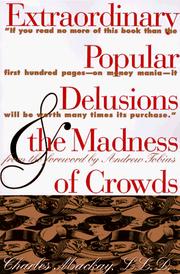
Crowd manias from the Mississippi scheme and South Sea Bubble to witch trials.
“The first couple of chapters of this book, which describes in detail the great financial and stock market manias of the eighteenth century, are essential reading for all serious investors.” — Barton Biggs
Source: Biggs on the first chapters as essential reading
Recommended by: Barton Biggs, Bernard Baruch, Peter Cundill and 2 others

Common knowledge, where everyone knows that everyone knows, and what it does.
Recommended by: Bill Gates

Speculation from ancient Rome and tulip mania to the 1990s, and its recurring traits.
Recommended by: Howard Marks, Mohnish Pabrai and 1 other

Financial crises follow a repeated sequence of boom, mania, panic and crash.
Recommended by: Howard Marks, Li Lu
Where it sits in the reference 2
Topics