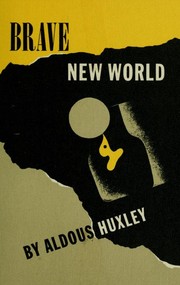
Brave New World
A novel of a future world where people are bred in hatcheries into contented castes.
Summary
Huxley's 1932 novel is set in a world state six hundred years in the future where humans are produced in hatcheries, conditioned from infancy into five castes, and maintained in contentment through consumption, casual sex and a drug called soma. Stability is the state's supreme value, and it has been achieved by removing the conditions that produce discontent, including family, religion, art, science conducted freely, and any experience of difficulty.
The central argument is that control is achieved more completely through pleasure than through fear. Citizens are not coerced, they are conditioned to want what they receive, which removes any basis for objection. Bernard Marx and Helmholtz Watson are dissatisfied but cannot articulate why, and John, raised outside the system on a reservation, provides the position from which the arrangement can be criticised.
The confrontation between John and Mustapha Mond, the Controller, states the argument directly. Mond concedes that the society has removed art, science and religion, and argues that these were the price of stability and that the trade was worth making. John claims the right to be unhappy, which Mond grants him.
Postman's contrast between Huxley and Orwell, that Orwell feared what would be forbidden while Huxley feared what would be given, is the standard framing. The biology of the hatchery is dated and the caste system is drawn from 1930s eugenic thinking that Huxley later revised. The satire of consumer conditioning has become more accurate rather than less, and the argument that engineered contentment removes any basis for objection is the enduring one.
Key takeaways 8
- Control achieved through pleasure is more complete than control achieved through fear, since a satisfied population has no basis for objection.
- Conditioning people to want what they receive removes the gap between desire and circumstance that would otherwise produce discontent.
- Stability requires the removal of art, science conducted freely and religion, which the state's Controller concedes explicitly as a deliberate trade.
- Consumption is engineered as a social obligation rather than a preference, which sustains the economy and occupies attention.
- A drug that removes distress without impairing function eliminates the last route by which dissatisfaction would surface.
- Family and lasting attachment are abolished because they produce the intense feeling that destabilises the arrangement.
- The right to be unhappy is what John claims and what the society has removed, which is the novel's statement of the cost.
- Huxley's fear was that people would be given what pacifies them rather than denied what they need, which is the contrast with Orwell.
Who should read it
Readers thinking about engineered contentment, consumer conditioning and control exercised through satisfaction rather than through coercion.
Who recommended it 5 · 3 direct
“But alongside Orwell's dark vision, there was this other slightly older and less well known but equally chilling vision of Huxley's Brave New World.”
Similar books 6
Chosen by shared topics, the entries that hold them, and the people who recommended both.
A novel of a clerk who rewrites history under a totalitarian state that watches all.
Recommended by: David Perell, Richard Branson and 7 others
A novel: a mathematician foresees an empire's fall and plans to shorten the dark age.
Recommended by: Balaji S. Srinivasan, Matt Mullenweg and 11 others
A satire in which animals stage a revolution that ends in power and corruption.
“My first step toward understanding the workings of the various economic systems came in junior high school in the late 1950s, when I read George Orwell’s Animal Farm.” — Howard Marks
Source: Shall We Repeal the Laws of Economics?
Recommended by: David Perell, Howard Marks, Sahil Lavingia and 2 others
A novel setting Anna's ruinous affair against Levin's search for how to live.
Recommended by: Nat Eliason, Austen Allred, Laura R Walker and 5 others

A sailor jailed for treason he did not commit escapes and takes his revenge.
“In Alexandre Dumas’ famous novel, The Count of Monte Cristo, the author states that the expression that defines him is cupitor impossibilium.” — Francois Rochon
Source: Giverny Capital Annual Letter to Partners 2019, page 4
Recommended by: Francois Rochon, Patrick Collison and 2 others
A self-styled 'judge-penitent' confesses his life to a stranger in Amsterdam.
Recommended by: Sam Altman