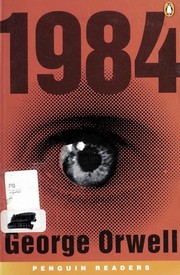
1984
A novel of a clerk who rewrites history under a totalitarian state that watches all.
Summary
Orwell's 1949 novel is set in Oceania, a totalitarian state at permanent war, where Winston Smith works at the Ministry of Truth revising historical records to match current policy. The Party maintains control through continuous surveillance by telescreens, the reconstruction of the past, the Thought Police, and Newspeak, a language engineered so that unorthodox thought becomes impossible to formulate.
The political mechanisms are the book's substance. Doublethink is the capacity to hold two contradictory beliefs simultaneously and accept both, which the Party requires because its claims change and its members must not notice. The mutability of the past means that history is continuously rewritten and no evidence of any previous version survives. The perpetual war exists to consume production and keep the population poor, since general prosperity would end hierarchy.
The Goldstein book within the novel states the theory directly, arguing that all hierarchical societies use the same mechanisms and that the Party's innovation was recognising that power is the object rather than a means to anything. O'Brien's interrogation of Winston makes the final argument, that the Party seeks power for its own sake, that it will remake reality itself, and that the objective is not obedience but genuine belief.
The novel has been used to describe almost every political arrangement, which has diluted its terms considerably. Orwell wrote against Stalinism specifically, and readers applying it to commercial surveillance should note that the mechanisms differ substantially. Its relevance to technology is in the treatment of surveillance normalised through convenience, of language shaping the range of expressible thought, and of records that can be silently revised.
Key takeaways 8
- Control of the record of the past determines what can be argued in the present, because a claim contradicted by no surviving evidence cannot be challenged.
- A language can be engineered to make certain thoughts difficult to formulate, which removes the need to suppress them directly.
- Doublethink means holding contradictory beliefs simultaneously and accepting both, which is required of anyone serving an authority whose claims change.
- Perpetual war consumes production and maintains scarcity, since general prosperity would undermine the hierarchy the state exists to preserve.
- Surveillance works through uncertainty about when it is active rather than through continuous observation, since the possibility is sufficient.
- The Party seeks power as an end rather than as a means, which O'Brien states directly and which distinguishes it from ordinary tyranny.
- The objective of coercion is genuine belief rather than obedience, because an obedient person who privately disagrees remains a threat.
- Orwell wrote against Stalinism specifically, and applying the mechanisms to commercial surveillance requires noting where they differ.
Who should read it
Readers thinking about surveillance, language and records, with the recognition that the political mechanisms differ from the commercial ones they are often used to describe.
Who recommended it 6 · 1 direct
Similar books 6
Chosen by shared topics, the entries that hold them, and the people who recommended both.
A novel of a future world where people are bred in hatcheries into contented castes.
“But alongside Orwell's dark vision, there was this other slightly older and less well known but equally chilling vision of Huxley's Brave New World.” — Tristan Harris
Source: The Tim Ferriss Show Transcripts: Tristan Harris — Fighting Skynet and Firewalling Attention (#387)
Recommended by: Matt Mullenweg, Stewart Brand and 3 others
A satire in which animals stage a revolution that ends in power and corruption.
“My first step toward understanding the workings of the various economic systems came in junior high school in the late 1950s, when I read George Orwell’s Animal Farm.” — Howard Marks
Source: Shall We Repeal the Laws of Economics?
Recommended by: Howard Marks, Sahil Lavingia, Sophie Bakalar and 1 other

Short stories, among them the celebrated title story.
Recommended by: Sophie Bakalar
Huck Finn tells of his journey along the Mississippi River in the American South.
Recommended by: Mohnish Pabrai, Richard Branson

A satirical novel of the Second World War that moves from hilarity to horror.
Recommended by: Sophie Bakalar
The education of the orphan Pip and his great expectations.
Recommended by: Richard Branson