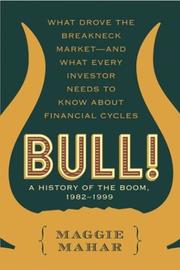
Bull! A History of the Boom, 1982-1999
The US bull market from August 1982 to its 1999 peak, and what changed in it.
The seventeen-year bull market as one continuous argument.
Summary
Mahar, a financial journalist, wrote a history of the American bull market from its August 1982 beginning to the peak, working from contemporaneous sources and from interviews.
The narrative traces the changes that produced the market and the beliefs that sustained it. She covers the shift from defined benefit to defined contribution retirement plans, which put tens of millions of people into equities through payroll deduction and created a continuous flow of buying that was insensitive to price. She covers the growth of mutual funds and the marketing that accompanied it, the emergence of financial media as entertainment, the analysts whose compensation depended on investment banking, and the arrival of discount brokerage and then online trading.
The intellectual history is the more interesting part. Mahar traces the beliefs that became consensus: that stocks always outperform over the long run and therefore that time removes risk, which she shows rests on a misreading of the historical record; that price to earnings ratios could permanently reoccupy a higher range because of low inflation and improved productivity; that a new economy had changed the rules; and that any decline was a buying opportunity. She documents the small number of professionals who dissented and what happened to their careers and their assets under management.
Her general argument is that the bull market changed the way Americans understood investing, converting it from something done by professionals for the wealthy into a mass activity, and that the beliefs required to sustain participation were manufactured rather than discovered.
The book was published in 2003 after the collapse and is written with the outcome known, which shapes the selection. It is a history rather than an analysis and does not engage with the finance literature on valuation. The account of how professional dissent was punished by client withdrawals is the most useful part for practitioners.
Key takeaways 7
- The shift to defined contribution retirement plans created continuous equity buying insensitive to price.
- Belief that time removes equity risk rests on a misreading of the historical record and became consensus during this period.
- Financial media developed as entertainment, which changed what information reached investors and how it was framed.
- Analysts' compensation depended on investment banking revenue, which determined what their research said.
- Professionals who dissented from the consensus lost clients and assets, which is why dissent was rare rather than because it was absent.
- The belief that valuation multiples could permanently occupy a higher range was constructed to justify prices already reached.
- Investing became a mass activity during this period, and the beliefs required to sustain mass participation were manufactured.
Who should read it
Investors who want the documented history of how a market's supporting beliefs are constructed and what happens to professionals who dissent.
Who recommended it 2 · 1 direct
“A 2003 book that investors can learn much from is Bull! by Maggie Mahar.”
Similar books 6
Chosen by shared topics, the entries that hold them, and the people who recommended both.

How psychology, not fundamentals, drove the stock and housing booms of 2000 and 2005.
“In Irrational Exuberance he takes the reader on a scholarly tour of the excesses of the millennial capital markets.” — William J. Bernstein
Source: Efficient Frontier, issue 700 (2000)
Recommended by: Mohnish Pabrai, William J. Bernstein and 2 others

The case, made at the peak, that internet stock prices could not last.
Why long good times erode the memory of losses and set up the reversal.
“Market," and "The Trouble with Prosperity." If you ever have the opportunity to hear this man speak, you should avail yourself.” — William J. Bernstein
Source: Efficient Frontier, issue 401 (2001)
Recommended by: Mohnish Pabrai, William J. Bernstein and 1 other
The study that first showed stocks beat bonds over long periods.
“Edgar Lawrence Smith, Common Stocks as Long Term Investments (New York: The Macmillan Company, 1924)” — Michael Mauboussin
Source: Competitive Advantage Period: The Neglected Value Driver
Recommended by: Michael Mauboussin, Warren Buffett

Client letters that tracked the dot-com bubble as it inflated and burst.
Recommended by: Mohnish Pabrai, Seth Klarman, Warren Buffett
Where it sits in the reference 1
Topics 2
As an Amazon Associate I earn from qualifying purchases.