Updates

  1. Person pages list letters, writing, profiles and links as sortable tables with filters, and show each person's companies as links; Fund letters show each letter's description in its own column.
  2. Experts show a checked job title and a short description of each person; 30 more people have photographs.
  3. Every company, fund, university and publication the experts work for has a page listing the people there.
  4. Fund letters show each letter's thesis and filter by it; 225 person pages list the essays, columns and newsletter issues the person wrote.
  5. Person pages list every essay and newsletter issue a person wrote, and their own books as a table in List view.
  6. Recommends shows the five largest kinds of book and the rest under More; browse pictures load sooner.
  7. Podcasts and talks link the original episode, filter by Audio and video or Press, and list each publisher once.
  8. Pages are wider, Recommends has List and Grid, and a filter clicked again turns off.
  9. Book cards sit in a ruled grid with Open Library and Goodreads links and each book's one-line note.
  10. Funds is now Investors; each investor's styles are buttons that filter the table.
  11. Podcasts and talks on a person's page filter by year and publisher and show as a list or a grid of pictures.
  12. Quotes show only people's own words: 472 summaries written by list sites are gone.
  13. Country pages open from Browse again, and every link on the shelf lands on a page.
  14. Subject and person pages show their sections as tabs, and each book appears once on a person's page.
  15. Book cards show the quote, who said it and the source; grids show five cards to a row.
  16. On a phone, a menu holds the sections, search, Updates, Feedback and dark mode.
  17. Feedback takes a screenshot of the page with no browser prompt, opens a screenshot full size when you click it, and clears itself once sent.
  18. Book cards are centred, search names the topic each book sits in, and any text cut short shows whole on hover.
  19. Search groups its results by kind: people, companies, geographies, subjects, topics, books, funds, fund letters and papers.
  20. The Books table lists who recommended each book by name, and the browser tab names the section you are in.
  21. Feedback can take a screenshot of the page, or one you paste or choose, and opens in the corner beside Updates.
  22. Each rail button reopens its section where you left it, and Browse, Table and People show on every book and subject page.
  23. Filters grey out choices that hold nothing instead of hiding them, and Books › People filters by authors or recommenders.
  24. Feedback takes a subject line and up to three screenshots.
  25. Biographies are grouped by the person they are about: 41 new pages, from Abraham Lincoln to Lee Kuan Yew.
  26. Sport splits into 23 sports, and Religion into one topic per faith.
  27. Book lists show as cards: the cover, one recommendation quote and every recommender by name.
  28. Seventeen subjects that had two or three pages under different names now have one page each.
  29. Every page lists its Experts as authors and recommenders, with a link to them on the Experts tab.
  30. Economics, Financial history, Financial panics and Accounting are subjects of their own, with one page per financial crisis.
  31. Book, person and subject pages open inside the app, so the tabs stay in view.
  32. 996 more book covers, and photographs or logos for 227 more people and companies.
  33. Books › Browse shows every subject as cards, and the rail holds Fund letters, Papers, Experts, Books and Funds.
  34. Every topic over 150 books splits into narrower topics, each with a page of its own.

Send feedback

What is it?
Screenshots, up to 3 (optional)
or paste one with Ctrl+V

We use your email only to reply to you.

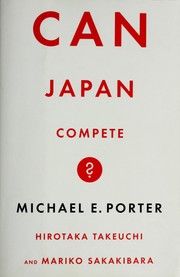
Can Japan Compete?

Can Japan Compete?

Michael E. Porter, Hirotaka Takeuchi, Mariko Sakakibara
2000
T4 208 pages · about 3h 28m to read Open Librarygoodreads

Summary

Porter, Takeuchi and Sakakibara examined Japanese competitiveness and reached a conclusion that contradicted the prevailing explanation of Japan's success.

The standard account, dominant in the 1980s, held that Japan's performance came from government guidance through the Ministry of International Trade and Industry, from keiretsu group structures, from lifetime employment and from cooperative rather than competitive relationships. The authors argue this is wrong, and they test it by examining Japanese industries systematically rather than only the successful ones.

Their finding is that Japan succeeded internationally in a small number of industries and failed in a large number, and that the difference correlates with domestic competition rather than with government support. The successful industries, including automobiles, machine tools, cameras, robotics and consumer electronics, featured intense rivalry among many domestic competitors, weak government direction and limited protection. The unsuccessful industries, including chemicals, financial services, software, retailing, pharmaceuticals and agriculture, were exactly the ones with the most government intervention, the most protection and the most restricted entry.

The implication is that government policy was not the source of Japanese success and was actively harmful where it was strongest. The authors extend this to argue that Japan's competitive weaknesses, including low productivity in domestic services and poor capital allocation, follow from the same interventions.

Their recommendations are for competition policy, deregulation, corporate governance reform and a shift from operational excellence to distinctive strategy, which they argue Japanese firms have generally avoided in favour of competing on the same dimensions.

The book was published in 2000 after a decade of stagnation, when the earlier admiration had already faded. The finding is well supported by the industry evidence and remains the strongest empirical challenge to the industrial policy interpretation of Japan. Critics argue the authors understate the early-stage role of protection and technology acquisition.

Key takeaways 7

  1. Japan succeeded internationally in a small number of industries and failed in a much larger number, which the standard account ignores.
  2. The successful industries featured intense domestic rivalry, weak government direction and limited protection.
  3. The unsuccessful industries were exactly those with the most government intervention and the most restricted entry.
  4. Government industrial policy was not the source of Japanese success and was harmful where it was applied most heavily.
  5. Domestic competition rather than cooperation produced the capabilities that succeeded in export markets.
  6. Japanese firms competed on operational excellence rather than on distinctive strategy, which produced convergence and eroded profitability.
  7. Low productivity in Japan's domestic service sectors follows from the same protections that were credited with creating manufacturing strength.

Who should read it

Anyone assessing industrial policy arguments who wants the systematic industry-level evidence against the standard interpretation of Japanese success.

About Michael E. Porter

Bishop William Lawrence University Professor Emeritus, Harvard Business School; founder, Institute for Strategy and Competitiveness

Competitive Strategy and the five-forces framework are the primary source for industry analysis, and Competitive Advantage supplied the value-chain vocabulary the field still uses.

Harvard Business School, Institute for Strategy and Competitiveness

Similar books 6

Chosen by shared topics, the entries that hold them, and the people who recommended both.

Neil Monnery · 2017

John Cowperthwaite, Hong Kong's Financial Secretary in the 1960s, and his policies.

Montek Singh Ahluwalia · 2019

Insider memoir by the architect of much of the reform programme.

David Lewis · 2011

The one readable overview of how the state, NGOs and business interlock.

Just Faaland, J. R. Parkinson · 1976

The founding pessimist study; useful baseline for what was later beaten.

Alice H. Amsden, Wan-wen Chu · 2003

How Taiwan moved into higher-value industries after its first industrialisation.
Eun Mee Kim · 1997

The state-chaebol bargain and how it shifted over forty years.

Where it sits in the reference 2

Strategists
Economics

Topics

EconomicsBusiness and ManagementPolitics and GovernmentAsia and the Pacific