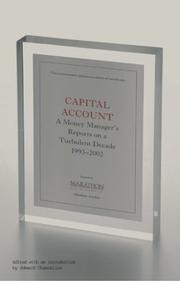
Capital Account: A Money Manager's Reports on a Turbulent Decade
Edited by Chancellor; the reports are Marathon Asset Management's client letters
Summary
Chancellor, a financial historian and author of Devil Take the Hindmost, edited this selection of the reports written by Marathon Asset Management to its clients between 1993 and 2002.
The organising framework is the capital cycle, which Marathon uses as its central analytical tool. High returns in an industry attract capital. New entrants and incumbent expansion increase supply. Increased supply depresses prices and returns. Capital then leaves, supply contracts, and returns eventually recover. The investment implication is that an investor should be sceptical of industries where capital is flooding in, however good current returns look, and should look for opportunity in industries where capital has been withdrawn and supply is contracting.
The practical application requires attention to supply rather than to demand. Marathon's reports repeatedly argue that most analysts forecast demand, which is difficult and where consensus is usually already priced, while supply is more predictable because capacity additions are announced and take known periods to arrive.
The reports also emphasise management's capital allocation record, arguing that the question is not whether managers are good operators but whether they expand into strength and contract from weakness, which most do the reverse of.
The selected period covers the technology bubble, and the reports show Marathon identifying the capital influx into telecommunications and internet infrastructure and avoiding it while the market rewarded participation. Chancellor's introduction and connecting commentary situates each report.
The reports are contemporaneous, which is what makes them useful: the reasoning is recorded before the outcome. A selection edited after the fact necessarily favours the reports that were right. Chancellor produced a second volume, Capital Returns, covering the following decade.
Key takeaways 7
- High returns in an industry attract capital, which increases supply and eventually destroys the returns that attracted it.
- Investors should analyse supply rather than demand, because capacity additions are announced and arrive on known timetables.
- Industries where capital has been withdrawn and supply is contracting are where subsequent returns are found.
- Management should be assessed on whether it expands into strength and contracts from weakness, which most do in reverse.
- Rising capital expenditure across an industry is a warning regardless of how strong current profitability appears.
- Consensus demand forecasts are already reflected in prices, so forecasting demand better is unlikely to produce returns.
- A selection of reports edited after the outcome is known favours those that proved correct.
Who should read it
Investors who want the capital cycle framework applied in contemporaneous reports rather than stated abstractly, particularly for cyclical and capital-intensive industries.
About Edward Chancellor
Financial historian and investment strategist; formerly Lazard Brothers, GMO and Breakingviews; columnist, Reuters Breakingviews
Devil Take the Hindmost remains the standard history of speculative bubbles, and The Price of Time did the same job for interest rates.
Similar books 6
Chosen by shared topics, the entries that hold them, and the people who recommended both.

Returns follow the supply of capital: invest where it is leaving an industry.
Recommended by: Patrick O'Shaughnessy

Every Berkshire annual letter since 1965, in order, as the company grew.
“…books I've recommended, highlighted to death, or forced on friends.” — Andrew Wilkinson
Source: Andrew Wilkinson's Bookshelf, neverenough.com
Recommended by: Andrew Wilkinson, Arnold Van Den Berg and 5 others
Recommended by: Andrew Wilkinson
A large-fund manager's framework for ranking buybacks against alternatives.

Value is discounted future cash flow, not earnings per share or return on equity.
“I read that book and the light bulbs all went off for me personally.” — Michael Mauboussin
Source: The Tim Ferriss Show #659 — official transcript
Recommended by: Michael Mauboussin, Mohnish Pabrai
Berkshire's shareholder letters arranged by topic: governance, valuation, mergers.
“The resource is as valuable as Larry Cunningham's The Essays of Warren Buffett, which similarly organizes by subject matter” — Christopher Bloomstran
Source: Semper Augustus 2024 Letter to Clients, 'Books and Tunes for Walking', p. 96
Recommended by: Christopher Bloomstran, Francois Rochon and 11 others
Where it sits in the reference 2
Topics