Updates

  1. Person pages list letters, writing, profiles and links as sortable tables with filters, and show each person's companies as links; Fund letters show each letter's description in its own column.
  2. Experts show a checked job title and a short description of each person; 30 more people have photographs.
  3. Every company, fund, university and publication the experts work for has a page listing the people there.
  4. Fund letters show each letter's thesis and filter by it; 225 person pages list the essays, columns and newsletter issues the person wrote.
  5. Person pages list every essay and newsletter issue a person wrote, and their own books as a table in List view.
  6. Recommends shows the five largest kinds of book and the rest under More; browse pictures load sooner.
  7. Podcasts and talks link the original episode, filter by Audio and video or Press, and list each publisher once.
  8. Pages are wider, Recommends has List and Grid, and a filter clicked again turns off.
  9. Book cards sit in a ruled grid with Open Library and Goodreads links and each book's one-line note.
  10. Funds is now Investors; each investor's styles are buttons that filter the table.
  11. Podcasts and talks on a person's page filter by year and publisher and show as a list or a grid of pictures.
  12. Quotes show only people's own words: 472 summaries written by list sites are gone.
  13. Country pages open from Browse again, and every link on the shelf lands on a page.
  14. Subject and person pages show their sections as tabs, and each book appears once on a person's page.
  15. Book cards show the quote, who said it and the source; grids show five cards to a row.
  16. On a phone, a menu holds the sections, search, Updates, Feedback and dark mode.
  17. Feedback takes a screenshot of the page with no browser prompt, opens a screenshot full size when you click it, and clears itself once sent.
  18. Book cards are centred, search names the topic each book sits in, and any text cut short shows whole on hover.
  19. Search groups its results by kind: people, companies, geographies, subjects, topics, books, funds, fund letters and papers.
  20. The Books table lists who recommended each book by name, and the browser tab names the section you are in.
  21. Feedback can take a screenshot of the page, or one you paste or choose, and opens in the corner beside Updates.
  22. Each rail button reopens its section where you left it, and Browse, Table and People show on every book and subject page.
  23. Filters grey out choices that hold nothing instead of hiding them, and Books › People filters by authors or recommenders.
  24. Feedback takes a subject line and up to three screenshots.
  25. Biographies are grouped by the person they are about: 41 new pages, from Abraham Lincoln to Lee Kuan Yew.
  26. Sport splits into 23 sports, and Religion into one topic per faith.
  27. Book lists show as cards: the cover, one recommendation quote and every recommender by name.
  28. Seventeen subjects that had two or three pages under different names now have one page each.
  29. Every page lists its Experts as authors and recommenders, with a link to them on the Experts tab.
  30. Economics, Financial history, Financial panics and Accounting are subjects of their own, with one page per financial crisis.
  31. Book, person and subject pages open inside the app, so the tabs stay in view.
  32. 996 more book covers, and photographs or logos for 227 more people and companies.
  33. Books › Browse shows every subject as cards, and the rail holds Fund letters, Papers, Experts, Books and Funds.
  34. Every topic over 150 books splits into narrower topics, each with a page of its own.

Send feedback

What is it?
Screenshots, up to 3 (optional)
or paste one with Ctrl+V

We use your email only to reply to you.

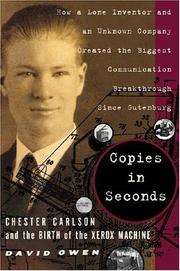
Copies in Seconds

Copies in Seconds

David Owen
2004
T3 320 pages · about 5h 20m to read Open Librarygoodreads

Chester Carlson and xerography, the invention that funded PARC.

Summary

Owen, a New Yorker writer, told the story of Chester Carlson's invention of xerography and of how it became the Xerox 914 copier.

The invention narrative covers Carlson, a patent attorney frustrated by the labour of copying documents, working through the physics in a rented room in Astoria in the 1930s, producing the first electrophotographic image in 1938. The process he devised is genuinely unobvious: charge a photoconductive surface, expose it to light reflected from the original so that the charge dissipates where the image is light, dust it with charged powder that adheres where charge remains, transfer the powder to paper, and fuse it with heat. Owen explains why this was not an incremental improvement on existing chemical copying methods but a different physical principle.

The commercialisation is the business story and the more instructive part. Carlson spent years being rejected by more than twenty companies including IBM, General Electric and RCA, all of which concluded there was no market because carbon paper was cheap and existing demand for copies was small. Battelle Memorial Institute took it on, and Haloid, a small photographic paper company in Rochester, licensed it and eventually staked the entire company on developing it, spending more on the programme than it earned across the years of development.

The 914's launch used a pricing model that solved the demand problem: Xerox leased the machines with a low monthly charge and a per-copy fee, which meant customers took no risk and Xerox captured the volume, which turned out to be vastly larger than any market study had predicted.

Owen writes clearly about both the physics and the business. The book is journalism rather than analysis and does not examine what happened to Xerox afterward.

Key takeaways 7

  1. Xerography works on a different physical principle from the chemical copying methods it replaced rather than improving on them.
  2. More than twenty companies rejected the invention because market studies showed existing demand for copies was small.
  3. Market research measured demand for the existing product and could not detect demand for a capability that did not yet exist.
  4. Haloid staked the entire company on the programme, spending more on development than it earned in those years.
  5. Leasing the machine with a low monthly charge and a per-copy fee removed the customer's risk and captured the volume.
  6. Actual copy volume after launch exceeded every prior estimate by orders of magnitude.
  7. An inventor without capital or institutional backing required a decade of rejection before finding any organisation willing to develop the work.

Who should read it

Founders and investors evaluating genuinely novel technologies who want a documented case of why market research failed to detect the demand.

Similar books 6

Chosen by shared topics, the entries that hold them, and the people who recommended both.
Michael A. Hiltzik · 1999

How Xerox PARC built the first personal computer and laser printer, and lost them.

Howard Rheingold · 1985

The idea of personal computing and the people who pursued it, up to PARC.

Katie Hafner, Matthew Lyon · 1996

How Licklider and Pentagon-funded engineers built the network behind the internet.

Recommended by: Patrick Collison, Chris Dixon

Douglas K. Smith, Robert C. Alexander · 1988

How Xerox invented the personal computer and then ignored it.

Where it sits in the reference 2

Companies
Business models

Topics

Technology and ComputingCompany HistoriesGeneral HistoryScience, Technology and MedicineInvention, engineering and energy