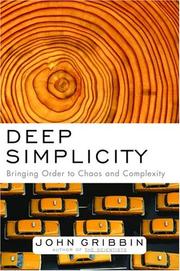
Deep Simplicity
Chaos and complexity theory: how simple rules produce complex behaviour.
Summary
Gribbin, a science writer with a physics background, explains chaos and complexity theory for general readers, arguing that simple rules generate complex behaviour and that this accounts for a great deal of what looks inexplicable in nature.
The content covers: the historical development from Newtonian determinism through Poincare's discovery that the three-body problem has no closed solution; sensitive dependence on initial conditions and why it makes long-range prediction impossible even in fully deterministic systems; attractors and phase space; the logistic map and the route to chaos through period doubling, including the Feigenbaum constant that recurs across unrelated systems; fractals and self-similarity; systems held far from equilibrium by an energy flow, which is where dissipative structures and self-organisation appear; self-organised criticality and the sandpile model; and applications to earthquakes, climate, evolution, extinction patterns and the origin of life.
His unifying argument is that complexity arises at the boundary between order and randomness, that it requires an energy flow through the system, and that the same mathematical structures appear across domains because the structures follow from the dynamics rather than from the subject matter.
The book is an accessible introduction and covers ground that Gleick's Chaos and Buchanan's Ubiquity also cover. Its distinctive contribution is connecting the chaos material to the thermodynamics of systems far from equilibrium, which most popular treatments omit and which is what makes the biology and earth science applications work.
Key takeaways 7
- Simple deterministic rules generate behaviour that is unpredictable in practice, which means determinism and predictability are separate properties.
- Sensitive dependence on initial conditions makes long-range prediction impossible in principle, regardless of how much measurement precision improves.
- The same route to chaos through period doubling appears across physically unrelated systems, with the same universal constants.
- Complexity arises at the boundary between rigid order and randomness, and systems held there produce structure that neither extreme generates.
- Self-organising structure requires a continuous energy flow through the system, which is why living systems must consume to maintain order.
- Self-organised criticality means a system drives itself to a state where events of any size can occur, which makes large events intrinsic rather than exceptional.
- Identical mathematical structures appear across unrelated domains because they follow from the dynamics rather than from the subject matter.
Who should read it
Readers wanting an accessible introduction to chaos and complexity that connects the mathematics to thermodynamics and living systems.
Who recommended it 1 · 1 direct
Similar books 6
Chosen by shared topics, the entries that hold them, and the people who recommended both.

The founding of the Santa Fe Institute and the people who built complexity science.
“Much of the work is being carried out in conjunction with a broad, interdisciplinary effort underway at the Santa Fe Institute, ably chronicled in a new book, Complexity by Mitchell Waldrop.” — Bill Miller
Source: 1992 Q4 Market Commentary
Recommended by: Bill Miller, Michael Mauboussin, Bill Gurley and 2 others

Control and communication in animals and machines run on the same principles.

How irreversible processes in thermodynamics bring order out of disorder.
Computer tools that help people, even children, explore how complex systems work.
“The first challenge to the centralized mindset comes from a delightful book by MIT Professor Mitchel Resnick, “Turtles, Termites, and Traffic Jams.” — Michael Mauboussin
Source: The Invisible Lead Steer: New Answers to Old Questions About the Stock Market, page 3
Recommended by: Michael Mauboussin
Self-organised criticality: why earthquakes and crashes come in all sizes.
“Mark Buchanan, Ubiquity: The Science of History . . . Or Why the World is Simpler Than We Think (New York: Crown Publishers, 2000)” — Michael Mauboussin
Source: Interdisciplinary Perspectives on Risk, page 5
Recommended by: Michael Mauboussin
A popular history of temperature and heat, entropy included.
Recommended by: Charlie Munger, Mohnish Pabrai