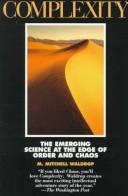
Complexity: The Emerging Science at the Edge of Order and Chaos
The founding of the Santa Fe Institute and the people who built complexity science.
Summary
Waldrop reports the founding of the Santa Fe Institute in the mid-1980s and the development of complexity science through the people involved, including physicist Murray Gell-Mann, economist Brian Arthur, biologist Stuart Kauffman, computer scientist John Holland and economist Kenneth Arrow.
The scientific content concerns complex adaptive systems, meaning systems of many interacting agents whose collective behaviour cannot be derived from the behaviour of the individual components. The recurring properties include emergence, in which organisation appears without any central direction; self-organised criticality, in which systems settle at a boundary between order and randomness where the most interesting behaviour occurs; and adaptation, in which agents change their behaviour based on outcomes.
The economics material is the part most relevant to a business readership. Brian Arthur's work on increasing returns argued that some markets exhibit positive feedback, so an early lead compounds and the outcome is path-dependent rather than determined by which technology is best. The QWERTY keyboard and the VHS format are the standard examples. This contradicted the standard economic assumption of diminishing returns and equilibrium, and Waldrop documents the resistance Arthur encountered in publishing it.
Holland's genetic algorithms and classifier systems, and Kauffman's work on autocatalytic sets and on order arising spontaneously in networks, receive substantial treatment. The book is from 1992 and complexity science has not delivered what its founders expected. Many of the specific research programmes stalled. Increasing returns became mainstream economics and is the most successful export. Read it as intellectual history and for the increasing returns argument.
Key takeaways 8
- Complex adaptive systems consist of many interacting agents whose collective behaviour cannot be derived from the behaviour of the components.
- Organisation emerges without any central direction, which means order in markets, ecosystems and organisations does not require a designer.
- Some markets exhibit increasing returns, so an early lead compounds and the eventual standard is path-dependent rather than the best available.
- Path dependence means that the technology that wins may be inferior, and the outcome could have been different with small early changes.
- The most interesting system behaviour occurs at a boundary between rigid order and randomness rather than at either extreme.
- Agents in these systems adapt their behaviour based on outcomes, which means the system's rules change as it operates.
- Equilibrium assumptions in standard economics fail where increasing returns operate, which was resisted strongly when Arthur proposed it.
- Complexity science has not delivered the general theory its founders expected, and increasing returns is its most successful export.
Who should read it
Readers wanting the intellectual history of complexity science and the origin of increasing returns and path dependence in economics.
Who recommended it 5 · 2 direct
“Much of the work is being carried out in conjunction with a broad, interdisciplinary effort underway at the Santa Fe Institute, ably chronicled in a new book, Complexity by Mitchell Waldrop.”
“M. Mitchel Waldrop, Complexity: The Emerging Science at the Edge of Order and Chaos (New York: Simon & Schuster, 1992)”
Similar books 6
Chosen by shared topics, the entries that hold them, and the people who recommended both.
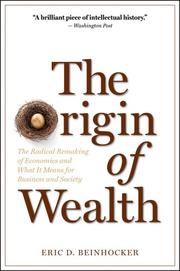
The economy as a complex evolving system rather than one in equilibrium.
“Eric D. Beinhocker, The Origin of Wealth: Evolution, Complexity, and the Radical Remaking of Economics (Boston: Harvard Business School Press, 2006)” — Michael Mauboussin
Source: Thirty Years: Reflections on the Ten Attributes of Great Investors, page 17
Recommended by: Michael Mauboussin, Ryan Peterson
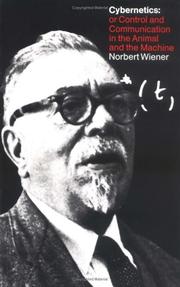
Control and communication in animals and machines run on the same principles.
Chaos and complexity theory: how simple rules produce complex behaviour.
Recommended by: Charlie Munger

How irreversible processes in thermodynamics bring order out of disorder.
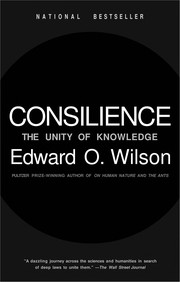
How the sciences and humanities can be unified by causal links from physics up.
“I was inspired by E. O. Wilson's book Consilience, which came out in 1998 and is a book I'd recommend.” — Michael Mauboussin
Source: MOI Global interview with Michael Mauboussin
Recommended by: Michael Mauboussin, Mohnish Pabrai
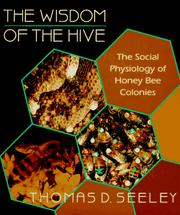
How a honeybee colony allocates its foragers, as a decentralised system.
“As Thomas Seeley writes in his delightful book, The Wisdom of the Hive: 22 The most thought-provoking feature of a honey bee colony is its ability to achieve coordinated activity among tens of thousands of bees without central control.” — Michael Mauboussin
Source: Capital Ideas Revisited: The Prime Directive, Sharks, and The Wisdom of Crowds, page 7
Recommended by: Michael Mauboussin