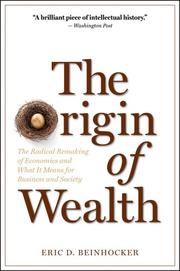
The Origin of Wealth
The economy as a complex evolving system rather than one in equilibrium.
Summary
Beinhocker argues that the neoclassical model of the economy, built on equilibrium, rational agents and perfect information, is wrong in its foundations, and that the economy should be modelled as a complex adaptive system that evolves. He traces the intellectual history of how nineteenth-century economists imported equilibrium mathematics from physics, and then presents the alternative developed at the Santa Fe Institute and elsewhere.
The substantive argument is that wealth is created by an evolutionary search process operating on three things simultaneously: physical technologies, social technologies meaning ways of organising people, and business plans that combine the two. Selection happens in markets. He uses agent-based modelling results, including Brian Arthur's work on increasing returns and the El Farol problem, Kauffman's work on fitness and adaptive search, and experimental economics, to argue that the economy has no equilibrium and that the distribution of outcomes is power-law rather than normal.
The implications he draws are for strategy and policy. He argues that firms should run portfolios of strategic experiments rather than commit to a single predicted future, that adaptation beats prediction, and that markets are valuable primarily as evolutionary search mechanisms rather than as allocative optimisers. The book is long, synthesising rather than original, and it is a good entry point to complexity economics. Critics note that complexity economics has produced far more critique of the standard model than replacement for it, and that agent-based models are difficult to validate empirically. Twenty years on, the promised paradigm shift in economics has not happened.
Key takeaways 7
- Neoclassical economics adopted equilibrium mathematics from nineteenth-century physics, and that borrowing determined a set of assumptions that do not describe real economies.
- Economic wealth is produced by an evolutionary process of variation, selection and amplification acting on technologies, organisational forms and business plans together.
- Social technologies, meaning ways of organising cooperation among people, contribute as much to growth as physical technologies do.
- Markets create value primarily by functioning as a search process over possible business designs, rather than by allocating resources optimally.
- Economic outcomes follow power-law distributions, which means extreme events are far more common than equilibrium models predict.
- Firms should hold a portfolio of strategic experiments and kill the failures quickly, because no one can predict which design will fit the environment.
- Cooperation and norm enforcement are observed features of human economic behaviour that self-interest models cannot generate.
Who should read it
Investors and strategists who want an accessible synthesis of complexity economics and its implications for treating strategy as experimentation rather than prediction.
Who recommended it 2 · 1 direct
“Eric D. Beinhocker, The Origin of Wealth: Evolution, Complexity, and the Radical Remaking of Economics (Boston: Harvard Business School Press, 2006)”
Similar books 6
Chosen by shared topics, the entries that hold them, and the people who recommended both.
Papers showing positive feedback and lock-in govern parts of the economy.
“Arthur, W. Brian, Increasing Returns and Path Dependence in the Economy (Ann Arbor, MI: University of Michigan Press, 1994)” — Michael Mauboussin
Source: Importance of Diverse Thinking: Why the Santa Fe Institute Can Make You a Better Investor, page 11
Recommended by: Michael Mauboussin
Papers on complexity economics and increasing returns, with commentary.
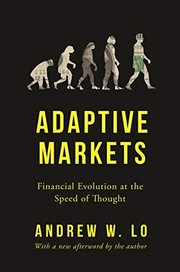
The adaptive markets hypothesis, joining efficient markets and behavioural finance.
“Lo, Andrew W., Adaptive Markets: Financial Evolution at the Speed of Thought (Princeton, NJ: Princeton University Press, 2017)” — Michael Mauboussin
Source: Who Is On the Other Side? You Need Good BAIT to Land a Winner, page 40
Recommended by: Michael Mauboussin

The founding of the Santa Fe Institute and the people who built complexity science.
“Much of the work is being carried out in conjunction with a broad, interdisciplinary effort underway at the Santa Fe Institute, ably chronicled in a new book, Complexity by Mitchell Waldrop.” — Bill Miller
Source: 1992 Q4 Market Commentary
Recommended by: Bill Miller, Michael Mauboussin, Bill Gurley and 2 others
How a game designer built artificial life from simple rules of biology.
Recommended by: Mohnish Pabrai, Jeff Bezos
Control and communication in animals and machines run on the same principles.