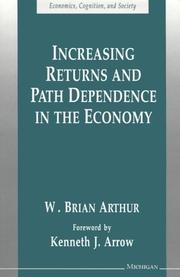
Increasing Returns and Path Dependence in the Economy
Papers showing positive feedback and lock-in govern parts of the economy.
Summary
Brian Arthur collects his papers from the 1980s and early 1990s arguing that positive feedback governs important parts of the economy and that standard equilibrium analysis, built on diminishing returns, cannot describe those parts. Where returns increase with adoption, small early events determine which of several possible outcomes the system settles into, and the outcome that wins need not be the most efficient.
Arthur's formal contribution is the application of non-linear Polya urn processes to technology adoption. He shows that when each adoption raises the probability of further adoptions, the process converges to one of multiple possible limits, and which limit it reaches depends on the random early sequence. The technology examples are QWERTY, the internal combustion engine over steam, VHS over Betamax, and nuclear reactor designs. He also applies the framework to industrial location, arguing that agglomeration produces regional concentration that historical accident selects.
The economic content became the theoretical basis for how technology investors talk about network effects and lock-in, and the book is the primary source for that vocabulary. The empirical claims have been contested: Liebowitz and Margolis published detailed rebuttals arguing that QWERTY was not inferior to Dvorak and that VHS won on merit, and the general question of whether inefficient lock-in actually occurs in practice remains open. The papers are technical in places and repetitive as a collection, since they were written separately.
Key takeaways 7
- When adoption raises the value of a technology to later adopters, the market can settle on any of several outcomes rather than converging on one.
- The outcome that emerges from an increasing-returns process depends on early random events and need not be the most efficient available.
- Standard equilibrium economics assumes diminishing returns and therefore cannot generate multiple equilibria or path dependence.
- Once a technology accumulates enough adopters, a superior alternative can fail because switching costs exceed individual gains.
- Regional industrial concentration results from agglomeration feedback rather than from underlying geographic advantage.
- Firms in increasing-returns markets should compete for early adoption share rather than for near-term margin.
- Arthur argues that knowledge-based industries operate under increasing returns while resource-based industries do not, so the two need different analysis.
Who should read it
Technology investors and founders who want the original formal argument behind network effects, lock-in and winner-take-most market structure.
Who recommended it 1 · 1 direct
“Arthur, W. Brian, Increasing Returns and Path Dependence in the Economy (Ann Arbor, MI: University of Michigan Press, 1994)”
Similar books 6
Chosen by shared topics, the entries that hold them, and the people who recommended both.
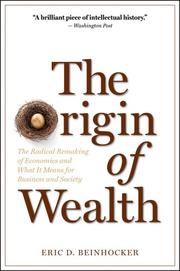
The economy as a complex evolving system rather than one in equilibrium.
“Eric D. Beinhocker, The Origin of Wealth: Evolution, Complexity, and the Radical Remaking of Economics (Boston: Harvard Business School Press, 2006)” — Michael Mauboussin
Source: Thirty Years: Reflections on the Ten Attributes of Great Investors, page 17
Recommended by: Michael Mauboussin, Ryan Peterson
Papers on complexity economics and increasing returns, with commentary.
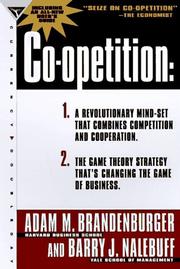
Game theory applied to business, which is cooperative and competitive at once.
“Adam M. Brandenburger and Barry J. Nalebuff, Co-opetition (New York: Currency Doubleday, 1996)” — Michael Mauboussin
Source: The Ecosystem Edge, page 10
Recommended by: Michael Mauboussin, Mohnish Pabrai

A political history of American monopoly and of the tradition that fought it.
“Matt Stoller, Goliath: The 100-Year War Between Monopoly Power and Democracy (New York: Simon & Schuster, 2019)” — Michael Mauboussin
Source: Market Share: Understanding Competitive Advantage Through Market Power, page 46
Recommended by: Michael Mauboussin, David Heinemeier Hansson
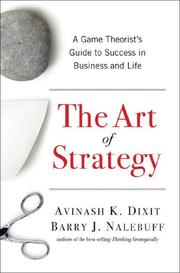
Game theory without maths, with new examples: commitment, signals, bargaining.
“for business, see Avinash K. Dixit and Barry J. Nalebuff, The Art of Strategy (New York: W.W. Norton & Company, 2008)” — Michael Mauboussin
Source: The Colonel Blotto Game: Transitivity and How to Win When You’re an Underdog, page 8
Recommended by: Michael Mauboussin, Marc Andreessen

How antitrust shrank to a consumer price test, and the case for breaking up giants.
“Gustavo Grullon, Yelena Larkin, and Roni Michaely, “Are U.S. Industries Becoming More Concentrated?” Review of Finance, Vol. 23, No. 4, July 2019, 697-743 and Tim Wu, The Curse of Bigness: Antitrust in the New Gilded Age (New York: Columbia Global Reports, 2018)” — Michael Mauboussin
Source: Public to Private Equity in the United States: A Long-Term Look, page 60
Recommended by: Michael Mauboussin, Jeff Jordan