Complexity and the Economy
Papers on complexity economics and increasing returns, with commentary.
Summary
Arthur, an economist associated with the Santa Fe Institute, collected his papers on complexity economics with connecting commentary.
His foundational contribution is the analysis of increasing returns. Standard economics assumes diminishing returns, which produces a unique equilibrium that is independent of history. Arthur showed that where increasing returns operate, meaning that adoption of a technology or product makes it more attractive to further adopters through network effects, learning curves or complementary investment, the outcome has multiple possible equilibria, the one reached depends on small early events, and the process is path dependent. Once locked in, an inferior standard can persist because switching requires coordinated action no individual can take. The QWERTY keyboard and the VHS format are the standard illustrations, both of which have been disputed empirically, but the theoretical result stands independent of the examples.
The implications for strategy are direct: in increasing returns markets, early share matters disproportionately, competition is for the market rather than in it, and the winner is not necessarily the best product.
The second body of work concerns inductive reasoning under complexity. The El Farol problem is his construction: a bar is enjoyable if fewer than sixty per cent of a population attend, everyone decides independently based on attendance history, and no deductively rational solution exists because any shared rule would be self-defeating. Agents must form hypotheses, act on them and discard those that fail, which produces a system that never settles.
The broader argument is that the economy should be modelled as a system of adapting agents whose actions continually change the environment the others face, rather than as a system that reaches equilibrium.
The papers are technical and the collection is uneven. Complexity economics has not displaced the mainstream, partly because it produces simulations rather than closed-form results that can be tested conventionally.
Key takeaways 7
- Where increasing returns operate, multiple equilibria exist and which one is reached depends on small early events.
- An inferior standard can lock in permanently because switching requires coordinated action no individual participant can initiate.
- In increasing returns markets, competition is for the market rather than within it, and early share matters disproportionately.
- The winner in a network market is not necessarily the best product, because adoption reinforces itself independently of quality.
- Where no deductively rational strategy exists, agents must reason inductively by forming hypotheses and discarding those that fail.
- A system of agents adapting to each other's behaviour never settles into equilibrium, because each adaptation changes what the others face.
- The economy is better modelled as continually adapting than as tending toward a determinate resting point.
Who should read it
Founders and investors in network and platform markets who want the economic theory of increasing returns, lock-in and path dependence at its source.
Similar books 6
Chosen by shared topics, the entries that hold them, and the people who recommended both.
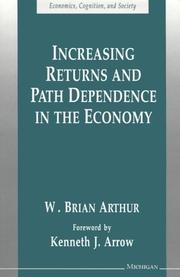
Papers showing positive feedback and lock-in govern parts of the economy.
“Arthur, W. Brian, Increasing Returns and Path Dependence in the Economy (Ann Arbor, MI: University of Michigan Press, 1994)” — Michael Mauboussin
Source: Importance of Diverse Thinking: Why the Santa Fe Institute Can Make You a Better Investor, page 11
Recommended by: Michael Mauboussin
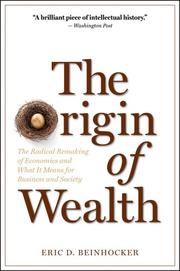
The economy as a complex evolving system rather than one in equilibrium.
“Eric D. Beinhocker, The Origin of Wealth: Evolution, Complexity, and the Radical Remaking of Economics (Boston: Harvard Business School Press, 2006)” — Michael Mauboussin
Source: Thirty Years: Reflections on the Ten Attributes of Great Investors, page 17
Recommended by: Michael Mauboussin, Ryan Peterson
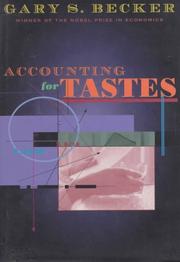
How economics can explain tastes rather than take them as given.
Recommended by: Eric Weinstein

How rituals, ceremonies and mass advertising create common knowledge.
Recommended by: Mark Zuckerberg

How monopoly intermediaries take the earnings of writers, musicians and artists.
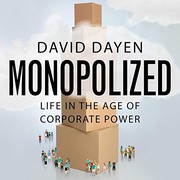
Market concentration in America, sector by sector, through the people it affects.