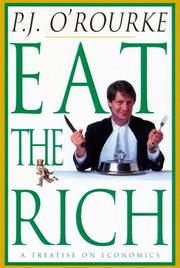
Eat the Rich
A humorist's world tour asking why some places prosper and others fail.
Summary
O'Rourke, the humorist, asks why some places prosper while others fail, and investigates through a world tour of what he calls funny economics. Starting on Wall Street, he sees good capitalism there, bad capitalism in Albania, good socialism in Sweden and bad socialism in Cuba, and then works through the introductory economics course he avoided in college.
The result, subtitled A Treatise on Economics and published in 1998, presents the basic principles of economics in a comic voice. His conclusion: the free market is ugly and stupid, like going to the mall, and the unfree market is just as ugly and stupid, except that the mall is empty and if you do not go they shoot you.
Key takeaways 3
- Comparing countries side by side shows which economic systems produce prosperity.
- Free markets are messy, but unfree markets are worse because they add coercion to the mess.
- Basic economics can be taught through reporting and jokes rather than equations.
Who should read it
Readers who want a funny, opinionated introduction to economics and to why nations prosper.
Who recommended it 1
Similar books 6
Chosen by shared topics, the entries that hold them, and the people who recommended both.
Twenty years of American economic debate, and which ideas made sense.
Recommended by: Eric Weinstein
How prices, incentives and trade-offs work, from housing and labour to trade.
Recommended by: Marc Andreessen
Economics for daily life: motivating people, choosing food, giving to charity.
“Recommendations for the transactions of life. When to give to charity, what restaurants to choose, what insurance to buy, etc. He makes a rational case for these, often surprising, from an economics point of view.” — Derek Sivers
Source: Derek Sivers book notes (primary, rated list) · Rating: 8/10
Recommended by: Derek Sivers, Graham Duncan
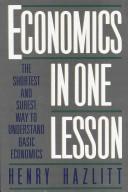
Judge a policy by its long-run effects on all groups, applied to two dozen cases.
“I've given dozens of copies of this classic to students... The book should be required reading on every campus.” — Christopher Bloomstran
Source: Semper Augustus 2020 Letter to Clients, 'To Read or Not to Read', p. 57
Recommended by: Christopher Bloomstran, Changpeng Zhao and 3 others
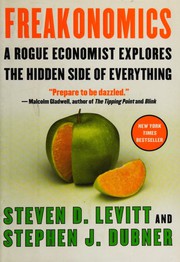
Incentives and data applied to cheating teachers, sumo wrestlers and other puzzles.
“Also, see the story of cheating in the Chicago Public School system in Steven D. Levitt and Stephen J. Dubner, Freakonomics: A Rogue Economist Explores the Hidden Side of Everything (New York: Harper Perennial, 2009), 23-35” — Michael Mauboussin
Source: Blaming the Rat: Incentives, Motivation, and How They Interact, page 14
Recommended by: Michael Mauboussin, Mohnish Pabrai and 7 others
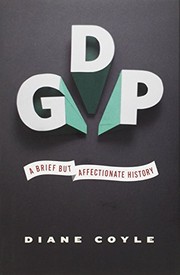
How GDP is measured, and why its figures can jump overnight.
Recommended by: Mohnish Pabrai, Patrick Collison