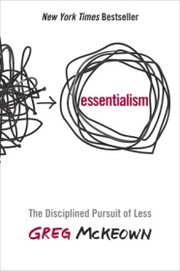
Essentialism
A method for finding the few activities that matter and dropping the rest.
Summary
McKeown argues for what he calls the disciplined pursuit of less, meaning a systematic method for identifying the few activities that matter and eliminating everything else. His framing distinction is between the non-essentialist, who assumes they must do everything and treats all opportunities as roughly equal, and the essentialist, who assumes almost everything is noise and applies a deliberate filter.
The book divides into four parts: essence, meaning the mindset that choice is always available and that trade-offs are real; explore, meaning creating enough space to evaluate options properly; eliminate, meaning the mechanisms for removing what does not qualify; and execute, meaning building systems that make the essential effortless.
The practical tools include the ninety percent rule, where any option scoring below ninety on the single most important criterion is rejected outright; the clarity of a single defined intent stated concretely enough to be measured; the practice of saying no gracefully with specific scripts; the reversal of sunk cost through asking what you would pay to acquire the commitment today; setting boundaries; buffers built into schedules; and removing the constraint that limits the whole system rather than optimising elsewhere.
The book contains no research of its own and repackages material from time management, from the theory of constraints and from Jim Collins. The examples are brief and mostly favourable. The advice presupposes enough seniority or autonomy to decline work, which limits its application for people who cannot. The message is simple and the book is long relative to it. The ninety percent rule and the trade-off framing are the parts most readers actually use.
Key takeaways 8
- Almost everything is noise and a small number of activities produce nearly all the value, so the default should be rejection rather than acceptance.
- Trade-offs are unavoidable, and pretending you can do both options is the standard mechanism by which people commit to too much.
- Any opportunity that does not score at least ninety out of one hundred on the most important criterion should be treated as a zero.
- Deliberate space to think is a requirement rather than a luxury, and a schedule with no gaps prevents the evaluation that produces good choices.
- Saying no costs a moment of social discomfort and buys back a large amount of time, and most people misprice that exchange.
- Sunk costs should be tested by asking what you would pay today to acquire the commitment, which usually reveals it should be abandoned.
- A single clear and measurable intent aligns decisions better than a set of values or a general direction.
- Building buffers into estimates and schedules removes the crisis management that consumes the time meant for essential work.
Who should read it
Operators with enough autonomy to decline work who need a filter and a set of scripts for doing so.
Who recommended it 13 · 6 direct
“My favorite book of 2014. I bought it for the whole team at AppSumo.”
Similar books 6
Chosen by shared topics, the entries that hold them, and the people who recommended both.
A philosophy of time for mortals, and how to make the most of a finite life.
Recommended by: Matt Mullenweg
A short New Thought essay on how a person's thinking shapes their life.
Recommended by: Nat Eliason, Tim Ferriss, Tony Robbins
Why distraction-free concentration is rare and valuable, and how to train for it.
“Crucial subject, dear to me: shutting out distractions for deep productive concentrated work. No huge surprises but great supporting thoughts. I liked the point of considering the downside of the internet, instead of only the positives.” — Derek Sivers
Source: Derek Sivers book notes (primary, rated list) · Rating: 7/10
Recommended by: Derek Sivers, Nat Eliason, Nir Eyal and 7 others
Why to spend and live fully while alive, rather than die with money unspent.
Recommended by: Ali Abdaal, Nat Eliason, James Altucher
Short pieces of advice on living, goals, generosity, careers, family and money.
“Tiny sentences with deep wisdom unelaborated. Up to you to extract, reflect, and apply.” — Derek Sivers
Source: Derek Sivers book notes (primary, rated list) · Rating: 6/10
Recommended by: Andrew Wilkinson, Derek Sivers and 1 other
How a person can live the life they want despite the constraints around them.
“Some fun "fist in the air" thoughts on freedom, from 1973. Includes related thoughts on parenting and honesty.” — Derek Sivers
Source: Derek Sivers book notes (primary, rated list) · Rating: 3/10
Recommended by: Derek Sivers, Nat Eliason