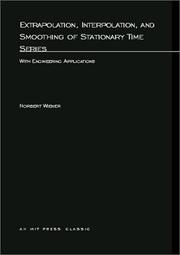
Extrapolation, Interpolation, and Smoothing of Stationary Time Series: With Engineering Applications (M.I.T. Press Paperback Series)
The wartime theory of filtering and predicting time series, applied to engineering.
Summary
The reference has not verified this book in detail; the summary states only what the title, author and subject establish.
Norbert Wiener's work first circulated in 1942 as a classified memorandum, because it was tied to wartime efforts to improve radar; it was published as a book in 1949. Combining statistics and time-series analysis, Wiener used Gauss's method of shaping the characteristics of a detector to give the best possible recognition of a signal in the presence of noise. The method became known as the Wiener filter.
The publisher's description calls it the basis of modern communication theory and notes the prediction that Wiener will be remembered for this work long after his Cybernetics is forgotten, since every communications student learns the Wiener filter. The source read in this pass is that description; it does not set out the book's chapters or mathematics.
Key takeaways 4
- Wiener developed the theory for wartime radar, and it first circulated as a classified memorandum in 1942.
- The Wiener filter separates a signal from noise as well as is statistically possible.
- The work joins statistics and time-series analysis.
- It became a foundation of communication theory.
Who should read it
Engineers, statisticians and historians of science interested in the origins of signal processing.
Who recommended it 1 · 1 direct
Similar books 6
Chosen by shared topics, the entries that hold them, and the people who recommended both.
An introduction for lay readers to the concepts and uses of probability theory.
Recommended by: Patrick Collison
How seeing turns into showing: turning data and evidence into explanation.
“The bibles of information design. Nothing comparable exists.” — Bret Victor
Source: Links — Bret Victor (his five-star list)
Recommended by: Bret Victor, Jeff Atwood, Patrick Collison
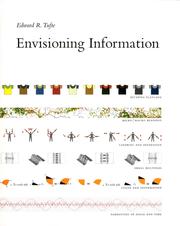
How to show complex information on flat paper or screens, with many examples.
“The bibles of information design. Nothing comparable exists.” — Bret Victor
Source: Links — Bret Victor (his five-star list)
Recommended by: Bret Victor, Jeff Atwood, Jim Collins and 2 others
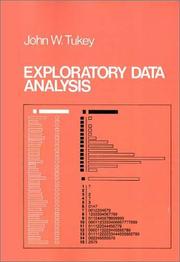
Informal ways to study data, from plots to numerical summaries done by hand.
Recommended by: Patrick Collison
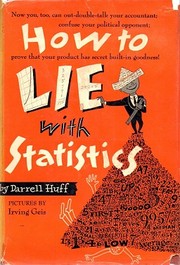
How biased samples, chosen averages and cut-off chart axes make numbers mislead.
“This puckish riff on how math can be manipulated is only 142 pages; most people could read it on a train ride or two, or in an afternoon at the beach. As light as the book is, however, it is nevertheless profound. In one short take after another, Huff picks apart the ways in which marketers use statistics, charts, graphics and other ways of presenting numbers to baffle and trick the public.” — Jason Zweig
Source: Best Books for Investors: A Short Shelf — jasonzweig.com
Recommended by: Bill Gates, Jason Zweig, Mohnish Pabrai and 7 others
A textbook on machine learning built around its algorithms.
Recommended by: Patrick Collison
Where it sits in the reference 2
As an Amazon Associate I earn from qualifying purchases.