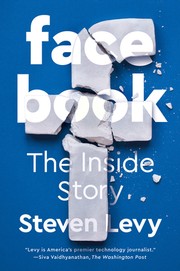
Subtitled The Inside Story; the fullest institutional history.
Summary
Levy, a technology journalist with a long record of access to major companies, wrote a history of Facebook from its founding to 2019, based on hundreds of interviews including extensive access to Mark Zuckerberg and to Sheryl Sandberg.
The corporate history covers the founding at Harvard and the disputes over it, the early venture financing and the decision to reject acquisition offers, the introduction of News Feed and the user revolt that followed, the arrival of Sandberg and the construction of the advertising business, the acquisitions of Instagram and WhatsApp, the mobile transition that the company initially handled badly, and the growth strategies including the Growth Circle team and the internationalisation programmes.
The second half covers the consequences. Levy documents the Cambridge Analytica data episode and the platform policies that made it possible, the Russian influence operation during the 2016 American election and the company's slow acknowledgement of it, the role of Facebook in Myanmar during the violence against the Rohingya, the internal debates over political speech and fact-checking, and the tension between Zuckerberg's growth priorities and the effects the platform was producing.
His interpretation is that the company's problems follow from its founding assumptions rather than from later mistakes: the belief that connecting people is inherently good, the measurement of success by engagement and growth, and a governance structure that gives Zuckerberg unchallengeable control through supervoting shares.
The book is thorough on the period it covers and Levy is fair to his subjects while critical of the outcomes. It was published in 2020 and does not cover the whistleblower disclosures of 2021, the pivot to the metaverse, the Apple privacy changes that damaged the advertising business, or the subsequent recovery. The access-based method also means the executives' framing of events is well represented.
Key takeaways 7
- Facebook's growth was driven by a dedicated growth team that ran systematic experiments on acquisition and retention rather than by product improvement alone.
- News Feed produced immediate user opposition and became the mechanism of engagement, which established the pattern of shipping despite objection.
- The advertising business was built by Sandberg's team on targeting capability that came from data users supplied for other purposes.
- Buying Instagram and WhatsApp removed the two competitors most likely to displace the company on mobile.
- Supervoting shares give Zuckerberg control that no board, investor or regulator can override internally.
- Measuring success by engagement selected for content that provokes reaction, which is a structural rather than incidental cause of the platform's problems.
- The company's founding belief that increased connection is inherently beneficial prevented it from anticipating the harms it later had to address.
Who should read it
Founders and investors in consumer platforms who want the fullest account of how the company was built and how its growth metrics produced its later problems.
About Steven Levy
American technology journalist and editor at large at Wired who wrote histories of hacker culture, Apple, Google and Facebook.
Hackers documented the MIT and Homebrew programming culture of the 1950s through the 1980s and named the ethic that later shaped open source and startup engineering. In the Plex and Facebook report from inside those companies on how their products, ranking systems and business models were actually built.
Similar books 6
Chosen by shared topics, the entries that hold them, and the people who recommended both.

How Facebook mishandled data and spread fake news and hate, and its inner politics.

A former Facebook policy director's memoir of the company from 2011 to 2017.
Dramatised founding story; source for The Social Network.
Facebook from its Harvard origin to 2010, with wide access to Zuckerberg.
Recommended by: Drew Houston, Dustin Moskovitz

Google's technical and business decisions from Stanford research to 2011.
Recommended by: Mohnish Pabrai, Charlie Munger, Drew Houston and 2 others
Where it sits in the reference 3
Topics