
In the Plex
The fullest inside-access history of Google's first decade.
Summary
Levy had unusual access to Google over two years and covers the company from the Stanford research through 2011. It is the most complete account of the company's technical and business decisions during that period.
The technical material is the strongest part. Levy explains PageRank clearly, covers the infrastructure decisions including building server hardware from commodity components rather than buying it, the development of MapReduce and the Google File System, and the machine learning applied to search quality and to translation. His account of how search quality was evaluated, including the rater guidelines and the experimental infrastructure, is the best available.
The business material covers the AdWords auction design, which Levy identifies as the decision that made the company, including the second-price auction and the weighting of bids by click-through rate so that relevance rather than payment determined placement. He documents the internal resistance to advertising and how the mechanism was constructed to satisfy it. The later chapters cover the China decision and eventual withdrawal, the Book Search litigation, the failure of Google's social products, the Android acquisition and strategy, and the founders' relationship with Eric Schmidt.
The access shapes the tone toward sympathy, and Levy is more impressed by the culture than a sceptical reader would be. The book ends in 2011, before the antitrust actions, the privacy regulation, the growth of the advertising business into its current form, and the machine learning developments that followed. It remains the definitive account of the founding period and of the auction design.
Key takeaways 8
- PageRank ranked pages by the links pointing to them, weighted by the rank of the linking pages, which treated the web's own structure as the quality signal.
- Building server infrastructure from commodity components and designing software to tolerate hardware failure produced a permanent cost advantage.
- The AdWords auction weighted bids by click-through rate, so that relevance rather than the highest payment determined placement, which made the advertising acceptable to users.
- A second-price auction removes the incentive to shade bids, which made advertiser behaviour simpler and the system more efficient.
- Search quality was evaluated through human raters working to written guidelines combined with live experiments, rather than through any single metric.
- The founders resisted advertising initially and the auction mechanism was designed specifically to satisfy that objection.
- Hiring exclusively for academic and technical capability produced both the engineering results and a persistent difficulty with products requiring other skills.
- The China decision required weighing market access against censorship compliance, and the eventual withdrawal followed a security breach rather than the censorship itself.
Who should read it
Founders and investors who want the technical and business decisions behind Google's first decade, particularly the auction design.
About Steven Levy
American technology journalist and editor at large at Wired who wrote histories of hacker culture, Apple, Google and Facebook.
Hackers documented the MIT and Homebrew programming culture of the 1950s through the 1980s and named the ethic that later shaped open source and startup engineering. In the Plex and Facebook report from inside those companies on how their products, ranking systems and business models were actually built.
Who recommended it 5 · 1 direct
Similar books 6
Chosen by shared topics, the entries that hold them, and the people who recommended both.
How Google hired and managed smart creatives, people who can't be told what to do.
Recommended by: Mohnish Pabrai, Cynthia Johnson and 2 others
Facebook from its founding to 2019, from hundreds of interviews including Zuckerberg.

How Google disrupted newspapers, books, television and advertising.
Recommended by: Brian Chesky, Keith Rabois
The search industry from early engines to Google, and how paid search was invented.
Recommended by: Gary Vaynerchuk, Keith Rabois
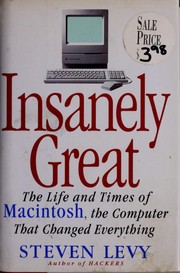
How the Macintosh was made and launched in 1984.
Where it sits in the reference 2
Topics