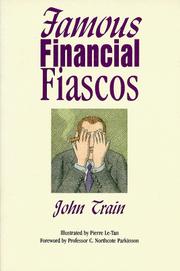
Famous Financial Fiascos
Short catalogue of manias and frauds across four centuries
Summary
Train, an investment manager and writer, collects short accounts of financial manias, frauds and disasters across several centuries: the tulip mania, the South Sea Bubble, John Law's Mississippi scheme, various American promotions, the Hunt brothers' attempt to corner silver, and assorted swindles and inventions that attracted capital.
The episodes are told briefly, often in a few pages each, with an emphasis on the absurd detail. Train's recurring observations are that manias require a plausible story about a genuinely new thing, that the promoters are frequently believers rather than cynics, that the last stage of a mania draws in people who have no knowledge of the subject at all, and that the same structures recur across centuries with different assets.
The book is entertaining rather than analytical, and its use is as a compact reference of cases rather than as a framework. Train does not attempt the economic history that Kindleberger or Chancellor provide, and readers wanting an explanation of why manias occur should go to those. The reference has not verified the specific factual details of the shorter episodes, several of which come from secondary popular sources and some of which, notably the tulip mania, have been substantially revised by subsequent scholarship. Read it for the range of cases and the pattern recognition, not as history.
Key takeaways 7
- Financial manias require a plausible story about something genuinely new, which is why they attach to real innovations rather than to obvious frauds.
- Promoters of speculative schemes are frequently believers rather than cynics, which is what makes them convincing.
- The final stage of a mania draws in participants with no knowledge of the asset, and their arrival is the most reliable signal of the top.
- Attempts to corner a commodity market fail because the high price the corner creates calls forth supply the cornerer must also buy.
- The same speculative structures recur across centuries attached to different assets, which suggests the cause is in the participants rather than the asset.
- Leverage is present in every episode and determines how fast the unwinding happens rather than whether it happens.
- Public enthusiasm for a new technology is not evidence about the returns available to investors in it.
Who should read it
Investors who want a compact collection of speculative episodes for pattern recognition, with the historical detail treated as unverified.
About John Train
American investment adviser who founded Train, Smith Counsel and wrote profiles of the era's leading money managers.
The Money Masters profiled Buffett, Graham, Templeton and Price while several were still working, setting out each manager's method in a few pages and establishing the format every later investor-profile book uses. Famous Financial Fiascos covers the reverse case, running through manias and frauds from the tulip trade onward.
Who recommended it 1 · 1 direct
Similar books 6
Chosen by shared topics, the entries that hold them, and the people who recommended both.
A template for how big debt crises unfold, with detailed case studies.

The history of business cycle theory and how credit cycles drive asset prices.
Free PDF at economicprinciples.org; first issued as A Template for Understanding Big Debt Crises.
Recommended by: Ray Dalio
Client letters through the dot-com bubble; value discipline written contemporaneously
“What a unique opportunity to traverse the Bubble and post-Bubble years with Frank Martin, exactly as he described them to his clients in real time. Speculative Contagion is sure to enlighten…” — Seth Klarman
Source: Klarman on traversing the bubble years with Martin
Recommended by: Mohnish Pabrai, Seth Klarman, Warren Buffett
Buying securities to profit from changes in value, with twelve commandments.
“The oldest book in my hall of fame is not The Intelligent Investor, but The Art of Speculation by Philip Carret. The book was published in 1930 and the best part in the book is the '12 Commandments'.” — Francois Rochon
Source: Rochon on the oldest book in his hall of fame
Recommended by: Francois Rochon, Mohnish Pabrai
The UK trust sector's own blow-up: gearing, cross-holdings and collapse.
Where it sits in the reference 2
Topics