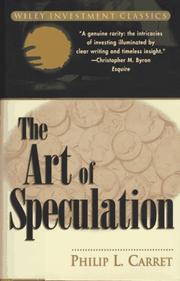
The Art of Speculation
Pre-Graham manual on speculation, margin and the psychology of markets
Summary
Carret founded the Pioneer Fund in 1928 and ran money for over sixty years, and this 1930 book states his approach to what he called speculation, meaning the purchase of securities in the expectation of profit from a change in their value rather than from income alone.
His definitional position is unusual and worth noting. Carret argues that the distinction between investment and speculation is less useful than commonly held, since any purchase involves a judgment about the future, and that the honest speculator who analyses a business is doing something more defensible than the investor who buys a bond without examining the issuer.
His twelve commandments of speculation are the most cited part. They include holding at least ten different securities covering at least five different fields of business; reviewing every holding at least once every six months; keeping at least half of total funds in income-producing securities; considering yield the least important factor in analysing any stock; being quick to take losses and slow to take profits; never putting more than a quarter of funds into securities about which detailed information is not readily available; avoiding inside information as one would avoid the plague; seeking facts diligently and advice never; ignoring mechanical formulas for valuing securities; avoiding buying during a bull market's peak enthusiasm; borrowing money sparingly and only when the market is depressed and rates are low; and setting aside a moderate proportion of funds for long-term options on promising companies.
The reference has verified the framework and the commandments rather than the detail of every chapter. The market conditions and instruments described are from before 1930. The commandments have held up remarkably well.
Key takeaways 8
- The distinction between investment and speculation is less useful than commonly held, since every purchase involves a judgment about the future.
- A portfolio should hold at least ten securities across at least five different fields of business.
- Every holding should be reviewed at least twice a year regardless of how it has performed.
- Yield is the least important factor in analysing a common stock, since a high yield frequently indicates a business in decline.
- Losses should be taken quickly and profits slowly, which reverses what most investors actually do.
- Inside information should be avoided entirely, since the person supplying it has their own position and their own reasons.
- Facts should be sought diligently and advice never, which places the analytical burden entirely on the investor.
- Borrowing should be done sparingly and only when the market is depressed and interest rates are low, which is the opposite of when credit is easiest to obtain.
Who should read it
Investors who want a set of durable operating rules from a practitioner whose career spanned more than sixty years.
About Philip L. Carret
Founded the Pioneer Fund in 1928 and ran money for seven decades through Carret & Company; died in 1998, aged 101.
The Art of Speculation, published in 1930, made the case for buying securities on appraised value with a margin of safety two years before Graham and Dodd's Security Analysis, which places it at the start of the value tradition rather than downstream of it. A Money Mind at Ninety records the holding periods, position sizing and management assessments behind a record spanning the Depression and the post-war decades.
Who recommended it 2 · 2 direct
“The oldest book in my hall of fame is not The Intelligent Investor, but The Art of Speculation by Philip Carret. The book was published in 1930 and the best part in the book is the '12 Commandments'.”
Similar books 6
Chosen by shared topics, the entries that hold them, and the people who recommended both.

Client letters through the dot-com bubble; value discipline written contemporaneously
“What a unique opportunity to traverse the Bubble and post-Bubble years with Frank Martin, exactly as he described them to his clients in real time. Speculative Contagion is sure to enlighten…” — Seth Klarman
Source: Klarman on traversing the bubble years with Martin
Recommended by: Mohnish Pabrai, Seth Klarman, Warren Buffett
The history of business cycle theory and how credit cycles drive asset prices.

A fund manager of sixty years on investing, business and a long life.
Recommended by: Mohnish Pabrai

Recommended by: Mohnish Pabrai

A template for how big debt crises unfold, with detailed case studies.
Buy a few outstanding growth companies, research them by scuttlebutt, and hold.
“The late Philip Fisher wrote several books that are very good [including] Common Stocks and Uncommon Profits.” — Arnold Van Den Berg
Source: Van Den Berg on Fisher's books
Recommended by: Arnold Van Den Berg, Bill Stewart and 10 others
Where it sits in the reference 3
Topics