Updates

  1. Person pages list letters, writing, profiles and links as sortable tables with filters, and show each person's companies as links; Fund letters show each letter's description in its own column.
  2. Experts show a checked job title and a short description of each person; 30 more people have photographs.
  3. Every company, fund, university and publication the experts work for has a page listing the people there.
  4. Fund letters show each letter's thesis and filter by it; 225 person pages list the essays, columns and newsletter issues the person wrote.
  5. Person pages list every essay and newsletter issue a person wrote, and their own books as a table in List view.
  6. Recommends shows the five largest kinds of book and the rest under More; browse pictures load sooner.
  7. Podcasts and talks link the original episode, filter by Audio and video or Press, and list each publisher once.
  8. Pages are wider, Recommends has List and Grid, and a filter clicked again turns off.
  9. Book cards sit in a ruled grid with Open Library and Goodreads links and each book's one-line note.
  10. Funds is now Investors; each investor's styles are buttons that filter the table.
  11. Podcasts and talks on a person's page filter by year and publisher and show as a list or a grid of pictures.
  12. Quotes show only people's own words: 472 summaries written by list sites are gone.
  13. Country pages open from Browse again, and every link on the shelf lands on a page.
  14. Subject and person pages show their sections as tabs, and each book appears once on a person's page.
  15. Book cards show the quote, who said it and the source; grids show five cards to a row.
  16. On a phone, a menu holds the sections, search, Updates, Feedback and dark mode.
  17. Feedback takes a screenshot of the page with no browser prompt, opens a screenshot full size when you click it, and clears itself once sent.
  18. Book cards are centred, search names the topic each book sits in, and any text cut short shows whole on hover.
  19. Search groups its results by kind: people, companies, geographies, subjects, topics, books, funds, fund letters and papers.
  20. The Books table lists who recommended each book by name, and the browser tab names the section you are in.
  21. Feedback can take a screenshot of the page, or one you paste or choose, and opens in the corner beside Updates.
  22. Each rail button reopens its section where you left it, and Browse, Table and People show on every book and subject page.
  23. Filters grey out choices that hold nothing instead of hiding them, and Books › People filters by authors or recommenders.
  24. Feedback takes a subject line and up to three screenshots.
  25. Biographies are grouped by the person they are about: 41 new pages, from Abraham Lincoln to Lee Kuan Yew.
  26. Sport splits into 23 sports, and Religion into one topic per faith.
  27. Book lists show as cards: the cover, one recommendation quote and every recommender by name.
  28. Seventeen subjects that had two or three pages under different names now have one page each.
  29. Every page lists its Experts as authors and recommenders, with a link to them on the Experts tab.
  30. Economics, Financial history, Financial panics and Accounting are subjects of their own, with one page per financial crisis.
  31. Book, person and subject pages open inside the app, so the tabs stay in view.
  32. 996 more book covers, and photographs or logos for 227 more people and companies.
  33. Books › Browse shows every subject as cards, and the rail holds Fund letters, Papers, Experts, Books and Funds.
  34. Every topic over 150 books splits into narrower topics, each with a page of its own.

Send feedback

What is it?
Screenshots, up to 3 (optional)
or paste one with Ctrl+V

We use your email only to reply to you.

Financial Services without Borders

Financial Services without Borders

Charles D. Ellis
2001
T4 240 pages · about 4h to read Open Librarygoodreads

Summary

The reference has not verified this book in detail; the summary states only what the title, author and subject establish.

Ellis, who founded Greenwich Associates and wrote Winning the Loser's Game, produced this in 2001 as an assessment of how the financial services industry would develop as national boundaries mattered less. The reference has not verified the book's detailed contents.

The context was the period's expectation that financial services would consolidate globally: national restrictions were falling, the euro had been introduced, electronic trading was replacing physical exchanges, the Glass-Steagall separation had just been repealed in the United States, and large institutions were combining banking, asset management, insurance and securities across borders.

Ellis's recurring positions across his career include the observation that active investment management as a whole cannot outperform the market it constitutes, that costs determine relative outcomes, that institutional investors' decisions are driven by client relationships and career considerations, and that the asset management industry's economics differ fundamentally from the interests of its clients.

The predictions of the period were substantially wrong in specific ways. The financial supermarket model that the repeal of Glass-Steagall enabled produced few of the promised cross-selling gains and considerable risk. Global consolidation reversed after 2008, with large institutions retreating to home markets under regulatory pressure and capital requirements. What did happen, the growth of index management and the resulting fee compression, was not the direction most observers of 2001 expected.

Readers should treat this as a period document and verify its specific arguments against its contents.

Key takeaways 6

  1. The 2001 expectation was that financial services would consolidate globally as national restrictions fell.
  2. The financial supermarket model enabled by the repeal of Glass-Steagall produced few of the promised cross-selling gains.
  3. Global consolidation reversed after 2008 as regulation and capital requirements pushed institutions back toward home markets.
  4. Active management as a whole cannot outperform the market it constitutes, which is arithmetic rather than a finding.
  5. Costs determine relative outcomes among managers more reliably than any other observable characteristic.
  6. The growth of index management and the resulting fee compression was not the direction most observers of 2001 anticipated.

Who should read it

Readers interested in what the financial services industry expected of itself in 2001, verified against the book's actual arguments.

About Charles D. Ellis

Founder of Greenwich Associates; chair of the Yale endowment investment committee; author of 'The Loser's Game'

His 1975 essay 'The Loser's Game' is the primary source that reframed active management as a negative-sum contest, and the argument is still cited verbatim.

Greenwich Associates

Similar books 6

Chosen by shared topics, the entries that hold them, and the people who recommended both.
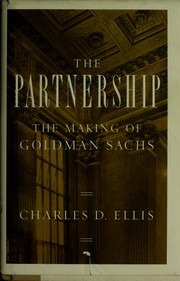
Charles D. Ellis · 2008

Goldman Sachs from Marcus Goldman's commercial paper to its 1999 public offering.

Recommended by: Mohnish Pabrai

Arthur Levitt, Paula Dwyer · 2002

How small investors can protect themselves from Wall Street's confusing practices.

Recommended by: Warren Buffett

Charles D. Ellis · 1998

Why active investing became a loser's game, decided by errors, not by skill.

“In his marvelous book, Winning the Loser's Game, Charlie Ellis says” — Bill Miller

Source: Bill Miller 2Q 2020 Market Letter

Recommended by: Bill Miller, Mohnish Pabrai, Howard Marks

Mauro F. Guillen, Adrian Tschoegl · 2008

How Banco Santander grew from a Spanish regional bank into a global one.

Stephen Aris · 1994

Commissioned history, written long before the run.

Where it sits in the reference 2

Investors
Financial history

Topics

Finance and MarketsInvesting