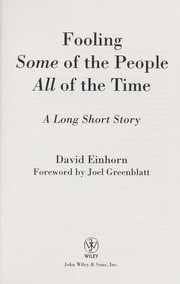
Fooling Some of the People All of the Time
Subtitled A Long Short Story; foreword by Joel Greenblatt; 2010 edition adds an epilogue.
Summary
Einhorn runs Greenlight Capital and documents his six-year short position in Allied Capital, a business development company he argued was overvaluing its illiquid investments and whose lending subsidiary was defrauding a federal loan programme. The book reproduces his analysis in detail, including the valuation methodology Allied used for assets with no market price, the specific loans he examined, and the arithmetic behind his conclusion. He first stated the position publicly at a charity investment conference in 2002, and the book covers what followed.
The more consequential material concerns the response. Allied hired investigators who obtained Einhorn's telephone records through pretexting. The company attacked him publicly and to regulators. The Securities and Exchange Commission investigated Einhorn rather than Allied. Analysts and journalists largely accepted the company's account. The lending subsidiary was eventually found to have defrauded the Small Business Administration and paid a settlement, years after Einhorn had documented it.
His broader argument is that short sellers provide information the market will not otherwise produce, that the structural and regulatory environment treats them as suspects rather than as sources, and that this asymmetry allows misrepresentation to persist.
The book is written by an interested party with a position, which Einhorn states throughout. It is long and the level of financial detail will lose readers without accounting familiarity. Allied disputed the account. Its value is the documented record of what happens to someone who publicly identifies a problem before the institutions do.
Key takeaways 8
- Companies holding illiquid assets with no market price can value them at whatever their own models produce, which is the specific vulnerability Einhorn identified.
- A short seller who states a position publicly becomes the subject of investigation rather than the company they are describing.
- The company obtained Einhorn's telephone records through pretexting and used public attacks and regulatory complaints as its response.
- Regulators investigated the person raising the concern and not the conduct he described, for years before the fraud was established.
- Analysts and journalists largely accepted the company's account, since the incentives favour the company that provides access.
- Short sellers produce information the market will not otherwise generate, since nobody else is paid to find problems.
- The position took six years to be vindicated, which is longer than most funds could hold it and most investors would tolerate.
- The book is written by a person holding the position, which Einhorn states throughout, and the company disputed the account.
Who should read it
Investors interested in analysing illiquid asset valuations and in the practical experience of holding a public short position against an active opponent.
About David Einhorn
Co-founder and President, Greenlight Capital 1996-present; Chairman, Greenlight Capital Re
Fooling Some of the People All of the Time is the most detailed first-person account of a public short thesis ever published, and his quarterly partner letters are widely read as a template for the form.
Who recommended it 2
Similar books 6
Chosen by shared topics, the entries that hold them, and the people who recommended both.
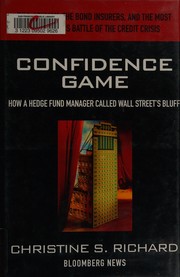
Bill Ackman's six-year campaign against bond insurer MBIA, from 2002 to 2008.
Recommended by: Andrew Wilkinson, Bill Ackman
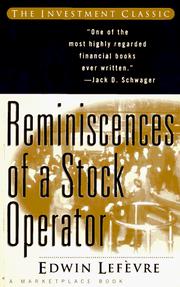
A speculator modelled on Jesse Livermore learns to read and trade the market.
“The finest trading book ever written is Reminiscences of a Stock Operator by Edwin LeFevre. It is colloquial reminiscences by a legendary speculator of the mistakes and lessons he learned over a…” — Barton Biggs
Source: Biggs calling it the finest trading book ever written
Recommended by: Barton Biggs, Bill Miller, Colm O'Shea and 5 others
The Hunt brothers' attempt to corner silver and its collapse in March 1980.
How Jho Low diverted billions from Malaysia's 1MDB fund into parties and politics.
Recommended by: Alexis Ohanian, Alfred Lin and 5 others
Enron's collapse told scene by scene from depositions, emails and interviews.
Recommended by: Mohnish Pabrai
Where it sits in the reference 3
Topics