Updates

  1. Person pages list letters, writing, profiles and links as sortable tables with filters, and show each person's companies as links; Fund letters show each letter's description in its own column.
  2. Experts show a checked job title and a short description of each person; 30 more people have photographs.
  3. Every company, fund, university and publication the experts work for has a page listing the people there.
  4. Fund letters show each letter's thesis and filter by it; 225 person pages list the essays, columns and newsletter issues the person wrote.
  5. Person pages list every essay and newsletter issue a person wrote, and their own books as a table in List view.
  6. Recommends shows the five largest kinds of book and the rest under More; browse pictures load sooner.
  7. Podcasts and talks link the original episode, filter by Audio and video or Press, and list each publisher once.
  8. Pages are wider, Recommends has List and Grid, and a filter clicked again turns off.
  9. Book cards sit in a ruled grid with Open Library and Goodreads links and each book's one-line note.
  10. Funds is now Investors; each investor's styles are buttons that filter the table.
  11. Podcasts and talks on a person's page filter by year and publisher and show as a list or a grid of pictures.
  12. Quotes show only people's own words: 472 summaries written by list sites are gone.
  13. Country pages open from Browse again, and every link on the shelf lands on a page.
  14. Subject and person pages show their sections as tabs, and each book appears once on a person's page.
  15. Book cards show the quote, who said it and the source; grids show five cards to a row.
  16. On a phone, a menu holds the sections, search, Updates, Feedback and dark mode.
  17. Feedback takes a screenshot of the page with no browser prompt, opens a screenshot full size when you click it, and clears itself once sent.
  18. Book cards are centred, search names the topic each book sits in, and any text cut short shows whole on hover.
  19. Search groups its results by kind: people, companies, geographies, subjects, topics, books, funds, fund letters and papers.
  20. The Books table lists who recommended each book by name, and the browser tab names the section you are in.
  21. Feedback can take a screenshot of the page, or one you paste or choose, and opens in the corner beside Updates.
  22. Each rail button reopens its section where you left it, and Browse, Table and People show on every book and subject page.
  23. Filters grey out choices that hold nothing instead of hiding them, and Books › People filters by authors or recommenders.
  24. Feedback takes a subject line and up to three screenshots.
  25. Biographies are grouped by the person they are about: 41 new pages, from Abraham Lincoln to Lee Kuan Yew.
  26. Sport splits into 23 sports, and Religion into one topic per faith.
  27. Book lists show as cards: the cover, one recommendation quote and every recommender by name.
  28. Seventeen subjects that had two or three pages under different names now have one page each.
  29. Every page lists its Experts as authors and recommenders, with a link to them on the Experts tab.
  30. Economics, Financial history, Financial panics and Accounting are subjects of their own, with one page per financial crisis.
  31. Book, person and subject pages open inside the app, so the tabs stay in view.
  32. 996 more book covers, and photographs or logos for 227 more people and companies.
  33. Books › Browse shows every subject as cards, and the rail holds Fund letters, Papers, Experts, Books and Funds.
  34. Every topic over 150 books splits into narrower topics, each with a page of its own.

Send feedback

What is it?
Screenshots, up to 3 (optional)
or paste one with Ctrl+V

We use your email only to reply to you.

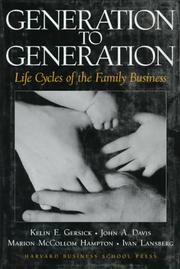
Generation to Generation

Generation to Generation

Kelin E. Gersick, John A. Davis, Marion McCollom Hampton, Ivan Lansberg
1997
T1 302 pages · about 5h 2m to read Open Librarygoodreads

The three-circle model; the founding text of family-business study.

Summary

Gersick, Davis, McCollom Hampton and Lansberg, researchers and advisers in family business, wrote this as the standard academic treatment of how family firms develop over time.

The framework builds on the three-circle model, which represents a family business as three overlapping systems: the family, the business and the ownership. Any individual occupies one or more of the resulting seven positions, and the model explains why conflicts arise: a family member who is an owner but not an employee has different interests from one who is an employee but not an owner, and both differ from a non-family manager.

The book's contribution is adding time. Each of the three systems develops through its own stages, and the combination determines what the business faces. The ownership axis moves from controlling owner, through sibling partnership, to cousin consortium, and each transition multiplies the number of owners while diluting each holding and increasing the distance between owners and the business. The family axis moves through young business family, entering the business, working together, and passing the baton, driven by the founder's and children's life stages. The business axis moves through start-up, expansion and formalisation, and maturity.

The practical value is that it identifies which problems arise from which transition. A firm moving from sibling partnership to cousin consortium faces liquidity demands from owners not employed in the business, the need for formal governance, and dividend policy conflicts that did not exist before. A firm whose founder is approaching succession faces different problems entirely.

The book is academic and thorough. It is descriptive rather than prescriptive: it explains what a family firm at a given point faces without saying what to do, and readers wanting operating advice must supply it. It remains the reference framework in the field.

Key takeaways 7

  1. A family business consists of three overlapping systems covering family, business and ownership, and any individual occupies one or more positions among them.
  2. Conflicts arise predictably from the different interests of owners who work in the business, owners who do not, and non-family managers.
  3. Ownership moves from controlling owner through sibling partnership to cousin consortium, and each transition multiplies owners while diluting holdings.
  4. A cousin consortium faces liquidity demands from owners not employed in the business, which earlier stages do not.
  5. Formal governance becomes necessary at the transition to multiple owners, because informal agreement no longer scales.
  6. The problems a family firm faces are predictable from its position on the three developmental axes rather than being unique to it.
  7. Dividend policy becomes contested once some owners depend on distributions while others draw salaries from the business.

Who should read it

Family business owners, advisers and investors in family-controlled companies who need to anticipate which conflicts arise at which transition.

Similar books 6

Chosen by shared topics, the entries that hold them, and the people who recommended both.
John L. Ward · 1987

How family-owned firms can plan for growth, ownership and succession.
John L. Ward · 2004

Lessons on why some family firms survive across generations and others do not.
Jack Stack, Bo Burlingham · 2002

Building an ownership culture in which employees think and act like owners.
William Poundstone · 2012

Tech firms' puzzle interview questions, and whether they pick good hires.

Recommended by: Sophie Bakalar

Where it sits in the reference 3

Business models
Business themes
Business themes

Topics

Business and ManagementParenting and Family