Updates

  1. Person pages list letters, writing, profiles and links as sortable tables with filters, and show each person's companies as links; Fund letters show each letter's description in its own column.
  2. Experts show a checked job title and a short description of each person; 30 more people have photographs.
  3. Every company, fund, university and publication the experts work for has a page listing the people there.
  4. Fund letters show each letter's thesis and filter by it; 225 person pages list the essays, columns and newsletter issues the person wrote.
  5. Person pages list every essay and newsletter issue a person wrote, and their own books as a table in List view.
  6. Recommends shows the five largest kinds of book and the rest under More; browse pictures load sooner.
  7. Podcasts and talks link the original episode, filter by Audio and video or Press, and list each publisher once.
  8. Pages are wider, Recommends has List and Grid, and a filter clicked again turns off.
  9. Book cards sit in a ruled grid with Open Library and Goodreads links and each book's one-line note.
  10. Funds is now Investors; each investor's styles are buttons that filter the table.
  11. Podcasts and talks on a person's page filter by year and publisher and show as a list or a grid of pictures.
  12. Quotes show only people's own words: 472 summaries written by list sites are gone.
  13. Country pages open from Browse again, and every link on the shelf lands on a page.
  14. Subject and person pages show their sections as tabs, and each book appears once on a person's page.
  15. Book cards show the quote, who said it and the source; grids show five cards to a row.
  16. On a phone, a menu holds the sections, search, Updates, Feedback and dark mode.
  17. Feedback takes a screenshot of the page with no browser prompt, opens a screenshot full size when you click it, and clears itself once sent.
  18. Book cards are centred, search names the topic each book sits in, and any text cut short shows whole on hover.
  19. Search groups its results by kind: people, companies, geographies, subjects, topics, books, funds, fund letters and papers.
  20. The Books table lists who recommended each book by name, and the browser tab names the section you are in.
  21. Feedback can take a screenshot of the page, or one you paste or choose, and opens in the corner beside Updates.
  22. Each rail button reopens its section where you left it, and Browse, Table and People show on every book and subject page.
  23. Filters grey out choices that hold nothing instead of hiding them, and Books › People filters by authors or recommenders.
  24. Feedback takes a subject line and up to three screenshots.
  25. Biographies are grouped by the person they are about: 41 new pages, from Abraham Lincoln to Lee Kuan Yew.
  26. Sport splits into 23 sports, and Religion into one topic per faith.
  27. Book lists show as cards: the cover, one recommendation quote and every recommender by name.
  28. Seventeen subjects that had two or three pages under different names now have one page each.
  29. Every page lists its Experts as authors and recommenders, with a link to them on the Experts tab.
  30. Economics, Financial history, Financial panics and Accounting are subjects of their own, with one page per financial crisis.
  31. Book, person and subject pages open inside the app, so the tabs stay in view.
  32. 996 more book covers, and photographs or logos for 227 more people and companies.
  33. Books › Browse shows every subject as cards, and the rail holds Fund letters, Papers, Experts, Books and Funds.
  34. Every topic over 150 books splits into narrower topics, each with a page of its own.

Send feedback

What is it?
Screenshots, up to 3 (optional)
or paste one with Ctrl+V

We use your email only to reply to you.

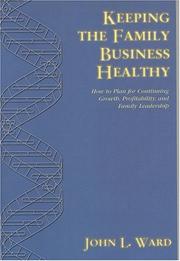
Keeping the Family Business Healthy

Keeping the Family Business Healthy

John L. Ward
1987
T2 266 pages · about 4h 26m to read Open Librarygoodreads

Growth, succession and ownership planning; the field's first practical manual.

Summary

John Ward taught family business at Loyola and later at Kellogg, and this book established much of the field's working vocabulary. Its subject is the specific planning problem faced by a business whose owners are related to each other, where the business strategy and the family's arrangements determine each other.

Ward's empirical starting point is the survival data: roughly thirty per cent of family businesses reach the second generation and about thirteen per cent the third. He argues that the usual explanations, incompetent heirs and family conflict, are symptoms. The underlying cause is that family firms stop reinvesting. A founder builds a business in a growing market, the second generation inherits a mature business with rising owner distributions, capital expenditure falls behind, and the firm loses competitive position at exactly the moment when the family's financial needs are greatest.

His prescription is joint planning. The strategic plan must be developed alongside the family plan, because decisions about dividends, about employing relatives, about ownership transfer and about outside directors all constrain what strategy is available. He sets out the specific mechanisms: written family policies on employment and compensation, boards with genuinely independent directors, formal strategy review, and explicit decisions about whether the family intends to remain owners. The book is from 1987, and its treatment of governance has been extended considerably by later work including Ward's own, but the diagnosis of the reinvestment failure remains the field's central insight.

Key takeaways 7

  1. Family firms fail because they stop reinvesting, and family conflict is a consequence of declining business performance rather than its cause.
  2. The second generation typically inherits a mature business whose market has stopped growing, which is a different problem from the one the founder solved.
  3. Owner distributions and capital expenditure compete for the same cash, and family needs rise as the business's needs do.
  4. Strategic planning and family planning must be done together, because each constrains the options available to the other.
  5. Written employment policies for family members, agreed before anyone applies, prevent the disputes that informal arrangements guarantee.
  6. Independent directors are the single most effective governance mechanism available to a family firm, because they can say what employees cannot.
  7. Ward argues that the family must explicitly decide whether it intends to remain an owner, since drifting into the next generation forecloses better options.

Who should read it

Owners, advisers and investors dealing with family-controlled companies who want the underlying economic explanation for generational failure and the governance tools that address it.

Similar books 6

Chosen by shared topics, the entries that hold them, and the people who recommended both.
Kelin E. Gersick, John A. Davis, Marion McCollom Hampton, Ivan Lansberg · 1997

How family firms develop, seen as three overlapping circles: family, owners, firm.
John L. Ward · 2004

Lessons on why some family firms survive across generations and others do not.
Jack Stack, Bo Burlingham · 2002

Building an ownership culture in which employees think and act like owners.
William Poundstone · 2012

Tech firms' puzzle interview questions, and whether they pick good hires.

Recommended by: Sophie Bakalar

Where it sits in the reference 3

Business models
Business themes
Business themes

Topics

Business and ManagementParenting and Family