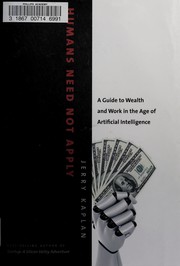
Humans Need Not Apply
How machine learning and robots will displace work faster than institutions adapt.
Summary
Kaplan, who founded GO Corporation and Onsale and teaches at Stanford, argues that machine learning and robotics will displace labour on a scale that existing institutions cannot absorb, and that the resulting problem is distributional rather than technological.
His framing has two parts. Synthetic intellects are systems that learn statistical patterns from data without being programmed with rules, and forged laborers are machines that act physically in the world. He argues these together attack cognitive and manual work simultaneously, which is different from previous automation waves that displaced one at a time. He examines the effect on employment, on wealth concentration since capital rather than labour captures the gains, on legal liability when a learning system causes harm and no one wrote the rule it followed, and on financial markets where algorithmic agents already interact faster than any human oversight.
His proposals are unusual and are the most interesting part. He suggests job mortgages, which finance retraining against future earnings; and a public benefit index that would give tax advantages to corporations whose shareholding is broadly distributed, on the reasoning that if capital captures the returns then ownership of capital should be widened rather than income redistributed after the fact. He is sceptical of universal basic income on the grounds that it separates people from productive participation.
The book is from 2015 and predates the transformer architecture and large language models entirely, so its picture of what the technology can do is dated in specifics while its distributional argument is not. Kaplan writes for a general audience and the economics is presented without much engagement with the labour economics literature on automation, which has found more complex effects than straightforward displacement.
Key takeaways 7
- Systems that learn statistical patterns from data and machines that act physically attack cognitive and manual work at the same time, which distinguishes this automation wave from earlier ones.
- The gains from automation accrue to owners of capital rather than to workers, which makes the resulting problem distributional rather than a question of total wealth.
- Legal liability breaks down when a learning system causes harm, because no person wrote the rule the system followed.
- Widening the ownership of capital is a better response to automation than redistributing income after it is earned.
- Universal basic income separates recipients from productive participation and is therefore an inferior solution to widened ownership.
- Financial markets are already populated by autonomous agents transacting faster than human supervision can operate, which is a preview of the wider problem.
- Retraining should be financed against future earnings in the way education is, rather than provided as a public programme detached from labour market outcomes.
Who should read it
Investors and policy-minded operators who want an early framing of automation as a distributional problem, read with the knowledge that the technology section predates modern language models.
Who recommended it 2
Similar books 6
Chosen by shared topics, the entries that hold them, and the people who recommended both.
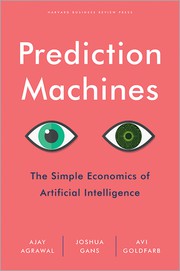
AI as a fall in the cost of prediction, and what that does to decisions and jobs.
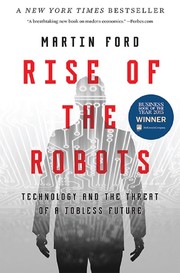
Why automation of cognitive work may cause lasting unemployment.
Recommended by: Daniel Petre, Patrick O'Shaughnessy
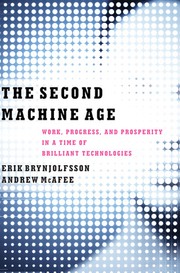
How digital technology is changing work and wealth as the Industrial Revolution did.
“For additional discussion of freestyle chess, see Erik Brynjolfsson and Andrew McAfee, The Second Machine Age: Work, Progress, and Prosperity in a Time of Brilliant Technologies (New York: W.W. Norton & Company, 2014)” — Michael Mauboussin
Source: Lessons from Freestyle Chess: Merging Fundamental and Quantitative Analysis, page 9
Recommended by: Michael Mauboussin, Mohnish Pabrai and 5 others
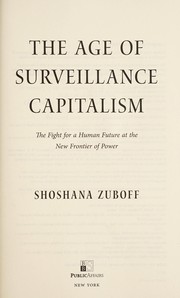
How Google and others turn behaviour into data to predict and steer what people do.
Recommended by: Vinod Khosla, Benedict Evans
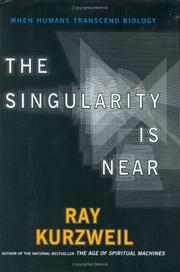
Why technological progress is exponential, and what follows if the trend holds.
Recommended by: Brian Armstrong, Patrick Collison and 7 others
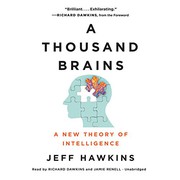
The theory that the neocortex works through thousands of models of the world.
Recommended by: Bill Gates