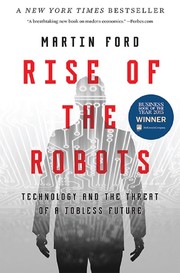
Rise of the Robots
Why automation of cognitive work may cause lasting unemployment.
Summary
Ford, a software entrepreneur, argues that information technology differs from earlier automation because it improves exponentially and applies to cognitive work, and that this will produce structural unemployment rather than the labour reallocation that followed previous waves.
His evidence is a set of trends: the decoupling of productivity from median wages since the 1970s, the falling labour share of income, declining new business formation, and the accumulation of specific automation cases across manufacturing, retail, food service, journalism, law, radiology and software development. He devotes chapters to higher education, arguing that the credential response to automation is failing because graduates are entering jobs that are themselves being automated, and to healthcare, where he argues costs are structurally unsustainable and where automation has been slowest.
His central economic claim is a demand argument. If automation removes the wage income of a large share of consumers, the resulting economy has no buyers for what the automated production generates. He proposes a guaranteed basic income, structured with incentives so that it does not remove the reward for work, as the mechanism for maintaining consumer demand in an economy where labour income has collapsed.
The book won the Financial Times business book prize and predates large language models, which have made several of his specific predictions about cognitive automation look prescient and others premature. Labour economists dispute the core claim, pointing out that employment did not collapse in the decade after publication and that the productivity growth his argument requires has been conspicuously absent. His treatment of the empirical labour literature is thin.
Key takeaways 7
- Information technology differs from previous automation because it improves at an exponential rate and applies directly to cognitive work rather than only to physical work.
- Productivity and median wages decoupled in the United States after the 1970s, and the divergence reflects automation capturing the gains from output growth.
- Automation now attacks the jobs that education was supposed to protect, which means acquiring more credentials is not a general solution.
- An economy that removes wage income from most consumers has no market for the output its automated production generates.
- A guaranteed basic income, designed to preserve incentives to work and study, is the mechanism required to maintain consumer demand.
- Machine learning systems that improve from accumulated data create winner-take-all positions, because the leading system attracts the data that widens its lead.
- Healthcare and education have resisted automation and therefore absorb a rising share of income, which is a constraint on living standards rather than a refuge for employment.
Who should read it
Investors and policy-minded readers who want the structural-unemployment case stated carefully, read against a decade of subsequent labour market data.
Who recommended it 2
Similar books 6
Chosen by shared topics, the entries that hold them, and the people who recommended both.
How machine learning and robots will displace work faster than institutions adapt.
Recommended by: Antonio García Martínez, Brian Armstrong
AI as a fall in the cost of prediction, and what that does to decisions and jobs.
How Google and others turn behaviour into data to predict and steer what people do.
Recommended by: Vinod Khosla, Benedict Evans
How digital technology is changing work and wealth as the Industrial Revolution did.
“For additional discussion of freestyle chess, see Erik Brynjolfsson and Andrew McAfee, The Second Machine Age: Work, Progress, and Prosperity in a Time of Brilliant Technologies (New York: W.W. Norton & Company, 2014)” — Michael Mauboussin
Source: Lessons from Freestyle Chess: Merging Fundamental and Quantitative Analysis, page 9
Recommended by: Michael Mauboussin, Mohnish Pabrai and 5 others

What humanity may seek after famine, plague and war: immortality and divinity.
“Very interesting alternative perspective on life from a historian. Anti-religion, anti-humanism, pro-animal. Seems detached, but is quite opinionated. Much to think about, regardless. My notes here give a taste. A lot to think about.” — Derek Sivers
Source: Derek Sivers book notes (primary, rated list) · Rating: 6/10
Recommended by: Andrew Wilkinson, Bill Gates, Derek Sivers and 8 others
Why technological progress is exponential, and what follows if the trend holds.
Recommended by: Brian Armstrong, Patrick Collison and 7 others