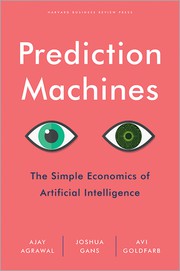
Prediction Machines
AI as a fall in the cost of prediction, and what that does to decisions and jobs.
AI framed as a fall in the cost of prediction; the standard economics treatment.
Summary
Agrawal, Gans and Goldfarb, economists at Toronto's Rotman school, argue that recent advances in artificial intelligence should be understood as a drop in the cost of one specific input: prediction, meaning filling in missing information from existing information. Framing it this way lets standard economics answer the strategic questions.
The consequences follow from price theory. When the cost of something falls, use of it rises, and the value of its complements rises while the value of its substitutes falls. Prediction's complements are data, judgement about what to do with a prediction, and action. Its substitute is human prediction. So cheap prediction raises the value of judgement, meaning the specification of what outcomes are worth, which machines do not supply.
They decompose a task into prediction, judgement, data, action and outcome, and argue that automation happens task by task rather than job by job, so a job survives when its non-prediction components dominate. They also argue that cheap prediction changes what problems are worth solving at all: when prediction becomes cheap enough, problems that were not framed as prediction problems get reframed, which is how autonomous driving became tractable.
The strategic material covers where to position in the value chain, how to decide whether to build or buy, and the risks including data feedback loops and liability.
The book is short and the framing is genuinely clarifying. It predates large language models, whose capabilities extend beyond prediction as narrowly defined here, and readers should test whether the framework still contains what these systems do.
Key takeaways 7
- Recent artificial intelligence advances amount to a fall in the cost of prediction, meaning filling in missing information from available information.
- When prediction becomes cheap, the value of its complements rises, and the most important complement is human judgement about what outcomes are worth.
- Automation occurs task by task rather than job by job, so a job survives when its non-prediction components dominate its value.
- Cheap prediction changes what problems get framed as prediction problems, which is how previously intractable tasks become solvable.
- Data is a complement to prediction, so the value of data rises as prediction costs fall, which determines where the returns accrue.
- Deploying prediction in a business requires specifying the payoff of each possible outcome, and that specification is the work that cannot be delegated to a system.
- The strategic question is which decisions in a business become worth making differently when prediction is nearly free, not which jobs are replaced.
Who should read it
Executives and investors deciding where machine learning changes their business economics, using a framework that turns the question into price theory.
Similar books 6
Chosen by shared topics, the entries that hold them, and the people who recommended both.
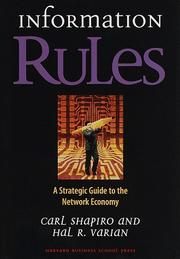
Economics for information goods: pricing, versioning, lock-in and network effects.
“Carl Shapiro and Hal R. Varian, Information Rules (Boston, MA: Harvard Business School Press, 1999), 174” — Michael Mauboussin
Source: The Ecosystem Edge, page 10
Recommended by: Michael Mauboussin, Mohnish Pabrai and 1 other
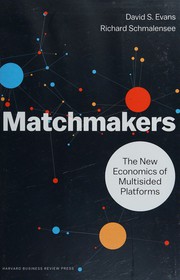
How multi-sided platforms such as card networks get both sides on board at once.
“David S. Evans and Richard Schmalensee, Matchmakers: The New Economics of Multisided Platforms (Boston, MA: Harvard Business Review Press, 2016)” — Michael Mauboussin
Source: Measuring the Moat: Assessing the Magnitude and Sustainability of Value Creation
Recommended by: Michael Mauboussin
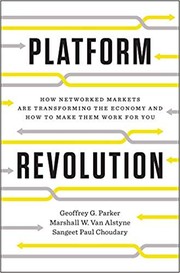
How platforms create value by matching groups, unlike linear pipeline businesses.
Recommended by: Reid Hoffman
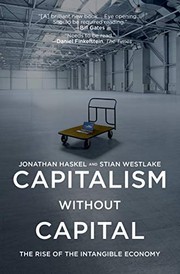
How the economy changes when intangible assets replace physical capital.
“For a more thorough review of the characteristics of intangible assets, see Jonathan Haskel and Stian Westlake, Capitalism Without Capital: The Rise of the Intangible Economy (Princeton, NJ: Princeton University Press, 2017), 56-88” — Michael Mauboussin
Source: The Impact of Intangibles on Base Rates, page 10
Recommended by: Bill Gates, Michael Mauboussin
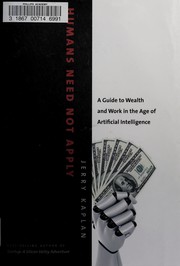
How machine learning and robots will displace work faster than institutions adapt.
Recommended by: Antonio García Martínez, Brian Armstrong
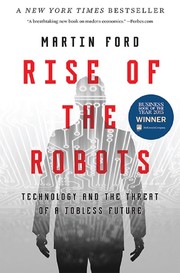
Why automation of cognitive work may cause lasting unemployment.
Recommended by: Daniel Petre, Patrick O'Shaughnessy