Updates

  1. Person pages list letters, writing, profiles and links as sortable tables with filters, and show each person's companies as links; Fund letters show each letter's description in its own column.
  2. Experts show a checked job title and a short description of each person; 30 more people have photographs.
  3. Every company, fund, university and publication the experts work for has a page listing the people there.
  4. Fund letters show each letter's thesis and filter by it; 225 person pages list the essays, columns and newsletter issues the person wrote.
  5. Person pages list every essay and newsletter issue a person wrote, and their own books as a table in List view.
  6. Recommends shows the five largest kinds of book and the rest under More; browse pictures load sooner.
  7. Podcasts and talks link the original episode, filter by Audio and video or Press, and list each publisher once.
  8. Pages are wider, Recommends has List and Grid, and a filter clicked again turns off.
  9. Book cards sit in a ruled grid with Open Library and Goodreads links and each book's one-line note.
  10. Funds is now Investors; each investor's styles are buttons that filter the table.
  11. Podcasts and talks on a person's page filter by year and publisher and show as a list or a grid of pictures.
  12. Quotes show only people's own words: 472 summaries written by list sites are gone.
  13. Country pages open from Browse again, and every link on the shelf lands on a page.
  14. Subject and person pages show their sections as tabs, and each book appears once on a person's page.
  15. Book cards show the quote, who said it and the source; grids show five cards to a row.
  16. On a phone, a menu holds the sections, search, Updates, Feedback and dark mode.
  17. Feedback takes a screenshot of the page with no browser prompt, opens a screenshot full size when you click it, and clears itself once sent.
  18. Book cards are centred, search names the topic each book sits in, and any text cut short shows whole on hover.
  19. Search groups its results by kind: people, companies, geographies, subjects, topics, books, funds, fund letters and papers.
  20. The Books table lists who recommended each book by name, and the browser tab names the section you are in.
  21. Feedback can take a screenshot of the page, or one you paste or choose, and opens in the corner beside Updates.
  22. Each rail button reopens its section where you left it, and Browse, Table and People show on every book and subject page.
  23. Filters grey out choices that hold nothing instead of hiding them, and Books › People filters by authors or recommenders.
  24. Feedback takes a subject line and up to three screenshots.
  25. Biographies are grouped by the person they are about: 41 new pages, from Abraham Lincoln to Lee Kuan Yew.
  26. Sport splits into 23 sports, and Religion into one topic per faith.
  27. Book lists show as cards: the cover, one recommendation quote and every recommender by name.
  28. Seventeen subjects that had two or three pages under different names now have one page each.
  29. Every page lists its Experts as authors and recommenders, with a link to them on the Experts tab.
  30. Economics, Financial history, Financial panics and Accounting are subjects of their own, with one page per financial crisis.
  31. Book, person and subject pages open inside the app, so the tabs stay in view.
  32. 996 more book covers, and photographs or logos for 227 more people and companies.
  33. Books › Browse shows every subject as cards, and the rail holds Fund letters, Papers, Experts, Books and Funds.
  34. Every topic over 150 books splits into narrower topics, each with a page of its own.

Send feedback

What is it?
Screenshots, up to 3 (optional)
or paste one with Ctrl+V

We use your email only to reply to you.

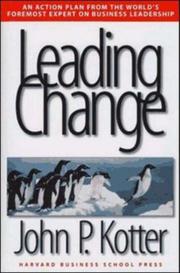
Leading Change

Leading Change

John P. Kotter
1996
T4 187 pages · about 3h 7m to read Open Librarygoodreads

Summary

Kotter, a Harvard Business School professor, sets out an eight-stage process for organisational transformation, derived from his observation of many change efforts and his conclusion that most fail.

The eight stages are: establish a sense of urgency, which he argues is the most commonly skipped and the most consequential omission, since people will not act while the current situation feels acceptable; create a guiding coalition with enough positional power, expertise and credibility to lead the effort, because no individual can drive change alone; develop a vision and strategy that can be communicated in five minutes; communicate the vision, which he argues requires an order of magnitude more repetition than executives supply and which fails most often when leaders behave inconsistently with it; empower broad-based action by removing the structures, systems and people that block it; generate short-term wins within twelve to twenty-four months, because credibility depends on visible results before the full change arrives; consolidate gains and produce more change rather than declaring victory, which he identifies as the most common cause of reversal; and anchor the changes in the culture, which happens last rather than first.

His central insight is the sequencing. The stages must occur in order, each is skipped at a predictable cost, and the most frequent failure is declaring success at stage six.

The book has no controlled evidence and rests on Kotter's consulting observation. It has been criticised as prescriptive and top-down, and later change literature emphasises emergence and participation more. The urgency and premature victory arguments are the most durable.

Key takeaways 7

  1. Establishing genuine urgency is the most commonly skipped stage and the most consequential, because people will not act while the current situation feels acceptable.
  2. No individual can drive organisational change alone, and a coalition with positional power, expertise and credibility must be assembled first.
  3. A vision that cannot be communicated convincingly in five minutes is not a vision that anyone will act on.
  4. Communication of a change vision requires an order of magnitude more repetition than executives supply, and fails entirely when leaders behave inconsistently with it.
  5. Visible short-term wins within two years are required to sustain credibility, and change efforts that promise only long-term results lose support.
  6. Declaring victory too early is the most common cause of reversal, because the changes have not yet become self-sustaining.
  7. Culture changes last rather than first, since new behaviour must produce visible results before people attribute value to it.

Who should read it

Executives leading organisational change who want a sequenced process and a diagnosis of the stages most commonly skipped.

Who recommended it 1 · 1 direct

Similar books 6

Chosen by shared topics, the entries that hold them, and the people who recommended both.

Patrick Lencioni · 2002

A fable of a failing executive team and a five-level model of what goes wrong.

Larry Bossidy, Ram Charan · 2002

Execution is a discipline the CEO must lead, linking people, strategy and operations.

Recommended by: Mohnish Pabrai, Jamie Dimon

T4 Fish
Stephen C. Lundin et al. · 2011

Where it sits in the reference 3

Business themes
Business themes
Business themes

Topics

LeadershipBusiness and Management