Updates

  1. Person pages list letters, writing, profiles and links as sortable tables with filters, and show each person's companies as links; Fund letters show each letter's description in its own column.
  2. Experts show a checked job title and a short description of each person; 30 more people have photographs.
  3. Every company, fund, university and publication the experts work for has a page listing the people there.
  4. Fund letters show each letter's thesis and filter by it; 225 person pages list the essays, columns and newsletter issues the person wrote.
  5. Person pages list every essay and newsletter issue a person wrote, and their own books as a table in List view.
  6. Recommends shows the five largest kinds of book and the rest under More; browse pictures load sooner.
  7. Podcasts and talks link the original episode, filter by Audio and video or Press, and list each publisher once.
  8. Pages are wider, Recommends has List and Grid, and a filter clicked again turns off.
  9. Book cards sit in a ruled grid with Open Library and Goodreads links and each book's one-line note.
  10. Funds is now Investors; each investor's styles are buttons that filter the table.
  11. Podcasts and talks on a person's page filter by year and publisher and show as a list or a grid of pictures.
  12. Quotes show only people's own words: 472 summaries written by list sites are gone.
  13. Country pages open from Browse again, and every link on the shelf lands on a page.
  14. Subject and person pages show their sections as tabs, and each book appears once on a person's page.
  15. Book cards show the quote, who said it and the source; grids show five cards to a row.
  16. On a phone, a menu holds the sections, search, Updates, Feedback and dark mode.
  17. Feedback takes a screenshot of the page with no browser prompt, opens a screenshot full size when you click it, and clears itself once sent.
  18. Book cards are centred, search names the topic each book sits in, and any text cut short shows whole on hover.
  19. Search groups its results by kind: people, companies, geographies, subjects, topics, books, funds, fund letters and papers.
  20. The Books table lists who recommended each book by name, and the browser tab names the section you are in.
  21. Feedback can take a screenshot of the page, or one you paste or choose, and opens in the corner beside Updates.
  22. Each rail button reopens its section where you left it, and Browse, Table and People show on every book and subject page.
  23. Filters grey out choices that hold nothing instead of hiding them, and Books › People filters by authors or recommenders.
  24. Feedback takes a subject line and up to three screenshots.
  25. Biographies are grouped by the person they are about: 41 new pages, from Abraham Lincoln to Lee Kuan Yew.
  26. Sport splits into 23 sports, and Religion into one topic per faith.
  27. Book lists show as cards: the cover, one recommendation quote and every recommender by name.
  28. Seventeen subjects that had two or three pages under different names now have one page each.
  29. Every page lists its Experts as authors and recommenders, with a link to them on the Experts tab.
  30. Economics, Financial history, Financial panics and Accounting are subjects of their own, with one page per financial crisis.
  31. Book, person and subject pages open inside the app, so the tabs stay in view.
  32. 996 more book covers, and photographs or logos for 227 more people and companies.
  33. Books › Browse shows every subject as cards, and the rail holds Fund letters, Papers, Experts, Books and Funds.
  34. Every topic over 150 books splits into narrower topics, each with a page of its own.

Send feedback

What is it?
Screenshots, up to 3 (optional)
or paste one with Ctrl+V

We use your email only to reply to you.

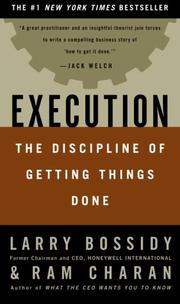
Execution: The Discipline of Getting Things

Execution: The Discipline of Getting Things Done

Larry Bossidy, Ram Charan
2002
T2 283 pages · about 4h 43m to read Open Librarygoodreads

Operating discipline linking people, strategy and operations into one process

Summary

Bossidy ran AlliedSignal and Honeywell after a career at General Electric, and Charan is a corporate adviser. Their argument is that execution is not the tactical work left over after strategy is set, but a discipline that the chief executive must personally own, and that most strategic failure is execution failure that gets misdiagnosed as strategy failure.

The structure is three core processes that must be linked: the people process, the strategy process and the operations process. The people process is treated as primary, and Bossidy is specific that a leader should spend a large share of time on assessing, placing and developing people, and should conduct rigorous personal reviews rather than delegate them to human resources. The strategy process must be built by the people who will execute it, must be tested against explicit questions about competitive response and capability, and must produce a plan whose assumptions are stated. The operating process converts the strategy into targets with named owners and dates, with contingency plans for the assumptions that could break.

The underlying behavioural argument concerns the quality of dialogue, meaning meetings where disagreement surfaces and decisions close with a specific commitment rather than dissolving. The book is repetitive, the examples are large industrial companies from the 1990s and early 2000s, and its treatment of Honeywell's own record is generous. Bossidy's successor context and the later performance of some of the companies praised complicate the case. The core process discipline remains widely used and the people-first sequencing is the part most operators find durable.

Key takeaways 7

  1. Execution is a discipline that the chief executive must personally run, not a set of tactics to be delegated after strategy is set.
  2. The people process should precede and drive the strategy process, because a plan is only as good as the specific individuals assigned to deliver it.
  3. Leaders should personally conduct candid individual assessments rather than delegate them to a human resources function.
  4. A strategy must be built by the people who will execute it, since a plan handed down from a separate planning group will not be owned.
  5. Every meeting should close with a named owner, a specific action and a date, and a decision without those is not a decision.
  6. Strategic plans should state their assumptions explicitly so that the ones that break can be identified and replanned against.
  7. Leaders who avoid confronting underperformance in individuals guarantee that the organisation cannot execute, whatever its processes say.

Who should read it

Executives building an operating rhythm who want the case for treating people decisions and review discipline as the chief executive's own work.

Who recommended it 2 · 1 direct

Similar books 6

Chosen by shared topics, the entries that hold them, and the people who recommended both.
Simon Sinek · 1900

Sinek's second major book applies neuroscience — oxytocin, cortisol, dopamine — to explain why some work environments feel safe and others don't, and how leaders establish the Circle of Safety that determines whether teams will take the risks that produce performance. More substantive than Start With Why.

Jim Collins · 2001

What eleven companies did to turn fifteen ordinary years into fifteen great ones.

Max DePree · 1989

A chief executive's advice on the art of leadership.

Recommended by: Mohnish Pabrai, David Cancel

Where it sits in the reference 3

Business themes
Business themes
Business themes

Topics

Business and ManagementLeadership